
Latest Comments

Guest - Katrin Sprang Discussion
18 September 2026
Hi Rachel, I have looked for more photos of you, but that was not very successful. I found a link on...
Guest - Beatrix Sprang Discussion
15 September 2026
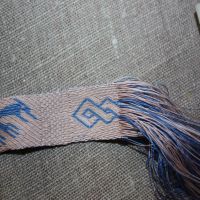
That lozenge pattern element is not a photograph, but a scan. So it should be to scale. But I pinned...
Guest - Katrin Sprang Discussion
15 September 2026
I was not referring to Rachel's reconstruction (is the reconstruction you refer to the one photograp...
Guest - Beatrix Sprang Discussion
14 September 2026
There is something Rachel did not mention. She told me: "Well, I worked with the measurements we too...
Guest - Katrin Sprang Discussion
14 September 2026
Well, this is certainly developing into an interesting discussion. Firstly, going from that lovely l...
JAN
29
0

Winter Wonderland.

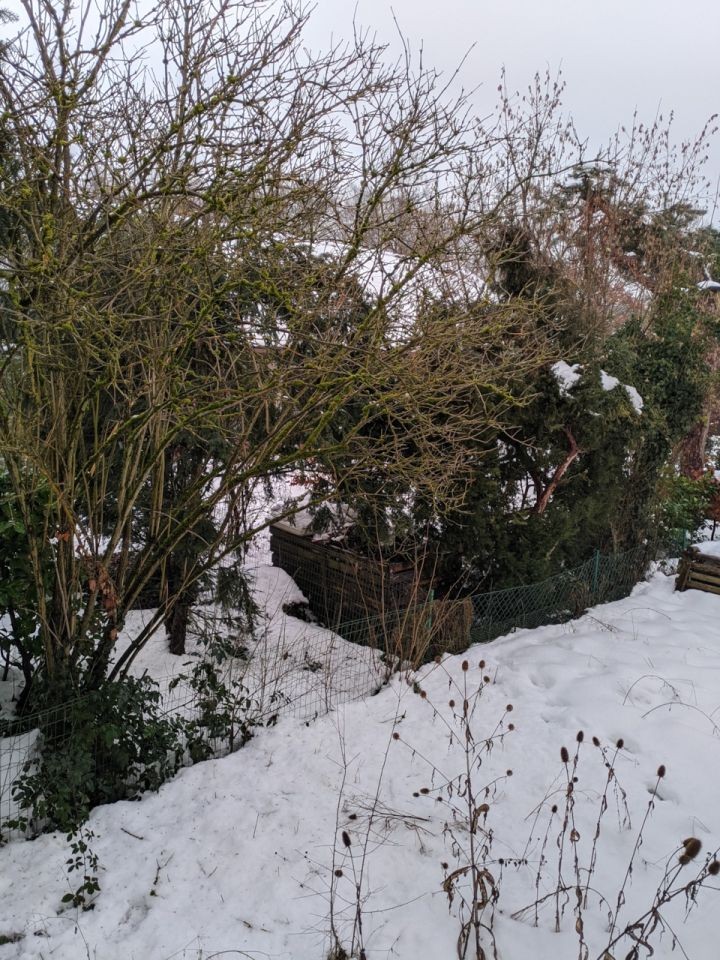
It's snowing here, again - after a day of things melting and dripping yesterday, the (rather large) amount of snow that was left has gotten a new dusting with white flakes. Now it's somehow indecided whether it wants to snow, or wants to rain, or... well.

It's been the first "real snow" for ages here now, and it has been enough for some chaos on the streets, and the buses not going for a while when it was especially bad. We got around having to drive the car when there was the peak of snow, and I'm quite happy about that (though I learned how to drive in wintery conditions when I was training for my driving license, that was a long time ago, with not too much practice inbetween). 

I wouldn't be surprised if the storms and the winter blasting in not just in Germany, but over large parts of Europe is a first taste of what winters after the climate change will bring us, if the gulf stream gets weaker (which is one of the issues we are facing). Snow is beautiful, and pretty, but it's also very heavy, and cold, and very wet, and can get slippery easily, and if you have to shovel lots of it you'd better be fit enough for that (and have good technique). 

Back when I was younger and the winters were colder and I was visiting my parents in the Fichtelgebirge during the winter, they'd go outside before I was due to arrive to shovel snow in order to make me a parking space... because the snowplough leaves a nice dam of snow on the left and right side of the street, just where you'd park. Heavy snowfall in that region was quite common, so we all knew how to deal with the issues, and were used to it.  I'm now living in a place that is a good bit more mild, regarding the winter weather, and correspondingly it's more of a surprise here to have lots of snow. Well... we will see what happens in the future, and if we'll all have to get used to handling it here, too! 

0
JAN
28
0

Some Lovely Stuff!

For a nice change, here's some really lovely news for those of you involved in braiding! If you've done research about historical braids, especially regarding their structures, you will surely have come across the name "Noémi Speiser". Sadly, Noémi died last year, but she has left as her legacy, among other things, four books about loop braiding.

Thanks to the efforts of several other people, among them braiding specialists Joy Boutrup and Carol James, The European LoopManipulation Braiding books are now available for free on Carol James' website www.SprangLady.com. You will find them under store, then educational materials, then books by others. Their titles are European Loop Braiding Vol I, II, III, and IV. The direct link to the books is https://www.spranglady.com/store/c10/Other_Books.html.

You will have to put the books into your cart and then go through the checkout procedure; you will then get to a page with direct download links, plus receive an email with the download links.

I hope you'll enjoy them - and a big, big thank you to Carol, Joy, and the others involved who made this possible!

0
JAN
27
0

ICE hat.

I'm torn, these days, between keeping caught up on the news and finding a nice big rock to live under. Preferably with some nice, warm sands (because the German idiom is to stick one's head into the sand). But it's not helpful, and I know that, so I try to stay up to date at least more or less - on that fine line between knowing too little and knowing too much, or between blissful ignorance and total despair. Because, well, I probably don't need to tell you, it doesn't look so good in many corners of this world. 

In case you have red yarn and a few dollars left over, and would like to do some political knitting, you could knit yourself a Melt the ICE hat. The pattern is available in that wonderful time sink for knitters called Ravelry, and - in case you don't do Ravelry - also via payhip. All proceeds from sales of the hat go to immigrant aid organisations, and will benefit the victims of ICE.

And let me join in, even though I'm pretty far away from the happenings: Fuck ICE. Fuck the political climate that allows this to happen. Fuck the general human incompetence to learn from history in order to avoid repeat performances of shit (brown, obviously) hitting the proverbial fan.

Wherever you are, I hope that you are as safe as can be, and that you are doing your part to keep this world a sane and livable one. Because we need every little bit of that right now.

0
JAN
26
0

Pins!

While it's snowing hard outside (still - we've had 27 to 30 cm since yesterday evening, and it's still building up) I spent some cozy time fiddling with pins. Or, to be more precise, making new ones.

This time, I used a different method for grinding the tips into shape, and it was much nicer to work and got better results, so I'm very happy with the new process. They're already marked as back in stock, and waiting to go to new homes and new adventures.

Now the only thing I need to tweak is how to wind the spiral for the heads, as there's still a rather large chance that the start will slip out of its holding place, and then everything turns around the core instead of adding new bits. 

0
JAN
22
0

New technology, or at least new uses...

One of the things that never cease to fascinate me in regards to archaeology is this wild, delightfully weird mix of the old and the new. You dig up something (or it is preserved some other way), and there you are, analysing the craft skills of some person long dead and probably forgotten. (Most people are, after all, a few hundred years into the future.) Here, it helps if you know a bit about natural materials, traditional tools and traditional, old-fashioned crafts methods. And then the new stuff comes in, where the archaeologists use the new technologies in order to learn more about the old ones. DNA analyses, protein analyses, strontium isotope analyses. The good old radiocarbon-dating, let's not forget that, but with refined methods these days and using calibration curves made in collaboration with dendrochronology. Electron microscopy, in a number of different flavours. When it comes to finding out what was once there instead of the ubiquitous archaeological brown in textiles, HPLC (the high-pressure liquid chromatography) is not the only thing these days to try and find out more about dyes applied long, long ago.

It's a delight, really. Even though there's still limits, obviously - you have to have to know about the possibilities, have to have the opportunity for the research, and need the possibility and the permission of the caretakers to take samples of your piece, or, with the non-destructive methods, it needs to be either brought to the lab for analysis or the tool has to be brought to the object. In all cases, a combination of time, knowledge, money, effort, and support is necessary, coming from different people involved. Realistically, that means there is much less cutting-edge, new-fangled stuff and most recent methods research done than there could be, in an ideal world.

It's still great. Every little bit of new tech for old stuff never stops to delight me. It's even better when there's names involved that I know (and thus people that I know). Like in this (already a few years old) article about looking at textile residue on a metal brooch. It was published in a physics journal, and it's open access, so you can join me in my delight.

0
JAN
19
0

Back to the backstrap.

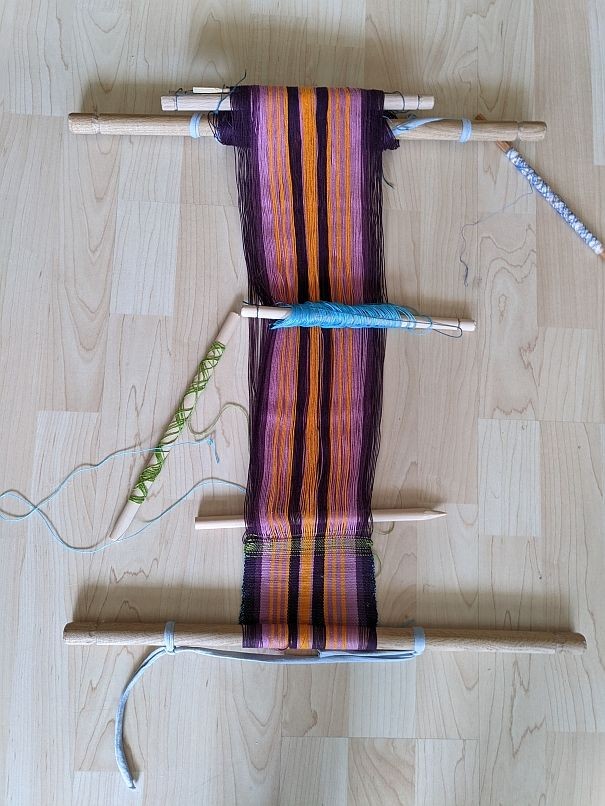
I've finally gotten around to taking out the backstrap loom thingie that I set up a few years (already!) ago. There are plenty of mistakes (starting at the very start when all of us in that session just left the warp slung around the sticks instead of sewing them onto the stick... well), and there's a lot of "trying to remember stuff" wonkyness, but I think I have now understood a few of the things I was going after.  

There's a stack of things that fascinate me here. One, it's such a simple setup - basically you need six sticks and a weaving sword, and you're good to go. However, you can still weave beautiful simple fabrics or intricately patterned ones. The basic sequence, even with a pattern weft, is very simple as well, but there's still plenty of possibilities to mess up. It will also teach you about symmetry (one of my selvedges is always much worse than the other, and I'm still working on finding out exactly what I am doing differently), about how much of an influence practice has, and about the difficulties of counting (when picking out the threads for the pattern part). Well, maybe the counting thing is a special "me" issue, but still. I'm also still working on a better understanding on when to let up on the tension, and when to up it a little, but I think that's something that might be for later.

The six sticks, by the way, are three for the ends of the warp (two at each end, a third one for the transfer when stitching the warp to a free one, and later for rolling up the fabric as you progress); one for the natural shed; one to hold the heddles; and one to serve as a stick shuttle. If you do patterns, you might want to add two additional sticks, one to sort out the extras in the natural shed and one to sort out the extras for the heddle shed. (That, by the way, is what was the thing I was puzzling about, and where I managed to miscount several times. In the number range from zero to four.) 

Tomorrow, though, and the day after, I will not be weaving - I will be off to learn more about making goldbeater's skin. Consequently, there will be no blogging the next two days!

0
JAN
15
0

Speed Reading Shenanigans.

I stumbled across this yesterday or so, and found it somewhat amusing and interesting. It's a (modified) speed reading check that places all the words at one point, so you don't have to move your eyes when skimming a page. 

So now I have found out that I can read fairly quickly (which is no real surprise, I knew that already).

While I can skim stuff very quickly, and read fast, I have more enjoyment in reading when I am not going for high speed. And if the text is very complicated, or in another language that I don't know very well, obviously I need to go even slower than the normal cruising speed. This shenanigan of putting all words in one spot, though, doesn't seem like really practical to me. Usually when I skim, it's to check if a text is relevant for me, or to find the bits that are. For that, I need to go over the page, turn the page, do the next one, rinse and repeat. Or, if it's on the computer, scroll and skim. In both scenarios, training the eye movement to do the skimming is essential, and that is exactly what this in-place speed reading leaves out fully. And even if I have a full text that I want to read quickly, it would mean having an app or something that converts the text into this format, then reading it. What happens if there's something I have to process, though? Or if I have a short lapse of concentration? Then how can I go back to the proper bit and re-find my place?

Which means... interesting, yes. Useful, well, probably limited, at least for me.

0

By accepting you will be accessing a service provided by a third-party external to https://pallia.net/

Contact