Latest Comments

Guest - Katrin Sprang Discussion
18 September 2026
Hi Rachel, I have looked for more photos of you, but that was not very successful. I found a link on...
Guest - Beatrix Sprang Discussion
15 September 2026
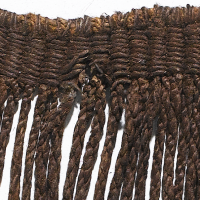
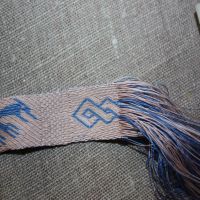
That lozenge pattern element is not a photograph, but a scan. So it should be to scale. But I pinned...
Guest - Katrin Sprang Discussion
15 September 2026
I was not referring to Rachel's reconstruction (is the reconstruction you refer to the one photograp...
Guest - Beatrix Sprang Discussion
14 September 2026
There is something Rachel did not mention. She told me: "Well, I worked with the measurements we too...
Guest - Katrin Sprang Discussion
14 September 2026
Well, this is certainly developing into an interesting discussion. Firstly, going from that lovely l...
APR
27
2

Spindles, now with optional notches.

One of the recurring questions about my spindle sticks, especially from modern spinners, is "Why don't they have a hook?" followed by "why don't they have a notch?" and "how do you fix the yarn without hook or notch?"

Finds of medieval spindle sticks are not too common (wood has that tendency to rot, and can be burned, and a spindle stick is not very spectacular so you'd want to carefully preserve it somewhere like you would a wooden altar, for instance) and they are published here and there, so putting together a good collection takes some rootling around. Even with surviving sticks, they are not always complete (the tips are often broken off), and then they may not be published in detail, with a drawing of the tips.

However... it does seem that the plain, un-notched and un-hooked spindle was very, very common, and I personally usually spin with the plain tips and am very comfortable with them.

There are instances of notched spindles in the medieval finds, though, and since I've been asked time and again about notches, I have finally looked through my sources, sharpened my little knife, practised some more... and am now offering optional notch cuts with my spindle sticks.

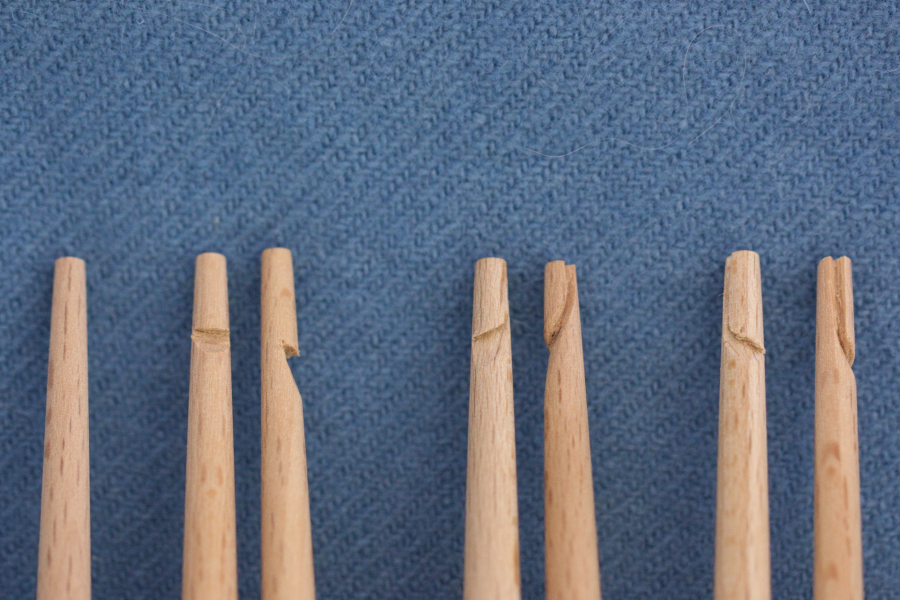
[caption id="" align="alignnone" width="900"] Notches! From left to right: plain un-notched tip, horizontal notch, diagonal notch for z-spun yarn, diagonal notch for s-spun yarn.


They are available both in horizontal, where they will very securely keep a half-hitch for either spinning direction, and in diagonal, where they will either keep a half-hitch, or, if the thread is thin enough and you wind it around the spindle in the right way, hold the thread all by themselves. I've tested the diagonal notches, and they usually need a bit of getting used to, but then they work fine. They accommodate a thin thread, and the notch sort of latches onto the thread to hold it securely enough for spinning. It's not as secure as the hitch, though, so the probability of the spindle slipping out and falling down is a bit higher throughout.

When it works, though... it's really, really fun!
0
APR
16
0

Oillight videos.

When I'm at the fairs, it's always fun to explain the simple yet ingenious principle of the oillight to people. A lot of them get just as excited about these little things as I am - especially those with a bit of a green soul and a bit of a love for tea on teapot-warmers, as it's possible to replace tealights with the oillight.

Explaining these things, I quickly learned that most of the visitors are really new to this old concept that's almost forgotten today: place a swimming wick-holder on top of some vegetable oil which in turn floats on some water in a glass of your choice. The wick will burn until the oil is used up (or you extinguish it).

Because the concept has been almost forgotten today, I ended up taking an explanatory video that runs on a little tablet in my booth - to help explain the thing, and show how the lights actually look when in use (safety restrictions keep me from just lighting one - no open fire allowed at any of the fairs).

Now I've finally managed to go over the oillight videos and get them embedded into my shop, and while I was at it, I did a translation of both of them (which for the German fairs were, obviously, subtitled in German). Yay! So you can now watch the show on my Youtube channel, when you are looking at the oillights in the shop... or right here:


0
MAR
16
0

Getting back on track.

As usually when I've been away for a few days, there is plenty of things stacking up that need to be de-stacked and processed and done and so on. So I'm trying to get back on track, whittling the mails down to the usual stack sitting in the inbox (where everything sits that still needs some action), plus all the usual suspects of ton the to-do list.

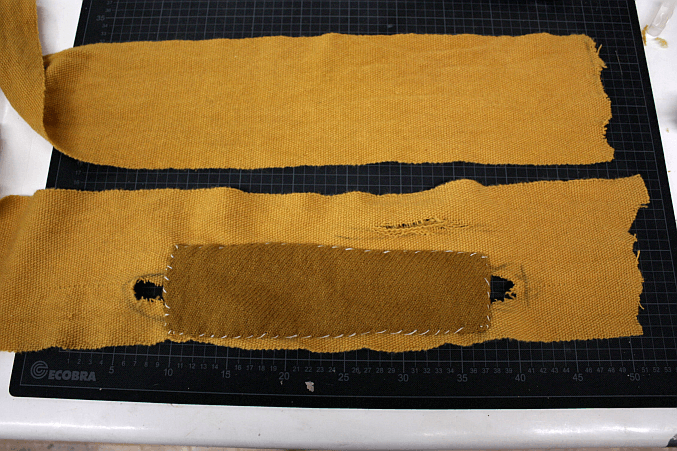
Also there's a private lesson to be given this afternoon, which I'm looking forward to - but which I also have to prepare. So instead of something dep and interesting and whatnot, you are getting a picture of the Bernuthsfeld man's reconstruction legwrap, during the process of giving it the holes and patch that it has on the original:

wadenbinden_kaputtmachen

It's actually not that easy to fake usewear traces. Holes are rather easy, but as soon as you are trying to have different usewear patterns, it really does get more complicated.
0
MAR
15
6

Everyone is home.

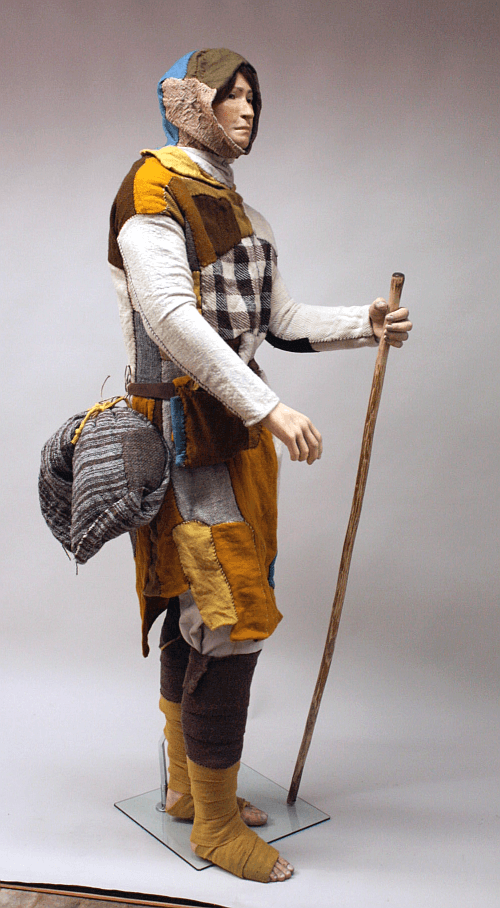
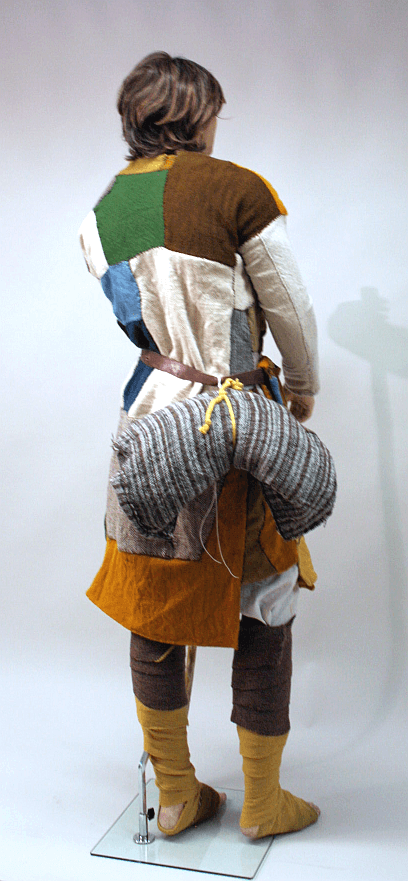
I'm back home, my colleague is back home, and the Bernuthsfeld Man reconstruction is home, too. He has a lovely spot in the OLME in Emden now, right at the end of the exhibition part about the find and the time, so you're getting a look at the original finds, then information about research and the context of how life was in the 8th century, and then, at the very end, he's waiting for you to look him in the eye.

To our great delight, the museum people were just as happy with how our reconstruction turned out as we are, and there was immense interest from the press. We got covered by several papers, such as the Sächsische Zeitung, the General-Anzeiger (behind a paywall, but you can see a pic), and the Hannoversche Allgemeine (again, paywall but a visible pic). We even made it into the TV news!

But obviously, you're waiting for a picture right here, right? Here you go:

[caption id="attachment_3694" align="alignnone" width="294"]bernie1 Our reconstruction, in the setup that he can be seen in at the museum.


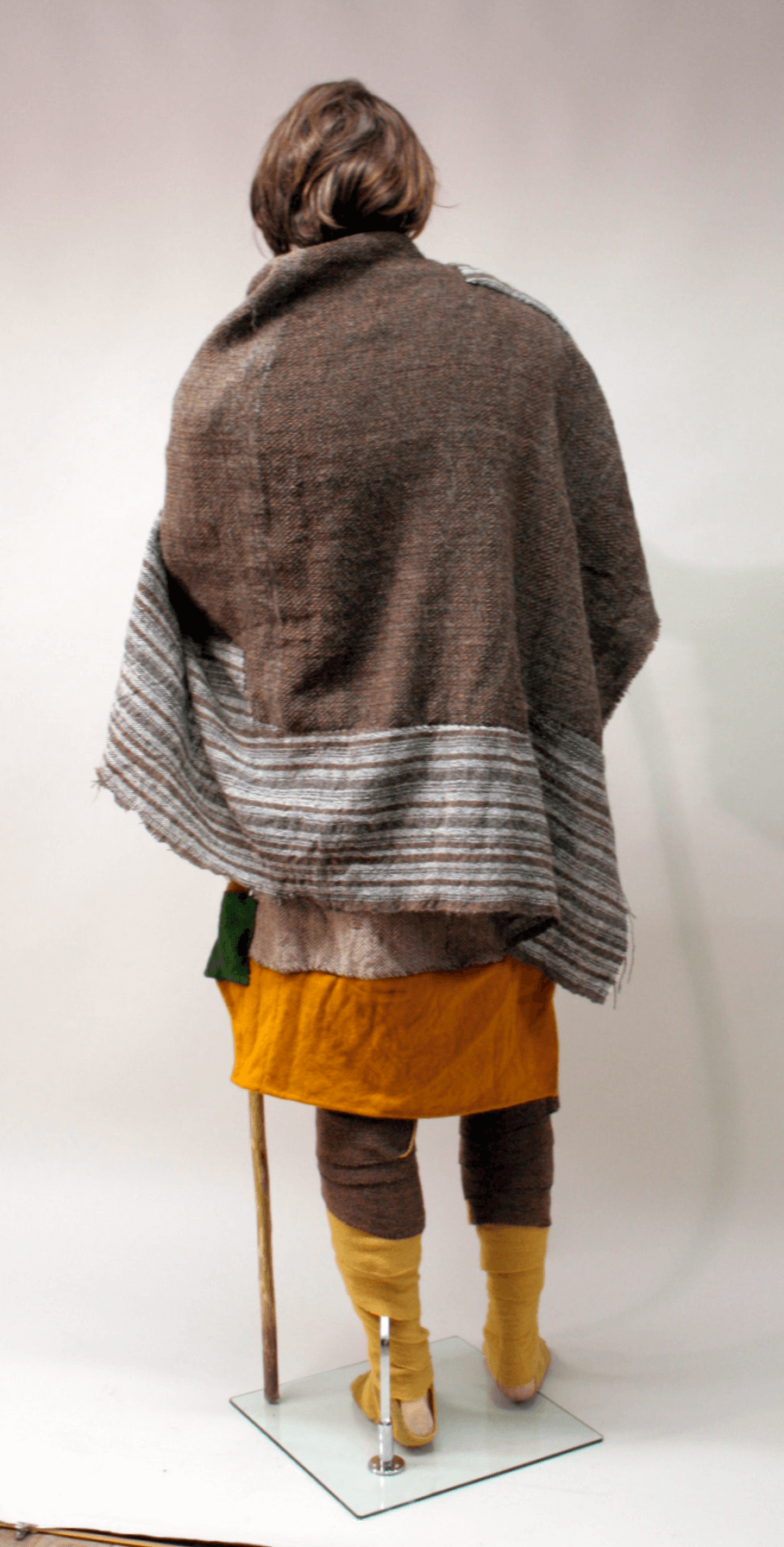
We thought long and hard about how to dress the figurine in a way that shows all his equipment, including the small cloak/blanket he had, and still shows off as much as possible of the tunic. Because while the small cloak would also be interesting to show in action, it will cover up quite a lot of the main piece:

bernie2

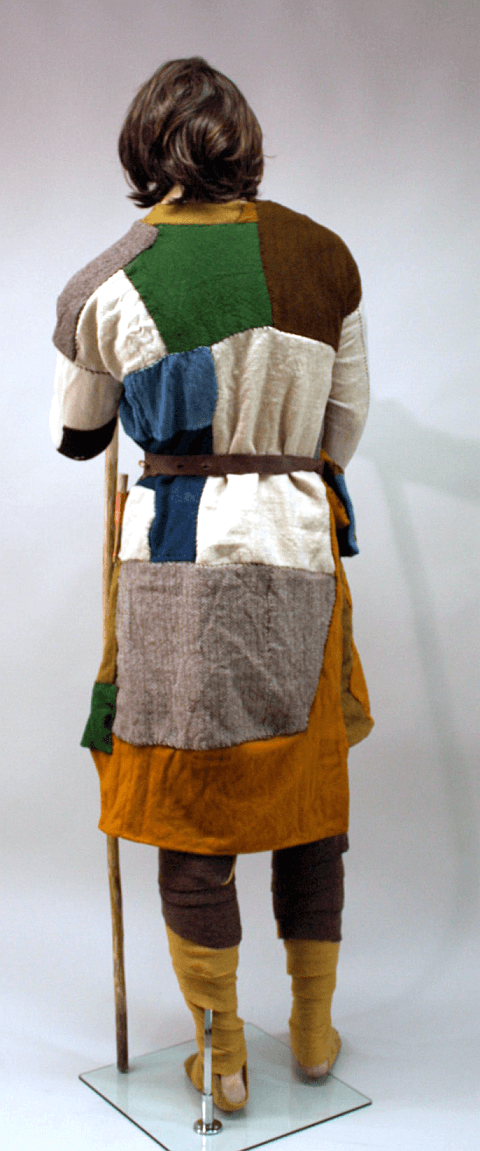
So we decided to wrap it up, tie it together with the wool cord he also had with him, and hang it on his belt. The belt actually had a spot where something heavy obviously hung for a good long time, or very frequently; we placed the blankie-pack in that spot, and you can see what happens in the next two pictures.

bernie4 bernie3

The belt suddenly sits at a bit of an angle, and everything looks a little more lifelike of a sudden. Also the worn spots at the tunic coincide exactly with the places where the belt sits and rubs against the cloth... to our great delight.

So now he's in the museum, and if you're in the area, go visit him in the Ostfriesisches Landesmuseum Emden. And if you do so, say hello from me!

 
1
MAR
08
2

The Niddy-Noddy (part 3), or: Sorting Pictorial Evidence.

So, after finding out that my drawing skills are indeed horrible, let's look a bit more at diverse instances of yarnwinders in actual historical artwork. Images of yarnwinders are not that straightforward to find, so I've been using the yarnwinder linklist by larsdatter.com as a starting point. Things listed in the following without links are from that list.

There's also some yarnwinders listed as utensils in the Morgan Pierpont library database, which is very nice. These are also referenced to without links, but you can identify them via call number.

If you know of more yarnwinding pictures, please let me know!

And now on th the actual images. Well. They vary greatly. Some of the later ones are very clearly showing the perpendicular crossbars and are also accurate regarding yarn path. Examples for these are, from the larsdatter list,

Peasants by the Hearth (Pieter Aertsen, 1560s)
Man and Woman by the Spinning Wheel (Pieter Pietersz, c. 1560-1570)

Base-de-page, The Hours of Catherine of Cleves (PML M.917, fol. 109), c. 1440. This is also on the PML list, Call No.: MS M.0917/945, p. 109.

Portrait of a lady spinning by Maerten van Heemskerck, c. 1531. This yarnwinder also has diagonal struts between the crossbars and the middle stem - something that might add even more to the confusion of images.

A visit to the wet nurse by Marten van Cleve (third quarter 16th century) shows a winder with very straight arms (on the partition wall close to the door at the right side of the painting).

An old man by Lucas Kilian also has the correct yarn path, and also looks like it has diagonal struts between crossbars and stem.

In addition to these from the larsdatter list, there's the bonus lady riding the pig, from the 1460s manuscript mentioned yesterday.

And from the PML list, Call No.: MS M.0230, fol. 003v - Flight into Egypt, dated to 1435.

There's also a variation of the yarnwinder with an extra handle coming out of the bottom end, and usually a little knob or short bit of rod at the upper end, showing a similar yarnwinding pattern to my very crude drawing from yesterday - one V-shape that has its point in the middle of one of the crossbars and two upright strands of yarn.

Again, the larsdatter examples:
Both examples from the Maastricht Hours (Brit.Lib. Stowe 17), 1st quarter 14th century.

However, there's a second winding pattern that can be seen, and that is an X shape with two parallel yarn strands at the sides. Examples for this kind of picture can be found both with handled and with handleless yarnwinders. Again, from the larsdatter list:

Mural cycle showing the processing of silk and flax at the Kanonikerhaus in Constance, Germany, c. 1320: a woman winds (linen?) thread (handled; image is hard to read)

An ape holds a spindle and winder, psalter (Douce 6, fol. 48r), c. 1320-1330 (non-handled, cross is at the back)

Adam and Eve, a book of hours (Douce 248, fol. 207r), middle of the 15th century (handled, cross very clear)


Finally, there are some winding patterns that differ again.
An ape winds wool, Voeux du paon (PML G.24, fol. 15r), c. 1350 shows just an X shape, with no extra upright yarn strands, and
A woman winds thread from a spindle, the Hours of Charlotte of Savoy (PML M.1004, fol. 96r), c. 1420-1425 seems to show the same pattern, though the picture available online is very hard to read, as it's very light.

From the PML list: Pierpont Morgan Library M.453, France, c 1425-1430 has a lady with a handled yarnwinder with X pattern on fol. 114r. Call No.: MS M.0453, fol. 114r


Also from the PML list: Call No.: MS M.0919, fol. 232v, early 15th century. I do not think that Call No.: MS M.0919, fol. 164r from the same manuscript shows a yarn winder - it looks more like a cooking stand or something similar to me.

Back to larsdatter - Veturia, De mulieribus claris (BNF Fr. 599, fol. 48v), 15th-16th century, is completely different again - here the yarn is wound straight around the parallel crossbars of a handled yarnwinder, no crossings whatsoever.

For both the long-handled one and the handle-less one, some images look like the crossbars are parallel, and some like they are perpendicular.
Old woman spinning (the niddy-noddy is next to her on the bench), 16th century shows an empty handled yarnwinder, with the crossbars clearly not parallel, but not properly perpendicular either.
Standing woman with winding tools by Andrea del Sarto (late 15th to early 16th century) also shows an empty handled version, crossbars perpendicular.

PML Call No.: MS M.0754, fol. 080v has a yarnwinder in a bird's beak in the upper margin, though whether this is an empty one with struts or a filled one is not possible to tell.
PML Call No.: MS M.0754, fol. 067v shows the same yarnwinder again, same style (which is to be expected in the same manuscript). That manuscript seems to have been yarnwinder central, actually - fols. 22r and 21v also show yarnwinders. Date is 1320-1329.

So. Plenty of different types, plenty of different winding patterns. Next step? Finding out if there's a pattern somewhere. Which will work even better with more pictures, so if you have something to add to this list, please comment!
0
MAR
07
0

The Niddy-Noddy (part 2), or: A Closer Look.

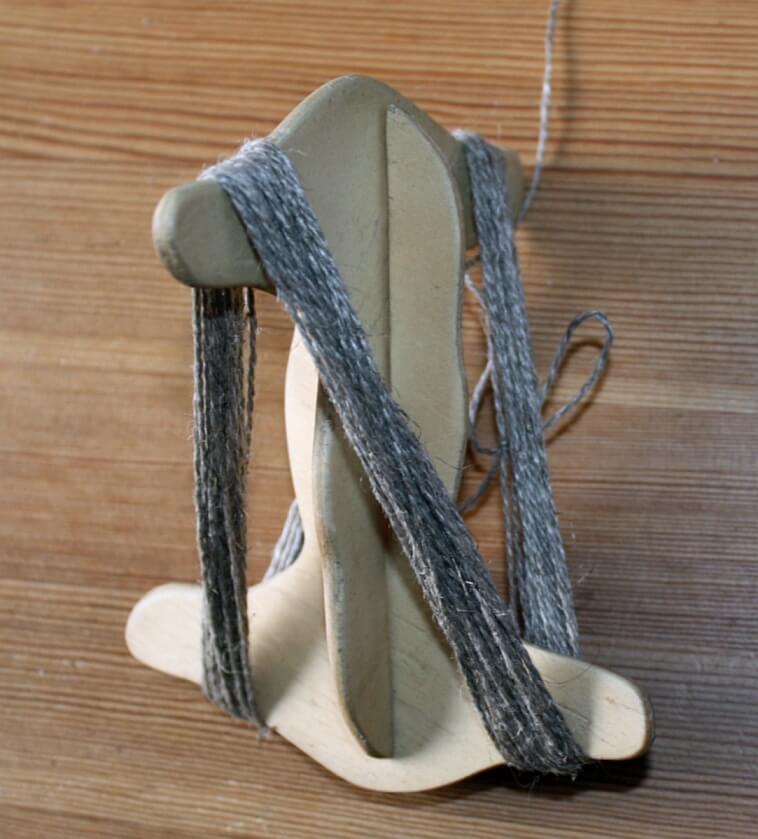
Let's start out with taking a closer look at the yarnwinder with the perpendicular arms. This is how it looks when yarn is wound onto it:

niddynoddy_90grad

As you can see, it sort of looks like a V-shape made by the yarn, and that is the case from every side. Looking at it like this, it's not that easy to draw, but also not completely impossible.

In fact, there are plenty of images from early modern times where such a yarnwinder is shown absolutely correctly, such as the one in "Man and Woman by the Spinning Wheel" from about 1560-70.

The earliest I have found yet is dating to the 1460s and is in the collection of the Royal Library of the Netherlands - a woman riding a pig and winding off yarn.

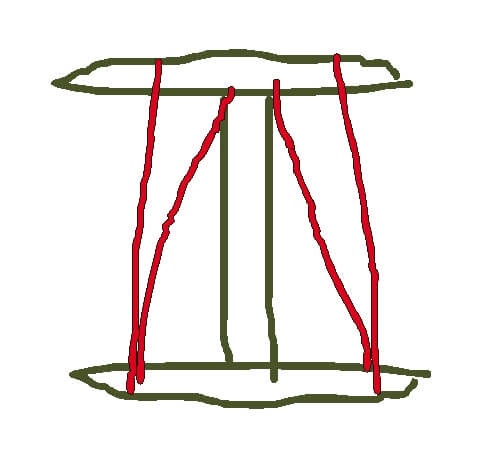
If I'm trying to draw how it looks and try to take out any attempt at perspective at the same time, I'm ending up with something like this:

[caption id="attachment_3683" align="alignnone" width="495"]crudeniddydrawing Yes. My skills at making freehand drawings on the computer with the touchpad are very, very near zero. Sorry.

It is caused by trying to capture the V-shape the yarn forms and showing all four strands of yarn. It's not really close to the actual thing, but have you tried to draw a bicycle recently, without looking at one to do it? The chances it would be non-functional, but other people are recognising it without any problems as a bicycle are rather high.

Coincidentally, this drawing does look similar to some of the yarnwinder illustrations in medieval manuscripts...

To be continued.
0
MAR
06
0

The Niddy-Noddy (part 1), or: I might be on to something here.

One of the many interesting things made out of wood and related to textile work are yarnwinders. One style is rather well known and still in use today - it's what is usually called a niddy-noddy. The design is very simple: two crossbars, standing at 90° to each other, connected with a stick in the middle. Yarn is wound around the bars so that there seems to be a V from each side, as the yarn comes down or up from the bar facing you with its side to the one showing only its tip.

Well, the design may be simple, and winding on may be simple as well, but drawing such a thing? It is not. Which I used to think would be the reason why we do have images of yarnwinders of that design that are depicted somehow... alternatively.

This ape winding wool from a 14th century manuscript is a typical example. Or this ape winding wool from a different 14th century manuscript. (Hm. Do we sense a pattern here?)

Medieval images are not always true to perspective, and they are not always mechanically correct when they are depicting tools that are a bit more complicated, like this wool wheel:

[caption id="" align="alignnone" width="500"]An amorous encounter A woman at a spinning wheel being kissed by a man while patting her on the bottom. France, S. (Toulouse?), c.1340. British Library MS Royal 10 E IV f. 139.


You can clearly see that this would not work as depicted. The wheel has the requisite one-sided axle, and there is only one post holding it up, but it is drawn on the wrong side - facing the viewer. You could theoretically spin with that setup by shoving the wheel and letting go of it again, but this is not really compatible with the usual style of spinning with this tool, where the fine control of the wheel's (even) speed lets you draw your thread out evenly.

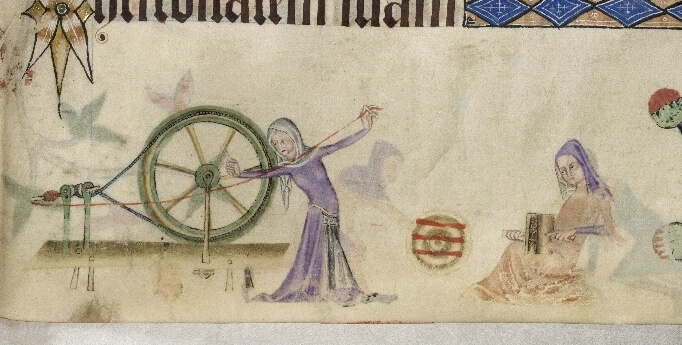
There's a similar error in the image in the Luttrell Psalter - again, you clearly have one post only, and it is on the wrong side.

[caption id="attachment_3679" align="alignnone" width="682"]British LIbrary MS Additional 42130 f. 193: Women working. British Library MS Additional 42130 f. 193: Women working.


So there are obvious difficulties in getting the details right, and it looks like the difficulties are similar, and it seems to be a pattern. In the case of the wheel, though, it really makes no sense at all to set it up this way.

Which is why I used to think that the alternatively depicted yarnwinders were also some kind of artistic thing - something not gotten quite right.

However... I'm going through the wood things again, and I am thinking of adding a yarnwinder based on medieval sources to my assortment of goods, and I've been looking at images again. There is a pattern - but the pattern is not what I expected, and it has led me to take a closer look, and start to doubt my previous assumptions - that it's just a matter of how things are drawn, and that you cannot wind yarn on a yarnwinder of this style if the crossbars are parallel to each other.

So. I'm very excited right now, and very much in research mode, and will look at more pictures, and try out things. And tell you more about the results tomorrow.
0

By accepting you will be accessing a service provided by a third-party external to https://pallia.net/

Contact