Latest Comments

Guest - Katrin Sprang Discussion
18 September 2026
Hi Rachel, I have looked for more photos of you, but that was not very successful. I found a link on...
Guest - Beatrix Sprang Discussion
15 September 2026
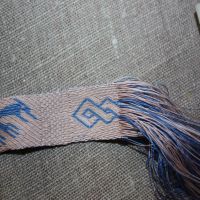
That lozenge pattern element is not a photograph, but a scan. So it should be to scale. But I pinned...
Guest - Katrin Sprang Discussion
15 September 2026
I was not referring to Rachel's reconstruction (is the reconstruction you refer to the one photograp...
Guest - Beatrix Sprang Discussion
14 September 2026
There is something Rachel did not mention. She told me: "Well, I worked with the measurements we too...
Guest - Katrin Sprang Discussion
14 September 2026
Well, this is certainly developing into an interesting discussion. Firstly, going from that lovely l...
MAR
10
0

Links, Courtesy of the Blogosphere.

News from here: The cat is sleeping, hazel pollen are flying prolifically (much to the chagrin of my poor nose), the sun is shining, and I have planted tomato seeds on Sunday.

Probably more interesting to you is the fact that after the mad rush to the finish line for our book project, Gillian and I are now patiently waiting until the book has done its things at the publisher's and we'll get feedback and the edits.

Apart from this, the blogosphere has provided me with links to things that you might also find interesting. Such as this Digventure piece about pioneering women in archaeology, which also fits in very nicely with Women's History Month.

John Scalzi has an opinion on opinions, and is voicing it on his blog.

Finally, a paper about medieval bread:


0
OCT
28
0

Linkapalooza.

It's time to shower you with links again! So here you go...

Are you looking for a movie to watch on Halloween? Here's a list of 10 horror movies featuring archaeologists.

If you prefer some real-life horror, how about this: the Swedish government wants to close all of the Swedish archaeological institutes in the Mediterranean. No joke. Archaeologik has done an article about this, in German; there is a petition running against the closure. If you want to sign (please do, and please spread the word), there is an explanation at the bottom of the English translation of the letter.

For those of you interested in the history of People of Colour, check out this tumblr "bookshelf" with free downloads - the books are concerning early modern and modern time.

In case you are looking for an excuse to visit Rome, there's a Protolang conference planned for September 2015, with the CfP open.

And finally, a very interesting video on how a seemingly small change in environment can have huge effects: Wolves in Yellowstone.
0
OCT
01
2

Funding, Open Access, and "Author Pays".

I've been pointed to a discussion about the journal "Internet Archaeology" by a friendly colleague. The journal IA has recently dropped its paywall and is now free access for everybody - to which I say Hooray and Thank you.

However, as someone in the discussion on Antiquist points out, it's not all free. The journal is financed by an "author pays" scheme, which means you need to be able to pay for having your paper published. The discussion quickly goes off into other terrains where there are problems in data access, but for me, the interesting bit is that one of the contributors says that "author pays" is not a problem, since nobody pays for that out of their own pocket anyways.

To which I say... not true. Definitely not true.

I would never publish in an author pays scheme, not only because I am a firm believer in the principle that the money flows towards the author, not away. I would also not be willing to shell out even more money for an experiment, thankyouverymuch. As a rule, I pay for my experiments myself, because getting funding for them? Difficult. Having an institution behind you makes things easier, but even then it's not guaranteed that you will get funding. Plus the time you have to spend on trying to secure said funding... never underestimate how much of your time, and energy, applications can suck out of your life.

I had plenty of experience with that topic when I tried to secure funding for my phd thesis (hint: I didn't get lucky). You have to do a new application package every time, then it takes ages to go through the system, and finally if you don't get funding, you have to deal with the emotional fallout. (At least I did.) At the end, I estimated about two to three weeks' work worth for each application. There's quite a lot of times that I've heard people complain that they are not getting around to really working, because in order to secure further funding so they will not lose their job, all they have time for is write one grant application after the other.

At some point, especially if the experiment is more work-time and not too much monetary investment for the things you need, you might decide it's not worth the effort to go for funding, and just go ahead and do it. Then, at the end, if all went well, you have an experiment and some results... and there you are. The thing should now be published. The last, very very last thing that I, personally, want to do in that case? Pay the journal.

So who is going to pay the people working at the journal? Actually, I would be fine with a paywall for journal articles - let the reader pay. With one caveat, though: make the prices reasonable. 30 or 50 USD for a 10-page article? You bet that nobody who can get around paying that will pay. However, if you charge 10 or 15 USD - that would be much more reasonable.
And for things that are older than, say, 2 years? If the journals would just charge one or two dollars, you can bet that I would not take the trouble to get the article via the library, or maybe ask a friend who has access. I'd pay, just for the convenience of having it at once. Because it's not a high price, and I'd be comfortable in paying that. Probably a lot of other folks would think exactly the same, and do exactly the same.

Oh, and in my ideal world? The author should get 10% of the income that the article generates. Fair pay for the work that went into it.
0
SEP
17
0

Random Linky Stuff.

Here are things, randomly assorted, that might be of interest.

If you like manuscripts and haven't checked out the medievalbooks blog yet, I thoroughly recommend doing it. Take a look at this post about Medieval Super Models, or this one about personal touches or personal statements in the margins.

A 3,500 to 3,900 year old suit of armor, made of bone, was found in Siberia.

Chloe Giordano is making really beautiful, really detailed animal embroideries. (h/t Heather)

Modern stair solutions - some of them really breathtaking.

And now for something completely different: Transgender people tell about the differences between how men and women are treated at work.
0
SEP
03
0

Archaeologists and the Press.

You all know what to think of archaeologists, right? We are the brothers and sisters of Indiana Jones and Lara Croft... not.

When I was still studying, one of the colleagues explained to us about the public image of archaeology, about the problems with bad press (or not-easy-to-understand press), and how to deal with press people and journalists. What I remember from that as the most important lesson is: It's not the journalist's job to learn about archaeology. It is your job, as the interviewed archaeologist, to give the journalist correct and concise information, in a way that he or she can easily use it for the piece. That was highly helpful!

If you want an in-depth treatment of the topic, you are in luck: Doug has written a multi-part blog post about archaeology and journalism, and I highly recommend reading it if you are in any contact with press people or journalists, even if you are not an archaeologist. Go read part I of Archaeology and the Press right now.

(To top things off, he's also posting about Archaeology Publishing at the moment, another series of posts... also very informative.)
0
JUN
27
0

Unsorted links, and stuff.

Want to see the oldest bottle of wine? You find it here.

If you are rather looking for about 1.5 kg of chocolate turned into an anatomically correct replica of a human skull, look no further.

Speaking of skulls, Dread Pirate Roberts' Favourite Winter Hat is currently being test-knit by a group of lovely folks over at Ravelry. I hope to have it available as a pattern soon - and will take it to LonCon, too.

Other not so nice news regarding SFF: Marion Zimmer Bradley had a dark side, protecting her child-abusing husband as well as molesting herself. Jim C. Hines has a blog post about this, with further links.

0
JUN
25
0

Hah! It works again...

Sometimes (though not very often, I'm afraid) it's enough to complain about something to make it go away. As apparently the blogfeed problem did - I came back to a properly working feed this morning, with a stack of interesting bits and pieces. Most of them are German, though - still, you might want to take a look at the pictures.

Rainer Schreg blogs about a mikwah in Venlo that turns out not to have been a mikwah, and the long story behind it. It's real drama, archaeology-wise - complete with "input from experts" that was never given by these people. (Text German, most of the links Dutch)

Schauhuette publishes 14C-Dates from early medieval graves in the Amberg-Sulzbach area. (German, but if you want to see a photo of a nicely dug early medieval skeleton, go there anyways.)

Finally, from the V&A: Rapid Form Mannequins. This is a really, really cool idea - unfortunately it's (still) quite difficult to make. But who knows? Maybe this will be the norm in a few years?
0

By accepting you will be accessing a service provided by a third-party external to https://pallia.net/

Contact