Latest Comments

Guest - Katrin Sprang Discussion
18 September 2026
Hi Rachel, I have looked for more photos of you, but that was not very successful. I found a link on...
Guest - Beatrix Sprang Discussion
15 September 2026
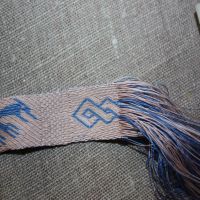
That lozenge pattern element is not a photograph, but a scan. So it should be to scale. But I pinned...
Guest - Katrin Sprang Discussion
15 September 2026
I was not referring to Rachel's reconstruction (is the reconstruction you refer to the one photograp...
Guest - Beatrix Sprang Discussion
14 September 2026
There is something Rachel did not mention. She told me: "Well, I worked with the measurements we too...
Guest - Katrin Sprang Discussion
14 September 2026
Well, this is certainly developing into an interesting discussion. Firstly, going from that lovely l...
JAN
19
1

Bronze Age Site - the "British Pompeii"

An excavation at Flag Fen Archaeology Park, near Peterborough, is yielding wonderful things (including textiles and such spectacularly unspectacular items as a spool of thread). The site is a wet preserved Bronze Age settlement, with outstanding preservation. And it gets even better (well, for the archaeologists, not for the settlers back then) - the two buildings caught fire and collapsed into the Fens so quickly that almost everything was left in situ - a little like Pompeii, earning the place the nickname of Peterborough Pompeii.

This includes said spool of thread and even pots that still contain food - which is an utterly major "wow" for any archaeologist or historian interested in food. I do hope there'll be results from an analysis soon, helping us get a much better idea of how a Bronze Age meal could have looked like. Isn't that wonderful?

 
0
JAN
12
0

Getting back on track.

Somehow catching up always takes longer than expected - so today I'm still trying to get back on track and sort out what has to happen, and how quickly it needs to be addressed. And since I was off the Internet for a good while (which helps me immensely to really relax), I don't even have a stack of linky goodness to give to you. There are only two things:

If you're interested in Speculative Fiction, you can find a post about Australian Spec Fic, written by women and published in 2015, over here.

Also, Doug is making another Archaeology Blogging Carnival, and I'm planning to take part in this. It's called The Grand Challenges for Archaeology... so you can expect a post regarding this in one of the next few days!

 
0
DEC
21
0

CfPs, and a job offer thingie.

Somehow I have accumulated a whole stack of things that wait to be shared, and since the holidays are very close now, I'd better start sharing them right away...

First of all, there are two calls for papers, both for sessions at the EAA, or more precisely the 22nd Annual Meeting of the EAA in Vilnius 2016 (31st August4th September).
All relevant information about the EAA conference, conditions, fees, accommodation etc., can be found on the conference web page, http://eaavilnius2016.lt/:1. Conference and membership fees and conditions: http://eaavilnius2016.lt/registration-fees-and-conditions/2. Accommodation: http://eaavilnius2016.lt/registration-fees-and-conditions/ and http://www.vilnius-tourism.lt/en/information/accommodation/3. Guidelines for speakers and poster presentations: http://eaavilnius2016.lt/general-info/guidelines/4. Deadlines: http://eaavilnius2016.lt/general-info/deadlines/
Untold Stories: Technology, Linearity and Complexity in Archaeological Thought.

The material record naturally lends itself to long-term perspectives. In few areas is this as apparent as the study of technology, which has historically been closely intertwined with the disciplines of archaeology and anthropology. But has our focus on the long-term caused us to unwittingly shape a unilinear, technologically deterministic picture of the past? And is there something to be learnt from the parts of the story which have been pruned from this evolutionist model?

The papers presented in this session will explore examples of how our pattern-seeking approaches have excluded interesting aspects of the story of the relationship between humanity and technology, and the methods by which we can reinstate these. We argue in favour of complexity (but not as a rule); of the little details which can enrich or subvert archaeological grand narratives, while acknowledging that the latter are also an integral part of our discipline.

This session is intended to stimulate discussion of our current approaches to the archaeology of technology, and to consider ways in which they can be developed in order to inform broader theoretical and methodological developments.

The deadline for submissions is February 15. More info and abstract submission:  http://eaavilnius2016.lt/
And another session at the same conference:

TH1-13: ‘Tradition and innovation in textile technology in Bronze Age Europe and the Mediterranean’ has been provisionally accepted in the theme "Interpreting the Archaeological Record", and the call for proposals of papers and posters has now been opened.

Textile craft with its complex technology and socio-cultural significance has been a key craft in the societies of Bronze Age Europe and the Mediterranean. However complex and socially and economically important, textile technology has often been considered as being rather traditional and non-innovative throughout many centuries of the Bronze Age.
The present session aims to examine textile technology in search for its traditional and innovative elements, through investigating the evidence of archaeological textiles, textile tools and their diachronic changes, botanical and faunal environment, textual sources and imagery of textiles and cloths. The session will focus on the Bronze Age in Europe and the Mediterranean, although papers referring to transitional periods from the Neolithic to the Early Bronze Age, and from the Late Bronze Age to the Early Iron Age will also be welcomed.
We particularly welcome all papers discussing various aspects of traditions and innovations traced in textile technology, especially these regarding raw materials and their processing, textile techniques, textile tools and equipment, organisation of textile production and dynamics of its specialisations, cross-cultural and cross-craft interactions, and changes of textile craft in relation to socio-cultural transformations of the past societies.

All paper and poster proposals should be submitted electronically at: https://www.eventure-online.com/eventure/welcome.form?type=abstract&congress=152_EAA&c=bd4350a3-56f9-46d1-8d66-514d76e0eb3c by 15 February 2016.
EXARC invites to a meeting called Goals and perspectives for experimental archaeology and archaeological open-air museums, Leiden (NL), taking place March 10 to 13, 2016. More about the meeting can be found here.

In addition, there's a PhD project in Glasgow, with a spot for a student. The research project will develop nanoparticles for the treatment of textiles found in the Mary Rose. More about this and contact for application can be found at the Glasgow Textile Conservation blog.
And that's all conference and job links I have for now...
0
AUG
31
0

Un-busy Monday.

I spent this Saturday giving a long workshop, so today is destined to be non-busy, making up for the half-weekend. The cat, as usual, is happy to help relaxing by snoozing right at my feet (and also making it nearly impossible to move the chair).

For you who are busy, though, I have some links!

Apart from the famous Herjolfsnaes garments, there's another site with textile remains in Greenland, called Garden under Sandet. The fur finds from there have recently been analysed, and what was thought to be bison, muskox and bears have turned out to be horse and goat. The full article is up at Elsevier (paywall).

A video on Youtube shows several historic egg preservation techniques.

Finally, if you read German, Mathis from Schauhuette has posted a thoughtful piece about the payment and situation of private archaeology businesses in Germany.
0
JUN
29
1

Archaeology News.

There's been a Bronze Age find, with residues of food (which is really, really special) in Cambridgeshire.

In sadder news, the C14 lab closest to my home, situated in the Physics Institute Erlangen, is closing down this summer, after twenty years. They don't say why they will close down, but Mathias' blog Schauhuette hints that it's due to budget cuts.

Finally, though a little older news already: The remains of a medieval knight whose skeleton shows damage consistent with jousting injuries.
0
MAR
20
0

Gazillions of links.

I have a gazillion of browser tabs open, and that needs to change. So I'm going to give you a gazillion of links!

First of all, Franklin Habit has mashed Victorian knitting into an entirely non-Victorian baby hat that is definitely worth a look for its mohawk fringe. (Victorian, of course.)

Gamergate is still not dead - but you can auto-block them on Twitter. Here's an interesting article about that (which also explains what "sealioning" means).

If you need to insult someone, here is a much cooler way to do it (and much more long-lasting): Names for plants and creatures.

Having too much stuff in your house can be a problem - but one that you can tackle by getting rid of things you don't use anymore. Running out of storage space for archaeological finds? Much worse, and much harder to solve.

An article about recreating a Roman hairstyle is open access online at the EXARC journal.

If you are in Germany and would like to go to a creativity retreat, there is a project up on Startnext called Hand-Herz-Seele. Margit from Alte Künste (my partner-in-crime from the LonCon last year) is one of the teachers there, so you might get a chance to dye with her. The project is currently collecting "likes" to be able to start the actual funding stage.

Speaking of dyes and colours, Ask the Past tells us how to dress a child. Now that's still the proper way around there - blue for girls and pink for boys. As it should be. (Someone got it wrong some time after 1890...)
0
MAR
17
0

Pretzels, Hommages, Sunshine.

The world's oldest pretzel has been found in Regensburg - a carbonised baked good that dates to the eighteenth century.

Terry Pratchett's name will be sent around in our equivalent of the Clacks towers.

The indiegogo campaign for Con Man has reached almost 2 million USD.

For those of you with a delivery address in Germany, I am running a spring special in my shop:
 there's a 5 € discount on shipping for delivery inside Germany this week, until March 20. (Minimum order for this is 20€.)

And it's sunny outside - I hope you can enjoy some weather as fine as the weather here, too!
0

By accepting you will be accessing a service provided by a third-party external to https://pallia.net/

Contact