
Latest Comments

Guest - Katrin Sprang Discussion
18 September 2026
Hi Rachel, I have looked for more photos of you, but that was not very successful. I found a link on...
Guest - Beatrix Sprang Discussion
15 September 2026
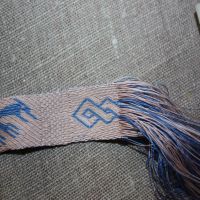
That lozenge pattern element is not a photograph, but a scan. So it should be to scale. But I pinned...
Guest - Katrin Sprang Discussion
15 September 2026
I was not referring to Rachel's reconstruction (is the reconstruction you refer to the one photograp...
Guest - Beatrix Sprang Discussion
14 September 2026
There is something Rachel did not mention. She told me: "Well, I worked with the measurements we too...
Guest - Katrin Sprang Discussion
14 September 2026
Well, this is certainly developing into an interesting discussion. Firstly, going from that lovely l...
JUN
20
3

Did you know...

... that castrated sheep were prized for their wool growth? I didn't, until very recently, when I found this blog post at ossamenta. I stumbled across that blog through the Blogging Archaeology Carnival, by the way.

Also, you may or may not have heard about the treasure found in Vienna Wiener Neustadt (south of Vienna) - it has now been published, and you can take a peek into the book (in Geman) and order it here. For those of you who don't read German but are curious, there are several pictures of pieces from the treasure on that page (listed under "Bilder"). The treasure is a spectacular find from the Late Middle Ages, found by chance in Vienna Wiener Neustadt (the ground's owner was digging a pond in his garden), and it's been analysed and researched and published by a team of experts for three years - among them one study colleague of mine.

(Ahem, I didn't realise it was not Vienna in my original post. I now know better. Also thanks to Michaela, I now know that the treasure is on display until November 2014 at Asparn an der Zaya.)
0
JUN
12
1

Viking Figurine Find.

A few days ago, I stumbled across a Past Horizon article about a new find of a Viking age figurine, showing a woman in full dress (or at least dressed). I took a look, marked it for looking at it again a little later, and planned on blogging about it, with maybe the inclusion of some thoughts about the dress and its possible interpretation.

Well, you know how some problems solve themselves with waiting? Cathy from Loose Threads has beaten me to it, and posts in detail about the figurine and the difficulties of interpretation of its dress. So I will just point you at her blog, for now. And say that I totally agree with what she writes: The figurine throws up more questions than it answers, and that is frustrating and fascinating at the same time.

Welcome again to the world of textile archaeology.
0
FEB
17
0

Ah. Sunshine.

The cat is sleeping beside me, and I am working my way through a gazillion and a half of (nice) emails, the sun is shining, I have Chai and chocolate cake for breakfast. There is gorgeous cloth waiting for me to work on a little later, preferably while sitting in the sunny wintergarden. Can a work week start in a nicer way?

While I am nicely swamped in work, you will get some links.

Here is a blog post about the adventures of an archaeological artefact after excavation

Oberösterreich (in Austria, obviously) has a database of archaeological sites, partly with find lists, which is still expanding. I'm hoping they will eventually include individual finds too.

If "Catal Höyük" rings a bell for you, the blog "Castles and Coprolites" might not only amuse you with its title, but also with the poem "Lady of the höyük".

Finally, a really amazing modern fashion dress, showing an old painting recreated as embroidery: Adam and Eve by Lucas Cranach, painted in the early 16th century.


0
JAN
10
0

Random thoughts.

I've barely started on the current big project, and first complications have already arisen, hooray - there is an issue with the fabrics I had planned to order. If I am lucky, I can get very similar replacements for them. If not... well. We shall see. At least it starts out quite, quite interesting.

There are bits and pieces I can get started on, though, and I am firmly planning to do so today, with just one single other point on my agenda.

(Sorry for the vagueness - if things work out, I'm planning to de-vague it soon, and you will be along for the ride.)

So while I'm feeling a little torn about how things will work, here are some scattered random links for you.

The Yarn Harlot writes about a baby sweater, and how only love could buy it. Yes. This. (Fits right in with the Fair Prices stuff that I blatantly plugged again yesterday.)

If you read German, Archaeologik posts about an excavation of a modern ceramic firing pit (pit was courtesy of a school project). If you don't read German, there's piccies.

Random fact of the day: I'm still doing yoga. My standard go-to site is doyogawithme.com, which I still highly recommend. There are pay-for sites that are by far not as nice as that one. And online yoga is a business with quite a bit of money to be made, as noticed by a company called YogaGlo... who have, apparently, patented a certain layout of the room for video classes.
This has led to hubbub and kerfluffle with the other yoga class sites, among them Yoga International. How is that interesting for you, you ask? Go read their open letter - and then you might want to enjoy their offer of all their classes for free (offer stands with undisclosed end time, but probably not forever).
0
NOV
12
0

News from out of the cold.

It's getting more wintery (or maybe still late-autumny) here, with fog in the morning and quite cold temperatures at night. Something outside seems to have changed for the cat, too - not just the weather, though. She's been all on edge these last few days, and this morning she even preferred her litter box to the garden flower beds, refusing to go out at all. We suspect there's a new cat in the neighborhood and they are on less-than-friendly terms. We have not discovered the culprit yet, though.

Speaking of discovery - I have re-discovered Doug's Archaeology Blog this morning, and this time I have added it to my reading list straight away. It's a lovely blog with lots of links and content and thoughtful articles, and if you are interested in behind-the-trowel archaeology (as in not only what is dug up, but who is doing it), I can heartily recommend it.

Another blog that looks like a fun read, with behind-the-scenes stuff: Powered by Osteons. Including critical (well, science-critical) reviews of Bones, should you be interested in that.

Final link for today - in case you have been looking for a database to work with in your excavation projects, you might want to take a look at this one. The IADB promises to be helpful with your documentation and research, up to and including the analysis of the finished excavation. (I guess you still have to do the work yourself, though...)
0
SEP
27
3

What is the most important thing?

I have been invited to give a one-hour lecture about archaeological textiles (soon, oh-so-soon), and I have all the freedom you can imagine in choosing the focus topic. Which is nice... but also not helping, as there are so many things that are important, or can be seen as important, or are so closely interconnected to each other that one could talk hours about them.

So the question I've been asking myself is: What is most important? What is the thing to tell people (students with no prior knowledge about archaeological textiles) about the world of textile archaeology? What does one really need to know, even if one knows nothing else at all about medieval or historic textiles?

If you had to pick one single thing as the most important message about textiles and textile production in history and archaeology - what would that be?

Your input would be very, very welcome while I go on to wrack my brains. (With coffee support. I think I need coffee now.)
0
SEP
20
2

There should be a law.

One of the topics in the Forum this year was embroidery - a lovely topic. It was also a wonderful and really fascinating piece in the focus of the paper. The only unfortunate bit? The piece (an embroidered late antique tunic from the RGZM Mainz) had been conserved and placed onto a stand in the main exhibition so that the back of the embroidery is not accessible - and there are no photos of the back.

Now, if you are an embroiderer, you will know that the frontside shows the picture and the backside tells the story. Which stitches were used? In what direction were they worked? How were starts and stops (or larger gaps between similarly coloured batches) handled? Was the worker sloppy or neat? Which parts were worked first? All this... discernable only from the backside.

So I will repeat the There-should-be-a-Law thing that I posted already ages ago - I mentioned it at the Forum, and there was general agreement, by the way.

There should be a law that makes anyone writing about an embroidered piece to post at least three good quality photographs, showing a) the complete piece with measurements given in the text; b) a close-up (or several) of a detail, showing all the stitch techniques and materials used on the piece, together with a ruler or other size indicator on the photo; and c) a close-up of the back side of exactly these said details, also with a size indicator on the photograph.
Because it's the backside that tells the story, and the detailed view that makes it possible to listen to that story.

Now we only need to make it a real law. Any helpful suggestions on that?
0

By accepting you will be accessing a service provided by a third-party external to https://pallia.net/

Contact