
Latest Comments

Guest - Katrin Sprang Discussion
18 September 2026
Hi Rachel, I have looked for more photos of you, but that was not very successful. I found a link on...
Guest - Beatrix Sprang Discussion
15 September 2026
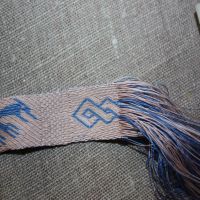
That lozenge pattern element is not a photograph, but a scan. So it should be to scale. But I pinned...
Guest - Katrin Sprang Discussion
15 September 2026
I was not referring to Rachel's reconstruction (is the reconstruction you refer to the one photograp...
Guest - Beatrix Sprang Discussion
14 September 2026
There is something Rachel did not mention. She told me: "Well, I worked with the measurements we too...
Guest - Katrin Sprang Discussion
14 September 2026
Well, this is certainly developing into an interesting discussion. Firstly, going from that lovely l...
JUL
04
0

Some archaeology links (including Star Trek and Playmobil)

If you are one of the folks who read German, here's some archaeology stuff for you to check out. If you don't read German, there's pics in the first and third link - don't miss the Playmobil Burial of Hochdorf!

An old tunic has thawed free - how can I have missed the Lendbreen tunic, since this article came out in March already?

On Minuseinsebene, there's a blog entry about Star Trek and Archaeology.

In Konstanz, there's a tradition of having archaeology meet playmobil - the currently running exhibition is "Playmobil and the Celts", running until September 15. If you're too far away for a visit, follow the links. There's pictures that are too cool for words. Click the link already.

And never forget Rainer Schreg's blog Archaeologik, where the latest post is about the destruction of part of a pyramid in Peru (most of the links there are to English texts).
0
JUN
20
0

Modert tech to learn about ancient dyes.

There's a new technique on the block that can be used to detect and identify dyes, for example in leather: a variation of Raman spectroscopy coupled with laser blasts.

Here's the link to the Chemical and Engineering News article about it, and if you feel so inclined, you can also read the original paper in analytical chemistry. Lasers! Pricey spectrometers! Madder dye! What is not to like? (Well, it's not a loss-free method, so there's always that - but colour detection can rarely, if ever, be done without sacrificing a little bit of the material.)
0
MAY
14
0

Who stole my morning?

Somehow, these last few hours of the morning have slipped by without me really noticing it. If you saw the person who stole them, please let me know so I can get them back!

And now for your more-or-less random news: The cat is lying right beside me, sleeping. She has a slighly higher need for cuddles and closeness to her humans since we spent the last weekend away, so she wanted her nap close to me.

The garden is exploding into spring growth, with the roses sprouting stems and leaves. The tulips are nearing the end of their bloom cycle, but the lily-of-the-valley is taking up the baton, joining the forget-me-nots and strawberries. The pansies have been blooming for ages anyways, as have the dead-nettles... so the garden is looking quite full of flowers. So full, in fact, that I had to clear space to plant the tomatoes that I set out yesterday!

The internet has also been exploding into spring growth, or so it seems to me. There's lots of stuff to spend some time watching or reading, for example this:


Or, if you prefer reading, Sarah Goslee of the stringpage blogged a link to out-of-print publications put online by the Metropolitan Museum of Art, freely available to read and download. There's 371 publications available as of today, and Sarah has picked out a few of interest already, so visit her place for direct links.

And finally, if you are tired after all this reading and watching, here is something guaranteed to shock you awake: Google Earth pictures used to record looting at Apamaea, Syria, over the course of less than one year. Looting, my friends, is evil. EVIL.
0
MAY
06
0

Viking sails

While I was away, stuff has accumulated - so here is one of the linky lists again.

There seems to be a dispute about Viking sails and their reconstruction, as this article indicates. With my previous experiences regarding pictures as sources, I'd say it would be worth a try with the broad sail version that is depicted.

And here's a nice appeal to "stop dissing the humanities" - it's relating to US politics and financing, but much the same is true for other places, too.

Finally, in case you have heard about the "Paleolithic Diet" and wondered about how much it really has to do with food in the Stone Age, here is a very interesting video of an archaeologist explaining about... everything.


0
APR
24
0

Stuff that has happened.

First of all, the good news: The 14C-Dating of the Ribe mitten is fully financed, and the initiator is, accordingly, quite happy. Thanks to all of you who helped funding! If you have not helped funding yet and are sort of sad that the others did it without you: You can still pitch in, any extra money will be used for additional analysis of the piece. Ideas on further research are including the stitch type used, wool analysis, and yarn analysis. For the previously blogged English instructions on how to fund on the Danish site, click here.

The petition against the full cut of heritage conservation funding in one of Germany's federal states has led to some political discussion... but with no clear statements yet. You can read a short piece about that on Archaeologik (in German). The petition still lacks about 1.400 signatures to reach its goal, so if you have not signed yet, please do so and spread the word, there are still 30 days left to go. The text on the petition site itself is in German. If you need to get up to date on what it's about first, you can read my blogpost about it or go to the DGUF who initiated it; they have an English translation on their webpage.

And a last one - I have posted a link to the petition against food patenting before, but it seems as if there's more in the works: an EU law to make almost all traffic of non-industrially produced seeds illegal. When I first read about that, I thought it was a belated April Fool joke, but no, it looks like they really mean it. I found a link to the draft proposal here, and I'll keep my eyes open for protests against this. If you know more, please share in the comments!
0
APR
18
0

More radiocarbon stuff.

Just in case that you have now gotten totally hooked on that radiocarbon stuff, here are two more links:

First, a database listing 14C-dates from Slovakia, Czechia and neighbouring countries. There's about 860 dates in there already, with more to come, and the database can be downloaded as MS Access file.

If you ever come across uncalibrated radiocarbon dates given as "xxxx BP", it's not just a matter of doing the maths back from 1950 (the "present"). Radiocarbon content in the atmosphere did vary, and science is working on making even better calibration curves to get the dates correct. So instead of whipping out the calculator and getting a date with an offset, you can go here and have OxCal calibrate it for you.


0
APR
17
1

Crowdfund some archaeology!

Crowdfunding has become a thing, and I am quite fond of the idea. It's innovative, it's nice, and it opens up a lot of opportunities for projects that would otherwise have no chance.

So it was only a question of time until some archaeological projects come up... and currently, there is one running to fund the 14C-dating process of a nalebinding mitten found in Scandinavia.

The story behind? Apparently, there's not much known about this mitten. The initiator of the crowdfunding got into contact with the museum, trying to find some more information, and the museum indicated they'd like to do a radiocarbon dating if they could get the funds.

Just in case you wish to refresh your knowledge about radiocarbon dating: Here's an explanation including details about preparation and calibration, courtesy of Oxford. And another info page, with a little poetical citing of scientists at the start. The thing I find most curious, by the way, is the convention of dating "before present" - which means 1950. This is somehow so fitting for archaeology!

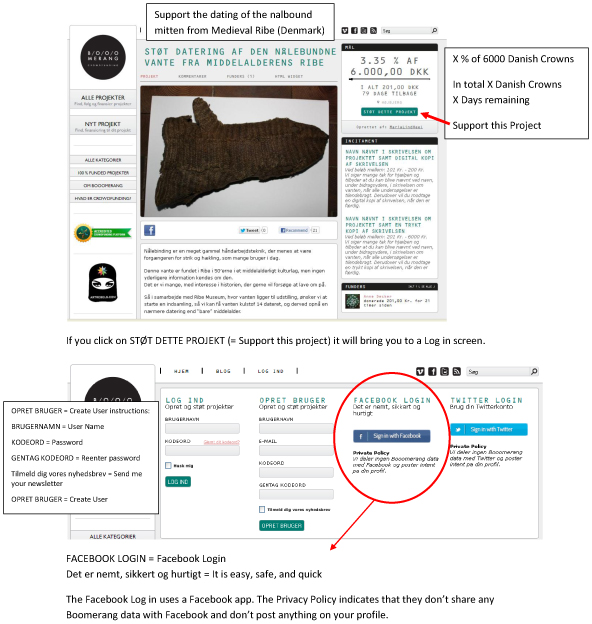
Anyway, back to our Ribe mitten: Maria Lind Heel has initiated a crowdfunding project to collect funds for the dating. Radiocarbon dating is not the cheapest of things to do, so the project's goal are 6000 DKK, which translates into roughly 800 €. The page is on a Danish crowdfunding site which means it's all in Danish - but fear not, you can still chip in, since Anne Marie Decker already made English instructions:


The project will run for about another month, and is already a bit more than halfway, funding-wise. Yay for crowdfunding!

0

By accepting you will be accessing a service provided by a third-party external to https://pallia.net/

Contact