Latest Comments

Guest - Katrin Sprang Discussion
18 September 2026
Hi Rachel, I have looked for more photos of you, but that was not very successful. I found a link on...
Guest - Beatrix Sprang Discussion
15 September 2026
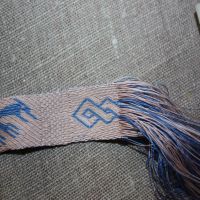
That lozenge pattern element is not a photograph, but a scan. So it should be to scale. But I pinned...
Guest - Katrin Sprang Discussion
15 September 2026
I was not referring to Rachel's reconstruction (is the reconstruction you refer to the one photograp...
Guest - Beatrix Sprang Discussion
14 September 2026
There is something Rachel did not mention. She told me: "Well, I worked with the measurements we too...
Guest - Katrin Sprang Discussion
14 September 2026
Well, this is certainly developing into an interesting discussion. Firstly, going from that lovely l...
APR
26
0

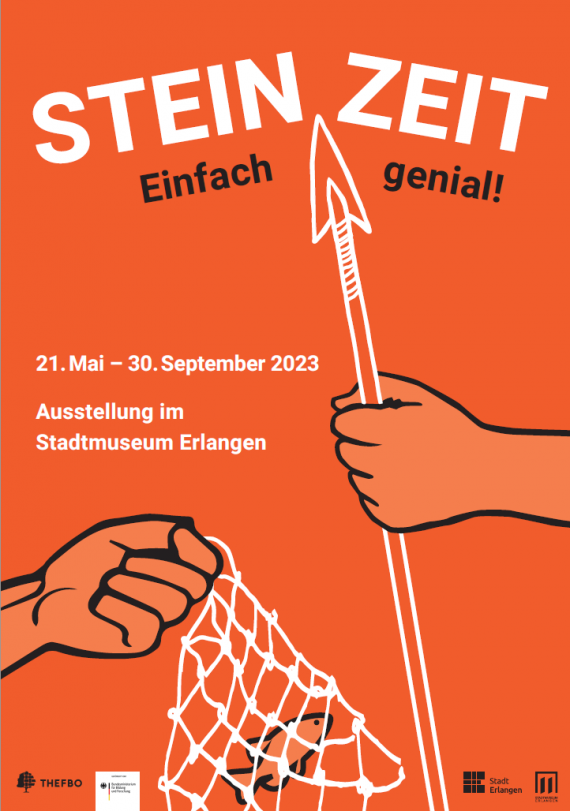
Exhibition coming up!

In the last years, I had the pleasure of doing demonstrations and having museum cooperations that involved quite a bit of travel. There was work to be done in Brandenburg, Lübeck, Emden, Berlin, just to name a few of them. It's lovely to travel there, get to see those places, meet the people and (important part of any travelling I do) sample the local delicacies. 

I'm just as delighted, though, to have a museum cooperation just in front of my own doorstep for a change, though. 

So I am very happy to share with you the  news about an exhibition coming up in my local museum, the Stadtmuseum Erlangen:

Die Ausstellung zeigt, wie vielseitig Gräser, Bast, Rinde und andere Materialien schon vor tausenden von Jahren eingesetzt wurden und lädt dazu ein, steinzeitliche Techniken selbst auszuprobieren.

I will be doing demonstrations of early textile techniques on the vernissage of the exhibition on May 21, starting after the official opening. There will be additional demonstrations on September 10 and on October 22, starting at 14:00 - plus one for the "Long Night of Science" on October 21, starting at 20:00.

I'm very, very much looking forward to this already. Almost no travel time! (There might still be sampling of the local delicacies, though. I will take any excuse for having delicious food of both the sweet and the savoury type... and Erlangen does offer nice specimens of both. Bonus: No exploring and luck necessary, I already know places to go to for the good stuff!)

0
APR
18
0

Stuff for the Germans.

Here's some stuff for the Germans among you (or those happy to travel and having some German...)

First, another weaving workshop in Krefeld, run by Barbara Thomas, who will teach about early composite fabrics. The workshop will be October 16-20, and you can find more information about it here

Second: There's an exhibition about Pestilence and Cholera in the Staatsbibliothek Bamberg - it's opening on Sunday, April 23. The topic? Plagues and how they were handled in the Early Modern Age. "Pest und Cholera" will run until July 2023.

And now I'll get back to my current project - finding evidence about how turning up in just your undergarments was regarded in the Middle Ages...

0
APR
12
0

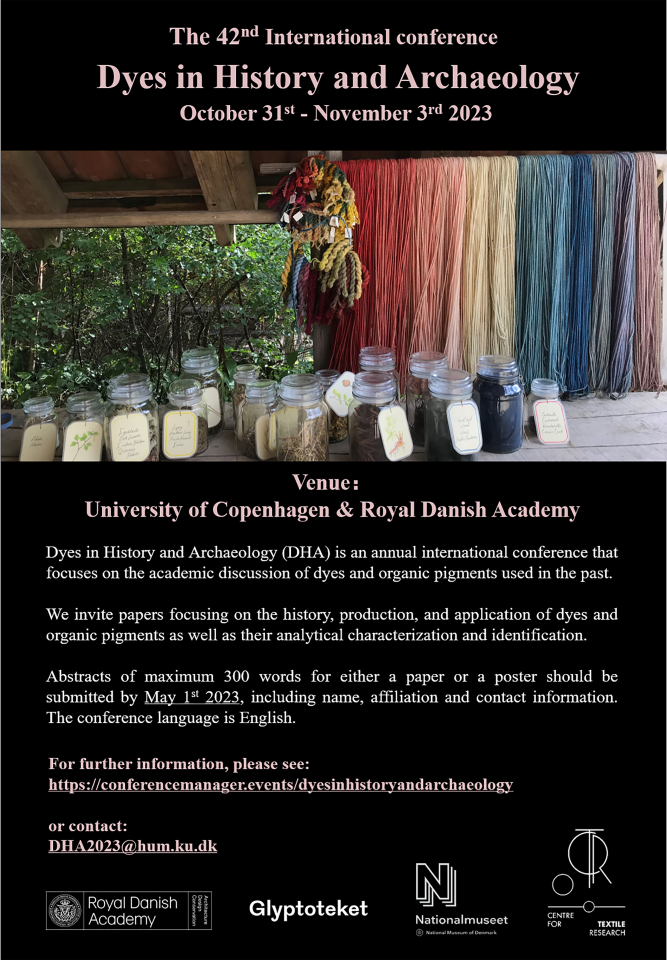
CfP - Dyes in History and Archaeology

If you like colours, especially those of the past, well, here's a Call for Papers for you: 

The CTR, The Ny Carlsberg Glyptotek, The National Museum of Denmark, and The Danish School of Conservation are jointly hosting this year's conference on Dyes in History and Archaeology (DHA 42) in Copenhagen from October 31st to November 3rd.The call for abstracts is open with the deadline being the 1st of May of 2023, so please consider sending your proposal! 

Here is the link for the conference website with all the necessary information: Dyes in History and Archaeology 2023 DHA42

I'm very, very tempted every year to go to this conference... even though I'm no dye specialist. But, well, the colours! The chemistry! The magic! I won't manage to go there this year either, as it's way too close to the European Textile Forum week and I will be doing the necessary prep work at that time, but some day I will surely make it.  

0
MAR
24
1

Karlsruhe! Nadelwelt!

I'm deep in the preparation for the Nadelwelt fair next week. It's amazing how, shortly before a fair, there's always this and that coming back to mind that could be done, or that would be nice to have on the fair, in addition to all the other things that have to be prepared, or made, or checked.

Weird, isn't it? 

I've made good progress today, both with checks of lists, and getting things sorted, and with more preparation. Like restocking on distaffs, which means finishing their top ends with a knife and fitting them with the band. Still plenty of things left to do, though...

The Nadelwelt! We will be in B6.5 this year. Drop by if you are there, and say hello!

... which means that I will be taking a little blog break. 

The fair runs from Friday, March 31, to Sunday, April 2 (come visit me and Margit at our booth in B6.5!), so after packing everything up, I'll be back home on Monday... and then it's almost Easter already. Which means I will be back on the blog after Easter, on April 11. 

Have fun, and happy egg hunting if you do!

0
MAR
08
0

Prep Step.

It's one thing done, the next thing in prep - I've just finished sorting and putting away all the tools and extra bits and bobs that went with me to the tablet weaving workshop. Apart from those bits and bobs of the collection that are going to travel to Lübeck with me!

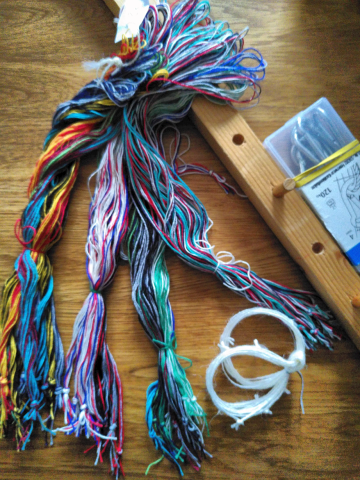
The loops for the braiding workshop are all cut, knotted, and bundled together for the different braids; there's material to anchor them, there's extra yarn and my trusty measuring and loop-making tool, there's scissors and loops and all that remains is to print out the things that have to be printed out, and to pick and pack some of the sample bands so people can get an idea of what is possible with loop braiding. Like in all my workshops, I try to teach "understanding the structure" as opposed to "follow this set of instructions blindly to get result A, and this set of instructions to get result B". So we start with five loops, and every loop in a different colour - this makes later analysis easier, as you can follow each of the colours through the band. Or bands, depending if you are braiding one or two at the same time.

The biggest part of the equipment are the clamps I use to anchor the braids - but fortunately, the trusty suitcase has no problem to fit them, and it rolls so well that it's also no trouble to push or pull it around. Only staircases are not my most favourite thing in the world when I'm travelling with workshop equipment... makes you keenly aware of what people with reduced mobility have to face every day. 

I'm already looking forward to Lübeck on Saturday and Sunday!

0
MAR
07
0

EuroWeb Conference in Lübeck Tomorrow!

The Hansemuseum Lübeck is up to great things - the first one in line: A conference about "Interwoven Societies", starting tomorrow.

For those of you interested in the conference, but unable to get to Lübeck for it, there's fantastic news: It will be streamed live on the EuroWeb YouTube channel! The conference programme is available here, it looks very interesting, and I'm looking forward to tuning in there tomorrow.


And then there's even more! 

The FGHO is celebrating their 30 year anniversary, and for that there's guided tours on Saturday - one of them including me. You can book your spot here on the museum website.

Finally, on Sunday I'll be giving a loopbraiding workshop. There's also still a few spaces left - you can join in!

0
MAR
06
0

Weaving Workshop Done.

I'm back from the weekend weaving workshop - which was (as these things tend to be) an enormous amount of fun, both for me and (according to their comments) the participants.

There was a lot of weaving done - quickly making centimeters on the bands on the first day. My weaving workshops always start with the very basics: Getting the hang of what different threading directions do, weaving stripes, the absolute basic principles on how patterns work. Then we do a little bit of doubleface to warm up, and then the fun starts.

That also means that the second is was devoted to more thinking and more looking at tablets, and more sorting things around, which slows down the weaving process. Let's say that it can be surprisingly hard to weave a simple monochrome surface... but all of my weavers did very, very well, and went away with a band and a learning curve that they can really be very proud of.

And I actually remembered to take a few photos! Though most of them are on a different camera than this very, very blurry one that I snapped with my phone, and have not transferred yet:

I did not promise twill in the workshop description, on purpose, but I usually get signals very quickly if the group, more or less, would like to try it. (They usually do.) And if that's the case, I try to get things arranged so everyone who wants to can get a little bit of the twill experience. 

That was also the case on the weekend, and we did manage to progress into twill weaving for the last part, to my great pleasure and to the great spinning of heads (in German you say "rauchende Köpfe", as in the brain is working so hard that smoke curls up from the head) on the weavers' side. 

I love weaving twill on tablets, and I really love teaching it. Twill is hard, though. You have to keep track of a lot of things simultaneously, and there's a stack of tablets that needs to be handled delicately and correctly, so some of your capacity is already taken up by the fine motor skills demands, and then (if you've done tablet weaving beforehand) there are things you always did differently and you have to do my way now (because of reasons, not because I like to pester people) so that eats even more of your brain or (if you haven't done tablet weaving beforehand) there are so many new movements that it's also eating up brain capacity, and that together means that it is getting hard to count to two.

There is concentrated deep silence during most of the time when I'm running a tablet weaving workshop. I have actually tried it once, where there was no carpet on the floor, and yes, you could hear the pin drop. That concentrated silence is even more obvious if twill is requested by the participants, though then you sometimes hear sighs, quiet mumblings (to keep track of the sequence in which things should be done) or, if something has gone properly wrong, a little cry for help or assistance.

As is also usual, only a part of the group went on to venture a little deeper into twill after the first bit of it. Twill weaving is not for everyone - you have to like this kind of brain-bending mental gymnastics, and some people do, and some people don't, and that is absolutely okay. The system I use is all logical throughout, and there's a stack of rules and little hacks and standard procedures that really help, but the challenge in the workshop is that you have to remember all of them at the same time, and a weekend workshop always means that there is limited time to let each new standard really settle into the brain and the hands.

I'd really like to try and teach tablet weaving for a full week some time, and see what could be done with a bit more practise before progressing to the next steps... but that would probably have to be at some weaving school or special event. Who knows, though - there's been so many interesting things and projects and jobs in the past that I'd never have dreamt of, the opportunity might arise at some place and some time.

For now, I have some notes to review, and some bits of my workshop script to tweak, a few little changes to make for the next workshop, and then I'll be waiting for the next opportunity to make some brain cells work very, very hard... 

0

By accepting you will be accessing a service provided by a third-party external to https://pallia.net/

Contact