Latest Comments

Guest - Katrin Sprang Discussion
18 September 2026
Hi Rachel, I have looked for more photos of you, but that was not very successful. I found a link on...
Guest - Beatrix Sprang Discussion
15 September 2026
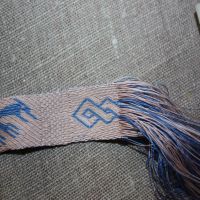
That lozenge pattern element is not a photograph, but a scan. So it should be to scale. But I pinned...
Guest - Katrin Sprang Discussion
15 September 2026
I was not referring to Rachel's reconstruction (is the reconstruction you refer to the one photograp...
Guest - Beatrix Sprang Discussion
14 September 2026
There is something Rachel did not mention. She told me: "Well, I worked with the measurements we too...
Guest - Katrin Sprang Discussion
14 September 2026
Well, this is certainly developing into an interesting discussion. Firstly, going from that lovely l...
SEP
11
0

Well, well, well. This is... interesting.

I received a slightly weird email yesterday with some inquiry about the ETF. The European Textile Forum. You know, this tiny, lovely, utterly historically-focused week of madness that I have the honour of organising.

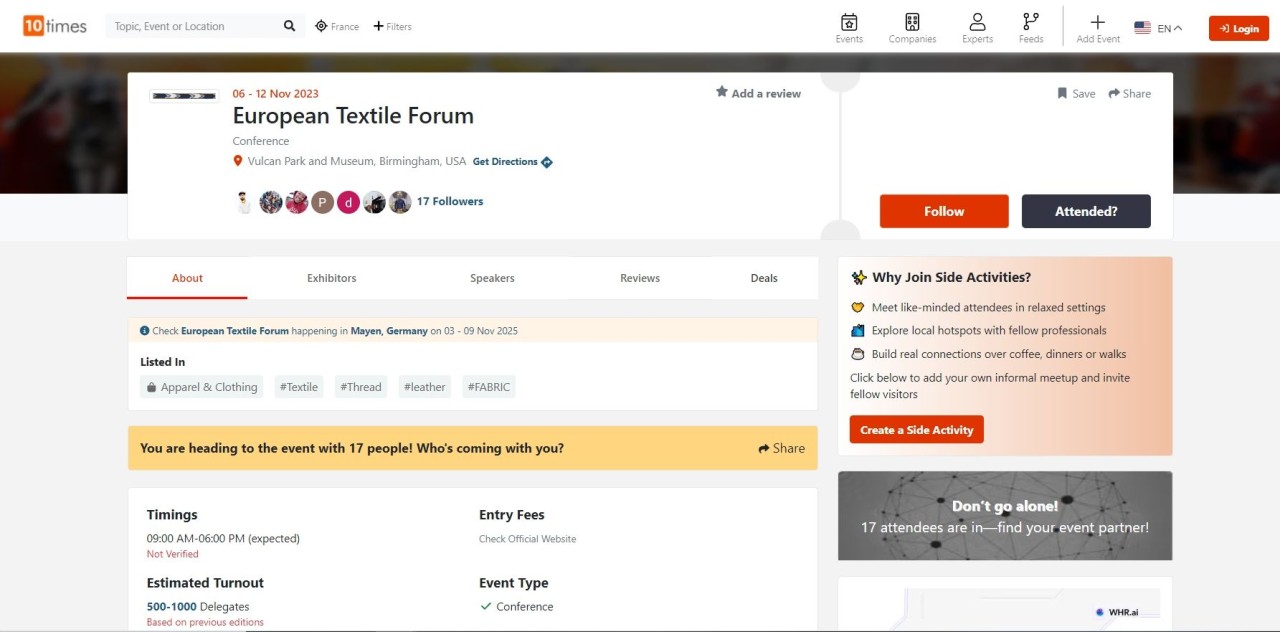
Well... apparently, it somehow got to be listed on some weird event website, and now it's listed there as 

"The European Textile Forum, set to take place in the charming town of Mayen, Germany from November 3 to November 9, 2025, promises to be an inspiring gathering for professionals and enthusiasts in the textile industry. This week-long event will feature a diverse lineup of workshops, discussions, and networking opportunities, designed to explore the latest trends, technologies, and sustainable practices in textiles. Attendees can expect to engage with industry leaders, gain insights into innovative materials, and participate in hands-on sessions that highlight the artistry and craftsmanship inherent in textile design." 

Erm. You got the week-long right, but somehow missed a beat with the latest trends thing. Unless you got stuck in, you know, let's say the 11th century and are now surprised to learn about those new-fangled late medieval trends.

Also, industry leaders. You'll definitely find some really, really good people there. But... somehow I have the feeling that it's not the industry that website is talking about. 

And then, to make things even weirder, I found out that Mayen seems to have snuck over across the pond for our Forum in 2023, because it's listed as taking place in Birmingham, USA. (Apparently we also were quite schizophrenic, too, if there were more than 500 people there. I only counted a few more than a dozen, and I'm pretty convinced that I did attend exactly that event.)

Now I'm wondering if that listing explains the occasional very weird mails and registrations I had for the Forum in the past years, with people from far away proposing some presentation about some very modern process and how to make it more sustainable. 

Funnily, also, the link promising to explain how the event got to being listed there leads... nowhere. Well, to a 404, but basically the same.

I've put in a request to delete this event listing now. I'm all happy for the Forum to get exposure, and for people to know about it, but then at least add a link to our own website, and a correct description, thankyouverymuch.

0
JAN
22
1

Conference Announcement and CfP, Instrumentum, October 2025

I have managed to get myself involved in yet another conference, which I'm very much looking forward to - and the Call for Papers is now out and open:

CALL FOR PAPERS

Instrumentum International Meetings

From fibre to fabric. Multidisciplinary approaches to spinning and weaving in preindustrial European societies

Clermont-Ferrand, FR, October 7-9, 2025

The upcoming Instrumentum International Meetings focus on fibers, thread, textiles, and the loom in pre-industrial European societies. The increasing number of discoveries of archaeological textile fragments and the development of technical methods for their study (among others, Moulherat 2008; Gleba, Mannering 2012) indeed reveal a great diversity in the ways threads were prepared and handled.

Following on from the research carried out in 1999 by the Lattes (F, 34) colloquium "Archéologie du textile des origines au Ve siècle" (Cardon, Feugère 2000) and by subsequent European colloquiums (notably Gillis, Nosch 2014; Bustamante-Álvarez, Sánchez López and Jiménez Ávila 2021; Lipkin, Wright and Ruhl 2023), the 2025 Instrumentum Association Meetings propose to bring together researchers and specialists to provide an updated overview of current knowledge. This time, the focus is on the reconstruction of operational chains related to textile manufacturing, from raw material acquisition to the finished product, including spinning and weaving.

The conference is organizing with partners : Maison des Sciences de l'Homme and University Clermont-Auvergne UR 1001 CHEC, UMR 5140-ASM Montpellier, Bargoin Museum and Clermont-Ferrand Métropole, Ville de Clermont-Ferrand, Conseil départemental du Puy-de-Dôme, Service régional de l'Archéologie et Région Auvergne-Rhône-Alpes, INRAP and association MOIRES.

* * * * * * * * * * *

The diversity of discovery contexts shows that the use of textiles in ancient European societies was multifaceted and ubiquitous, taking on various forms. However, the role of their manufacture and consumption in daily life activities—whether domestic, artisanal, funerary, or ritual—is only partially perceptible, mostly through non-perishable tools or instruments. Textiles and production structures are rarely preserved, reaching us either through impressions (negative forms) or altered organic remains (mineralized, calcified, carbonized) or unaltered. These remains are sparse, struggling to convey their importance and complexity. A search for the presence of looms in European archaeological contexts is all the more necessary when considering the significance of this instrument in non-European cultures (Brumfiel 2006), both in its omnipresent use and its social symbolism.

The chronological and geographical frameworks are broadly open and concern all pre-industrial societies on a European scale. This openness allows for a larger cross-referencing of available sources and for confronting and enriching data from archaeology, social anthropology, history of techniques, and experimentation. This enables the observation of the continuity or evolution of techniques and artefacts related to textiles, as well as the textiles themselves, through time and geographic space. Moreover, highlighting natural raw materials, ancient techniques and low environmental impact production methods aligns this scientific event with current sustainable development issues.

The first section is dedicated to threads, of animal, vegetable, metallic, or mineral origin, and spinning. It will provide an opportunity to:

-Review the instruments/tools and processes for acquiring, transforming, and dyeing raw materials;

-Present new findings on methods for identifying and preserving archaeological fibers and threads;

-Highlight potential choices of threads or weaving methods in creating finished products meeting specific creative criteria;

-Discuss studies aiming to define the gender and social status of those practicing spinning;

-Explore the symbolism associated with spinning objects (distaffs, spindles, whorls, spinning wheels, etc.).

The second section concerns looms, which occupy a central place among the means and tools used in fabric production, and other weaving instruments. The topics addressed include:

-Their identification (remains, negative impressions, non-preserved remains whose absence does not reflect reality) in light of the diversity of elements known through textual sources (literature), epigraphy and iconography;

-The current state of typological studies (morphologies, dimensions, constituent materials, shapes of finished products);

-Their place in the living spaces, whether domestic or artisanal (workshop);

-The gender and social status of those who make and/or use them, as well as the transmission of knowledge and craft functions within a community;

-The symbolic dimensions of the objects.

References

Brumfiel 2006: E. Brumfiel, Cloth, Gender, Continuity, and Change Fabricating Unity in Anthropology, American Anthropologist, New Series, 108-4, 2006, 862-877.

Bustamante-Álvarez, Sánchez López et Jiménez Ávila 2021: M. Bustamante-Álvarez, E. H. Sánchez López et J. Jiménez Ávila (dirs), Purpureae Vestes VII. Redefining Textile Handcraft. Structures, Tools and Production Processes, Proceedings of the VII the International Symposium on Textiles and Dyes in the Ancient Mediterranean World (Granada, Spain 2-4 October 2019), Université de Grenade, Grenade, 2021.

Cardon, Feugère 2000: D. Cardon, M. Feugère (dirs.), Archéologie des textiles des origines au Ve siècle. Actes du colloque de Lattes, octobre 1999. Monographies Instrumentum, 14, M. Mergoil eds, Montagnac, 2000.

Gillis, Nosch 2014: C. Gillis, M.-L. Nosch (dirs.), Ancient textiles : production, craft and society : proceedings of the First International Conference on Ancient Textiles, Oxbow Books, 2014.

Gleba, Mannering 2012: M. Gleba, U. Mannering (dirs.), Textiles and textile production in Europe from prehistory to AD 400, Oxbow Books, 2012.

Lipkin,Wright et Ruhl 2023: S. Lipkin, K. Wright et E. Ruhl (dirs.), Interdisciplinary Approaches to Textile Research: Northern and Central European Textile Production and Use of Textiles and Clothing from the Neolithic to the Modern Period. The Proceedings of NESAT XIV. 23. - 26. August 2021, Oulu, Archaeological Society of Finland, Helsinki, 2023.

Moulherat 2008: C. Moulherat, Archéologie des textiles : une nouvelle méthodologie appliquée à l'étude des tissus minéralisés, Nouvelles de l'Archéologie, 114, 2008, 18-23.

* * * * * * * * * * *

The colloquium is open to archaeologists, historians, art historians, anthropologists, and craftspeople working with historical or reconstructed techniques. Presentations (20 minutes) and posters may be drawn from artefacts (instruments, thread and weaving tools, textile remains), iconographic representations, documentary studies, imaging and physico-chemical analysis results, reconstructions or experimental results, craft pratices, comparative ethnological and anthropological research, and studies of textual and epigraphic sources. The presentations will focus on ancient European societies from Protohistory to the pre-industrial modern era. The authorized languages are French and English.

Organizing Committee (FR)

Isabelle Bertrand, Nicolas Delferrière, Elsa Desplanques, Stéphanie Raux et Emeline Retournard

Scientific Committee

The Organizing Committee members and Catherine Breniquet (FR), Macarena Bustamente-Álvarez (ES), Dominique Cardon (FR), Elisabeth Dospel Williams (US), Margarita Gleba (IT), Francisco B. Gomes (PT), Audrey Gouy (FR), Katrin Kania (DE), Christina Margariti (GR), Fabienne Médard (FR), Louise Quillien (FR), Laurence Riviale (FR), Stella Spantidaki (GR), Agata Ulanowska (PL)

Location

Maison des Sciences de l'Homme

4 rue Ledru, F-63000 Clermont-Ferrand


The CfP is open until April 30; you find the contact data and a form for application via the website of Instrumentum Europe, or click this link to directly download the CfP and form in French and English.

0
JAN
15
0

PhD Scholarship application open - prehistoric metalworking

In case you're looking for a place to do a PhD with getting money, here might be something for you - providing you're not averse to metal and metalworking:

Newcastle University (UK) announces a call for a PhD scholarship on a project titled Technological choice and variability in prehistoric metalworking: a transdisciplinary investigation, funded by the AHRC Northern Bridge Doctoral Training Partnership as a Collaborative Doctoral Award. The partner organisation is ISIS Neutron and Muon Source, Rutherford Appleton Laboratory, STFC, UKRI.

Project Summary

This project investigates variability and social choice in prehistoric metalworking through an innovative transdisciplinary approach that integrates experimental archaeology, materials science, and a critical review of social studies on craft practice. The student will develop a novel understanding of artisan skill, sensory perception, communities of practice, and craft specialisation in prehistoric bronzeworking. The research will provide new insights into the social context of early European metallurgy, reassessing the enduring link between metallurgy and the rise of social complexity. Through this work, the student will acquire a unique transdisciplinary skillset that will significantly enhance their intellectual profile and employability.

Prospective candidates are advised to look at the full project proposal here: https://northernbridge.ac.uk/applyforastudentship/cda/

Value and duration of the award

Tuition fees paid at a rate equivalent to the UK home fee. For international students, Newcastle University will generously cover the difference between home and international fees through the university's Global Scholarships Scheme. Costs for relocating to the UK cannot be covered.

A yearly stipend paid in regular instalments. Awards increase every year, typically with inflation. As an indicator, the level for 2024/2025 is £19,237.

A contribution to research costs of £600 per annum. Additionally, award holders can apply to a Northern Bridge fund reserved to support primary research costs.

Duration of the award: 3.5 years full-time or 7 years part-time. Funding can be extended up to 4 years by undertaking a placement at the partner organisation or another non-higher-education institution. The maximum duration of a UK PhD is 4 years full-time (8 years part-time).

As one would expect for a PhD thing, you need to have a Master's degree in Archaeological science or something similar or an MSc in a relevant science degree, as well as some knowledge about metallurgy and materials. Bonus points if you are familiar with bronze casting and have experience there. In addition, the usual stuff for working together with other researchers (including interdisciplinary work), writing scientific papers etcetera (and of course the thesis), and working towards deadlines in the academic field.

If you think that might be something for you, go find out more on the official website at https://northernbridge.ac.uk/applyforastudentship/cda/ for details about everything (look under "recruiting programs" and scroll down, unless something else sounds even more like the thing for you). Deadline for your application according to the guidelines on that page is Monday 3rd February 2025, midnight (UK time). 

0
DEC
02
0

Archaeological Textile Study Day, online.

Margarita Gleba has organised a zoom Study Day for textile archaeology - you can join online! 

It starts at 15:00 and goes until 18:00, and you can register via this form here (or click the image). 

0
OCT
29
0

Back home for a bit.

I'm back home for a bit after the wool festival in Backnang - which was lovely, and full of nice chats, and two spinning workshops that were very well received (at least I got a lot of positive verbal feedback, and nobody hit me over the head with a distaff! I count that as well received overall). 

It was very, very exhausting, though. If you're a solo trader and give workshops, you have basically no break at all. The setup I had - two workshops while running a booth throughout the whole weekend - was only possible because of the wonderful support of the Alte Künste-Team, who graciously occupied my booth and sold stuff for me while I was gone (thank you so much again!) and the help of my other wonderful neighbours, Frau Wöllfchen, who also had an eye on my stuff when I had to run off to the loo.

Because, let's face it - if you're a solo trader at these markets, reality is that you turn up in the morning when the place opens for the exhibitors, get your stuff sorted out, then you're there all the time except for a loo break when necessary - which is run to the toilet, do your stuff, and run back. If you're really lucky, someone from the team running the fair has organised a coffee distributor who passes by your stall and offers you a cup, or if you're really really lucky you have someone to spot you for ten minutes so you can have a breath of fresh air and maybe catch a cup of joe yourself. You're not getting out of your corner otherwise until the end of the day, when all you want to do is go to your overnight place and have something to eat and quiet and an early night to recharge for the next day.

Mind you, please, I'm not complaining. That's just how it is, and on a good fair, the day is so full of chats with people you don't even realize how time passes, and may even have trouble finding the time to eat. (You learn quickly to just make that time, no matter what.) Being in that rush, and knowing you're managing all this by yourself has its own kind of feelgood attached... and it's not that you don't know how it is after, at the latest, the first fair or show you're doing solo. (Kind-of-pro-tip: If you are on a fair, and have the time, and there's a solo trader you like - you might make their day if you ask them if you can fetch them a coffee, or something else.)

And there's always the unexpected talks about half- or very-way-off topics. The quiet chat with lovely people. The unexpected laugh, or crazy little action. In Backnang on the weekend, one of the giggliest times was the visit of the Green-Eared Cat (who is a very well-known personality at wool festivals here, and some of that may rub off on her taxi people). She turned up with her personnel, but of course the little piece of the Bamberg cloak reconstruction I had with me to show to people was only large enough for the cat herself to try on.  (The personnel will have to get themselves to Bamberg into the exhibition, where the full-size object is available for humans of any size to try on.)

But the cat did try it on, and to all our great delight, it fit her perfectly: 

So now it's sorting everything back, then packing for the European Textile Forum. Last prep for that is also running; we're still wondering about the best way to form artificial pearls, for instance. 

There's also two paper drafts that have to be finished and handed in, and some orders to be sent out, so I'm definitely not suffering from boredom right now!

0
OCT
15
0

A Lovely Loom.

Yesterday's blog post fell by the wayside - I was away all day going to set up the loom for the exhibition in Bamberg... and it was great fun. (I also learned a lot! Including a new knot, which is actually a big deal for me, as I seem to be a bit of a knot dyslexic sometimes.)

The loom standing in the exhibition now was the result of a lot of thinking, planning, and the effort of many people. Our idea was to show something about weaving in the era around 1000. Now... that's the time when there's already an inkling of the horizontal loom, but we have next to no good evidence for that (as in "good enough to build a reconstruction from"). So we decided to make a warp-weighted loom.

The original plan was to have a regular one, but the building (which is old) does not allow for a loom to touch the walls. (That's also a possible security issue in an exhibition, as a loom only leaning might fall, and attaching it to the wall was out of the question, as the building itself is under heritage protection). The second plan, having an iron/metal holder for the loom, was out because of budget reasons, so we did end up with a free-standing wooden loom.

It's a proper, nice one, though, not looking as if somebody went collecting a few sticks in the wood and cobbled them together.

(The curious thing is that you can build a functional loom from mostly odd sticks from the woods, provided you make sure that the essential bits that need to be straight are straight. That's harder to do nowadays, though, than making one from cured, available, straight bits of wood, though. So that's what we have.)

The main thing that we wanted to do with the loom was to show that textile production at that time was a high-standing, important, and highly developed part of production, and the resulting objects were of high quality. So we found an expert in warp-weighted loom weaving in Sweden - Marie Wallenberg - who worked together with us to get the idea across to the woodworker, who made an almost perfect loom. One of the folks from Kaptorga made the loomweights (scaled down a little to be lighter, because that helps to not wear out the threads over time - the normal fitted loom is not intended to stay for months or years with the loomweights hanging), and Marie wove a fabric to fill the loom.

If you've seen warp-weighted looms in exhibitions, they are often a crooked thing, with a crooked bit of coarse weaving on them. While that may have happened occasionally, it is not what we would expect them to be in general - after all, they were used to make fine, straight, high-quality fabrics in the past. And that is exactly what we wanted to portray.

So once the loom had arrived from the woodworker and the fabric had arrived from Sweden and I had finished making the Rod of Many Holes to attach the weave to the loom's top beam, I set out to set things up in Bamberg, with Marie coaching me through the process. 

 And now we have a "little clay army" (my new favourite expression for clay weights hanging on the loom) and a white wool waterfall, showing off nicely that yes, you can weave a fine 2/2 twill on a warp-weighted loom. I really love the beautiful starting border as well! 


The exhibition will be open from October 25, and even though the info page is German only, the exhibition itself and the catalogue are fully bilingual German and English.

1
OCT
10
0

Digital Exhibition "Zwei Geschenke für Hitler"

In the NS era, archaeology was used for a lot of propaganda things, usually to show that Germans are The Best Thing Ever and everybody else was, at best, second grade, and that from the Stone Age onwards. Or so. (This, by the way, is said to be one of the reasons why German archaeology after the war became this hard-facts-only science that is rather sparse with interpretations, if compared to how things are done in other countries.)

The Kreismuseum Syke is working on a case that will give some information about archaeology in that era, and while doing the prep and research for that, they stumbled across an interesting history surrounding a Thanksgiving present to Hitler. If you read German, you can follow that story in a digital exhibition on the museum website. (If you don't read German, you're welcome to look at the pictures and old letters there, but the whole thing is heavily reliant on the texts - and it's quite interesting how the writing styles changed over time.)

I think it's a very good idea to do that exhibition case, and the digital exhibition too!

0

By accepting you will be accessing a service provided by a third-party external to https://pallia.net/

Contact