Latest Comments

Guest - Katrin Sprang Discussion
18 September 2026
Hi Rachel, I have looked for more photos of you, but that was not very successful. I found a link on...
Guest - Beatrix Sprang Discussion
15 September 2026
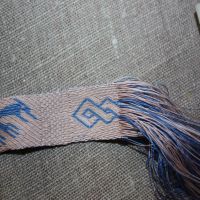
That lozenge pattern element is not a photograph, but a scan. So it should be to scale. But I pinned...
Guest - Katrin Sprang Discussion
15 September 2026
I was not referring to Rachel's reconstruction (is the reconstruction you refer to the one photograp...
Guest - Beatrix Sprang Discussion
14 September 2026
There is something Rachel did not mention. She told me: "Well, I worked with the measurements we too...
Guest - Katrin Sprang Discussion
14 September 2026
Well, this is certainly developing into an interesting discussion. Firstly, going from that lovely l...
NOV
02
1

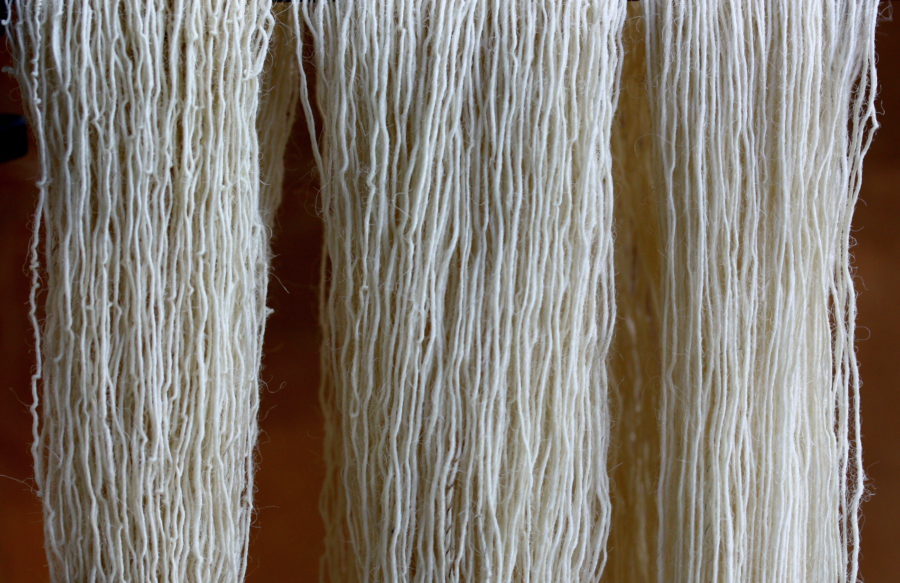
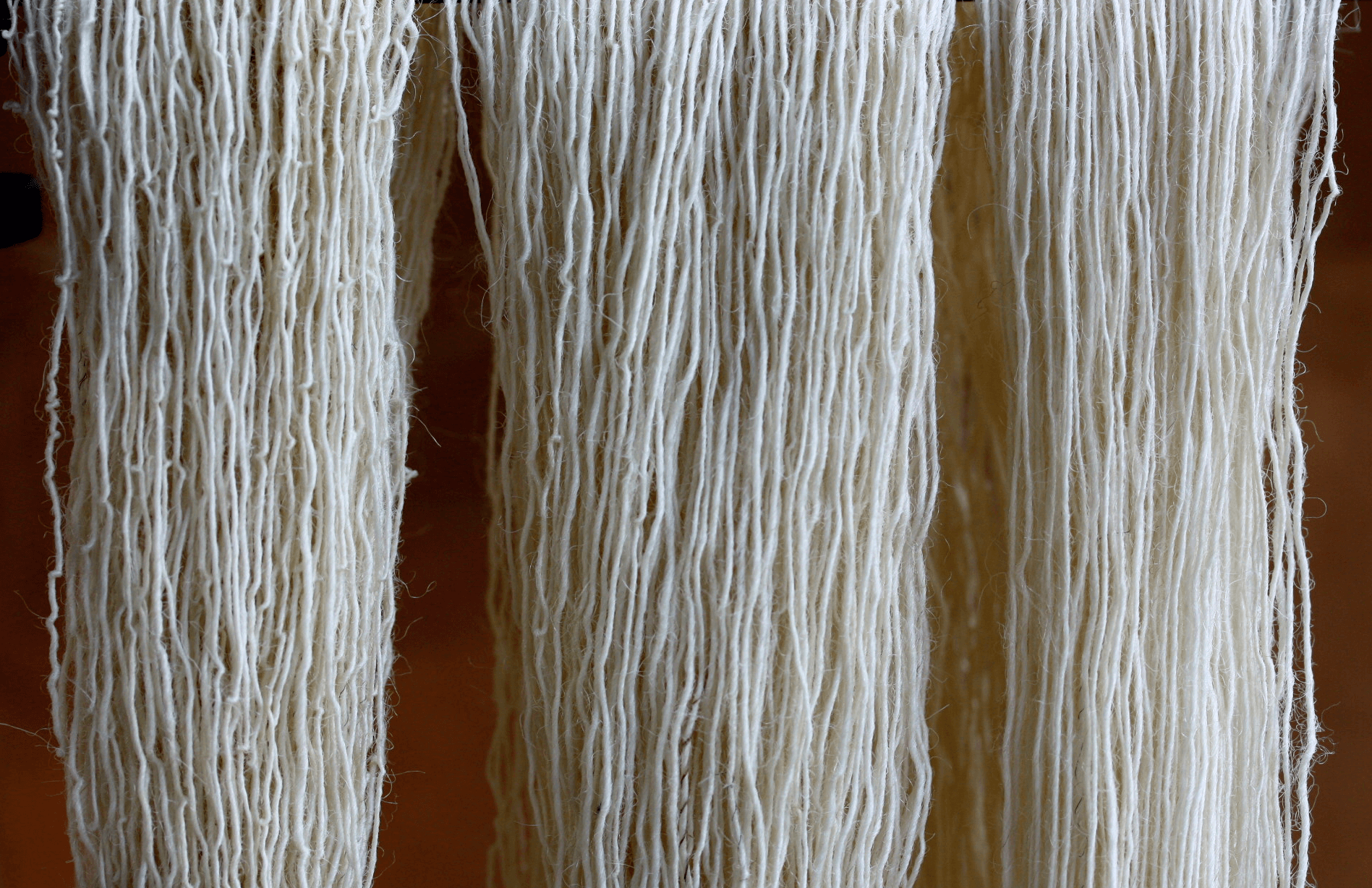
Three skeins.

My spinning for the experiment at the Textile Forum is done - and here's the result:

three_skeins
Three skeins, each with 230+ metres of yarn. Each from the same wool (Eider wool, I love that stuff, it really spins up beautifully), each in the same thickness of 0.5 mm, give or take a smidgen (even the evenest handspinning is not completely even!) and each finished in the same way (placed into a bowl, boiling hot water poured on top, left for 10 minutes to soak, then stretched out, then hung to dry with 1418 g of weight tied to the bottom end of the skein).

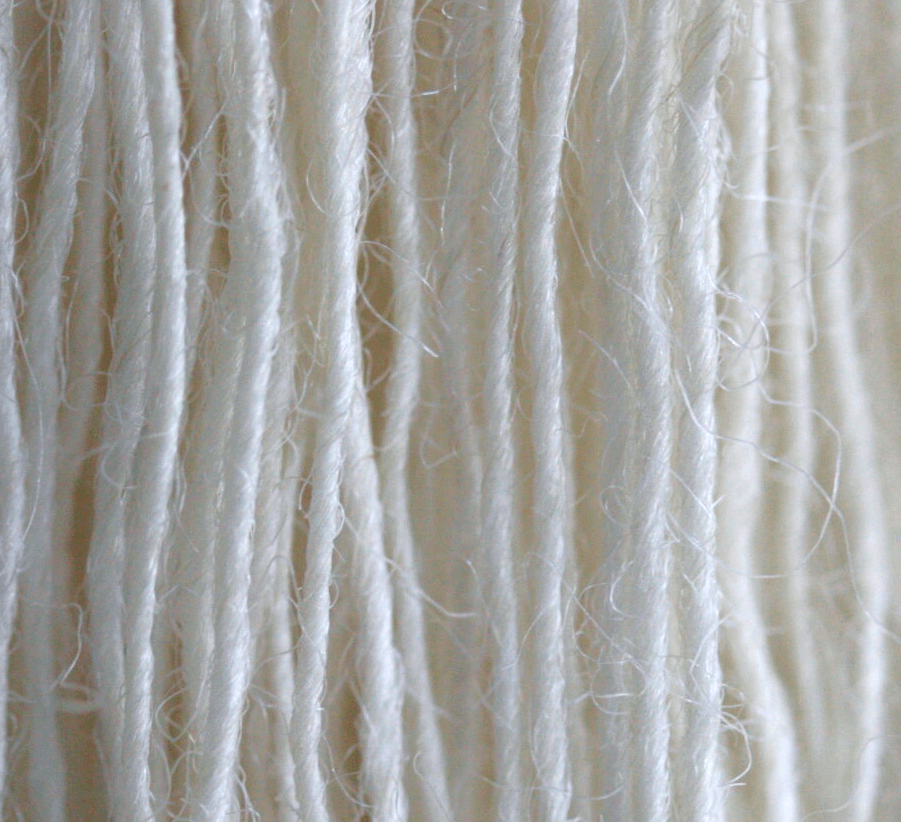
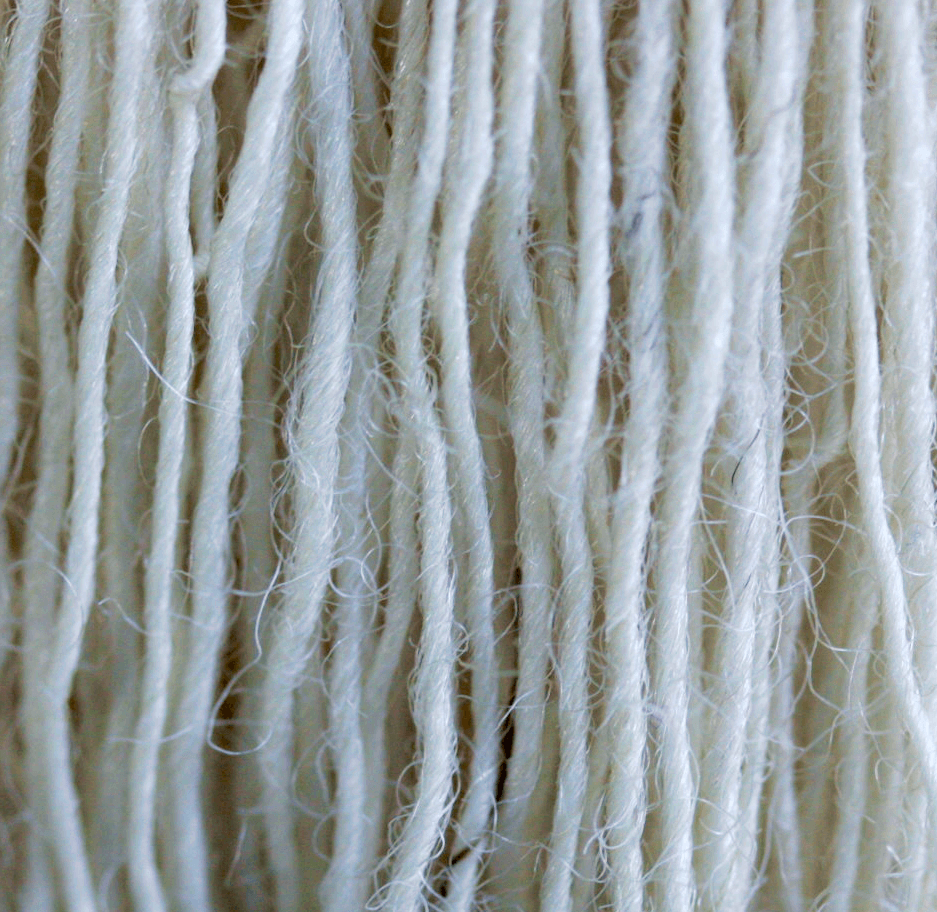
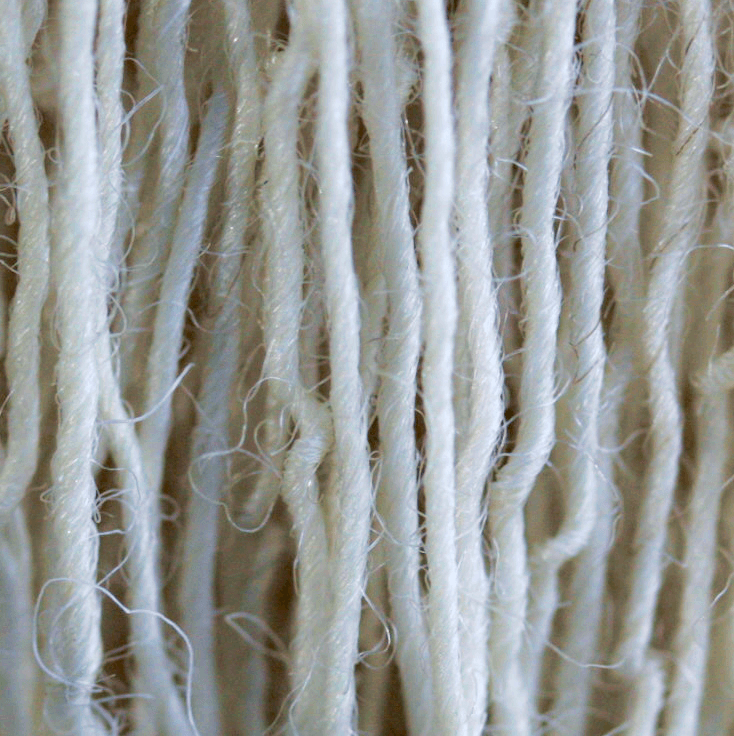
The only difference is the amount of twist between these three. The skein on the left has a spinning angle of about 45°, the one in the middle about 30°, and the one on the right about 20° - give or take a smidgen...

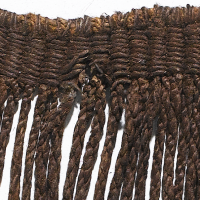
As you can see in the close-ups, the angle does make quite a difference. You can also see that it is not all the same everywhere in the threads, even though I always try to spin really, really evenly and really, really neatly.

[caption id="attachment_2718" align="aligncenter" width="196"]20angle 20° spinning angle


[caption id="attachment_2719" align="aligncenter" width="206"]30angle 30° spinning angle


[caption id="attachment_2720" align="aligncenter" width="204"]45angle 45° spinning angle


However, they should be regular enough for our purposes - and next week, during the Forum, they will turn into small bits of fabric, and that fabric will be dyed, and then we will see the differences between the three fabrics. Plus whether the dye penetrates them all equally well, or whether there are differences!
0
OCT
26
0

Still preparing...

Things are going more or less as planned here - every morning, I make a list of the things I want to get done during the day. Every evening, I find that I have not been able to get all of them done; partly due to mis-estimating how much I can fit into a day, partly due to not being able to finish them off because of missing information, or waiting for something, and partly because other things got into the way, or I decided to split the work over two days for a reason.

Still, progress is being made. This year at the Forum, we'll have not one, not two, but three tests/experiments (plus some extra dyeing with a fermentation vat that does not count for these) and they all need preparation. So I have wound skeins with 5 g of yarn each, and I'm working on putting the plan and protocol together for the repeat of the Pompeii dyeing experiment plus its add-on (I blogged about that here). It's proving to be not so simple to get all three batches done in a sensible way, so there's a good bit of thinking and checking and double-checking involved in making that plan (which is not yet finished, and probably will not be completely finished today, since I will want to go over it once again with a fresh brain...).

For the second experiment I'm deeply involved in, I have been spinning yarn - one batch with really high twist (a spinning angle of 45-50°), which is already finished, and has its twist set, and is now waiting for its partner. Which is a second batch with less twist (spinning angle of about 30°), about half-finished; and that is another thing I did today, some spinning. With the fabulous Zwirnzwerg! I'm really happy that I have this e-spinner now, it does help immensely especially when going for high-twist yarns. I could never have spun the 50° yarn in that time with any of my spinning wheels.

Why the yarns? We will be testing dye penetration in different fabric densities and with different yarns to find out how reliable the white spots between yarns are to indicate whether something was dyed in the piece or in the yarn/fleece. Which means spinning, and weaving, and then dyeing, the latter two done during the Forum.

There also has been ordering of supplies and materials for the Forum, and there will be more lists of things - things to bring for the diverse activities, lists of when what part of which experiment will take place, lists of meals planned by the catering service, and so on. Good thing I like lists!
0
OCT
17
2

Weaving Preparation: Wool yarn testing.

One of the things in frantic preparation right now are the experiments for the Textile Forum this year. We'll be having a rather experiment-heavy Forum, and all three planned things involve dyeing - one of the experiments will be a repeat of the Pompeii dyeing experiment exploring the influence of kettle metals, one will be a test about linen mordants with protein, and one will be looking at dye penetration in woven fabrics of different densities.

The lattermost requires appropriate yarns, and I will get to spinning tonight - a few hundred metres of yarn need to be done for weaving several samples. The weaving will take place at the Forum, and since the weaver lives in the Netherlands and I live in Germany, she will only see the yarns right before having to use them.

Most modern weavers use machine-spun, plied yarns, at least for the warp, because they are (usually) stronger than singles. Of course a plied yarn is stronger than just one of its singles, and modern yarns are often soft-spun, which means they are not very strong. So modern weavers tend to be a little nervous about using singles in the warp.

Just to make sure that the yarn is suitable for weaving - as in "strong enough" - I was sent instructions for testing, taken from "Inventive Weaving on a Little Loom: Discover the Full Potential of the Rigid-Heddle Loom, for Beginners and Beyond by Syne Mitchell (Storey Publishing 2015)". The two tests are the snap test and the drift test. For the snap test, you take the yarn between your hands so that about 10 cm are slack and then "snap your hands apart sharply"; for the drift test, you apply even, slow tension.

The instructions in the book say that if the yarn survives the snap test and "stretches and then stops" in the drift test, it's suitable as warp yarn. Can you guess my problem?

"Sharply" is not a very quantifyable thing. So if I take my yarn and pull my hands apart sharply, it will break. The same is true if I take a four-ply Regia sock wool yarn. In the drift test, my yarn will stretch and stretch and stretch and eventually snap... so according to these instructions, it would not be suitable for weaving.

I think the problem here is that you'd need to be a weaver and know the amounts of tension or snappiness in your own weaving process to really make these tests helpful. For non-weavers like me? Or for "remote testing" yarns? It needs to be more quantifyable.

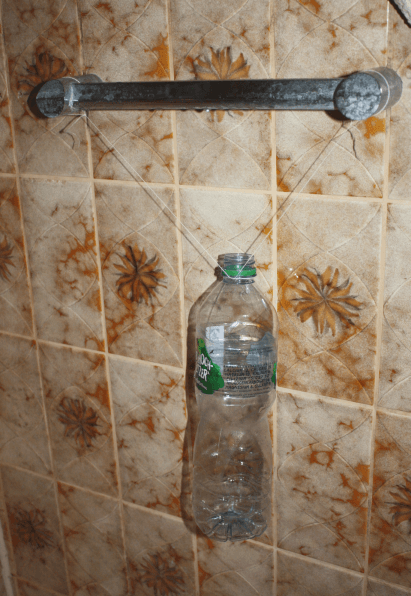
So here's my equivalent to the drift test: Tie an empty plastic water bottle in the middle of a piece of the yarn to be tested, then tie the two ends somewhere so that the bottle hangs in a suitable way to be filled. (Hint: A shower or bathtub, or someplace outside that can take a splash of water would be good places.)

[caption id="attachment_2677" align="alignnone" width="319"]Setup for the drift test. Please do admire the typically Germany-in-the-Seventies tiling in the background. Setup for the drift test. Please do admire the typical "bathroom-in-Germany-in-the-Seventies" tiling in the background. The white spots on the handgrip also tell you that we have really hard water here.


Measure out a certain amount of water, such as one litre, which will be one kilogram. Then, slowly and with as evenly a stream as possible, pour water into your bottle until the yarn snaps. The difference between the amount of water you filled into your pouring container and the amount still left is the weight the yarn could take - in my case, about 880 g.

Now the equivalent to the snap test: Tie a weight to one end of your yarn to be tested, then measure out one metre of yarn plus a bit to hold, starting above the weight. Take the end of the yarn securely in one hand, the weight in the other, hold them side by side high enough, then drop the weight. If the yarn bounces back, it has survived the test. If you are not sure on how much weight is necessary for the thread to pass the weaver's requirements, add more weight until it snaps. (Obviously, the smaller the increments of added weights are, the smaller your squishiness factor will be. My yarn snaps somewhere between about 60 and 100 g of weight.)
0
AUG
19
0

Friday Resources and Things to Read

The 10th Experimental Archaeology Conference will be held in Leiden, Netherlands, on April 20-22 2017. The Call for Papers is still open until September 1, so if you'd like to offer a presentation, you should do so soon.

The Virtual Library for Art, arthistoricum.net, has a full-text server called ART-Dok, made available by Heidelberg University Library. It offers members of the academic community worldwide the opportunity to publish their texts in electronic format on the internet at no charge. As for now, it provides free full-text access to 4,194 publications. You can also do fulltext searches through the texts. Intrigued? Go here to find the publications archive.

Textilis has a blog post about transferring embroidery designs in the 18th century.

The paper about the dyeing experiments done at the European Textile Forum in relation to the Pompeii lead vats, published in EXARC, has now gone open access: Investigating the Influence of the Kettle Material on Dyeing in the Industry of Pompeii.
And finally, totally unrelated and only here because of its sheer weirdness - did you know that there was a trend to dye armpit hair in bright colours, a while ago? I didn't, until this morning...
0
SEP
24
0

Experimentelle Archäologie, the contents.

Are you familiar with the conference proceedings of the EXAR? That society started out as "Experimentelle Archäologie in Deutschland" and later proceeded to be "in Europa". The papers published in their yearly proceedings are mostly in German, but if you do read German, there's some very, very interesting pieces among them.

I've recently hunted for some specific papers and found that while the individual tables of contents of each volume are on the EXAR website, there's no overview. So I made up a pdf for the first batch (when the proceedings still had "in Deutschland" in their name) and a second one, with all the contents in one file.

Here they are: Inhalt "Experimentelle Archäologie in Deutschland Bilanz 1990-2002" and Inhalt "Experimentelle Archäologie in Europa Bilanz 2002-2014". Enjoy!

(By the way, I have a stack of these books twice. If you are interested, I'd be happy to sell them - just let me know which ones you're interested in!)
0
JAN
28
0

Documentation is key.

If you've heard one of my presentations about Experimental Archaeology, the chances are high that you have also heard me talk about what defines an archaeological experiment. ExpArch has become a buzzword in recent years, and the term has often been applied to things that are not real experimental archaeology - because it seems to sell well, or excite people, or those doing the description don't know better, or for whatever other reason(s).

Experiments in general are very clearly defined: They are a process that is designed specifically to answer a question. The experiment design has a very great influence on how much of an answer you get, and on how general the answer can be - if you are doing a chemical experiment with, say, helium, you cannot tell things about what would happen with oxygen, or hydrogen in place of the helium.

Experiments, to be called such, also have to be documented clearly, accurately and objectively enough to allow the experiment to be repeated - and the outcome, if things are done correctly in each instance of the experiment, should be the same or at least very similar. This means anybody can, theoretically, replicate a given published experiment to test the reliability of the experiment itself and the answers it gave.

Which means that a proper archaeological experiment needs to be objective, it has to be repeatable, has to be designed to answer a specific question, and the design of the actual process has to be suitable for this  answer - you cannot say something about oak working if you used beech, and you cannot say something about the suitability of old tools if you use modern ones. It also has to be documented accordingly. Everything else is not archaeological experiments - it can be tests of tools and techniques, or archaeotechnic, or playing around, or making replicas, but it's not an experiment.

Now, very obviously, as soon as you go into archaeology, things get a little messier than in a nice, clean chemistry lab or physics facility, where you have controlled environments, controlled substances, and measurable outcomes.

The materials for archaeological experiments are very often natural stuff - and there can be a huge difference between wood and wood, even if it's the same tree species. Plus there's the human factor - craft skills are an important factor, and they are hard to quantify. Many things are also subjective, such as the preference of one style of working over another, or one tool variant over another. Which means that "objective" will, in various instances, turn into "as objective as possible" and "repeatable" into "as repeatable as possible" - since you cannot use the same tree twice. (In some cases, modern stand-in materials can be used to get better repeatability. I've learned about experiments about flint-knapping, for instance, that use specifically made ceramic cores for knapping: similar characteristics for the breaking, and uniform without flaws.)

One of the key things to still get workable results is... documentation. There's no such thing as too much documentation! This is especially important when human factors come into play. It's also important to keep in mind that these human influences may be very significant, and to document (and describe, and publish) accordingly. Even if it's not a proper, full-fledged archaeological experiment, but someone or a group trying out techniques, good documentation of the tests can make a world of a difference when you are trying to make sense of things - or just trying to get an inkling about a single person's skill development.

A very good example of documentation for this can be found on Agata Ulanowska's site. She's lecturing in Warsaw and has been giving courses about old textile techniques for several years, teaching students how to do things like tablet-weaving. For those courses, she's giving out documentation sheets, making it possible to track the progress of each student as well as getting an overview about times for designing, weaving, and finishing projects. The sheets are downloadable from her page (scroll down to find them) - maybe they will be helpful for you as well!

0
JAN
10
0

Random thoughts.

I've barely started on the current big project, and first complications have already arisen, hooray - there is an issue with the fabrics I had planned to order. If I am lucky, I can get very similar replacements for them. If not... well. We shall see. At least it starts out quite, quite interesting.

There are bits and pieces I can get started on, though, and I am firmly planning to do so today, with just one single other point on my agenda.

(Sorry for the vagueness - if things work out, I'm planning to de-vague it soon, and you will be along for the ride.)

So while I'm feeling a little torn about how things will work, here are some scattered random links for you.

The Yarn Harlot writes about a baby sweater, and how only love could buy it. Yes. This. (Fits right in with the Fair Prices stuff that I blatantly plugged again yesterday.)

If you read German, Archaeologik posts about an excavation of a modern ceramic firing pit (pit was courtesy of a school project). If you don't read German, there's piccies.

Random fact of the day: I'm still doing yoga. My standard go-to site is doyogawithme.com, which I still highly recommend. There are pay-for sites that are by far not as nice as that one. And online yoga is a business with quite a bit of money to be made, as noticed by a company called YogaGlo... who have, apparently, patented a certain layout of the room for video classes.
This has led to hubbub and kerfluffle with the other yoga class sites, among them Yoga International. How is that interesting for you, you ask? Go read their open letter - and then you might want to enjoy their offer of all their classes for free (offer stands with undisclosed end time, but probably not forever).
0

By accepting you will be accessing a service provided by a third-party external to https://pallia.net/

Contact