
Latest Comments

Guest - Katrin Sprang Discussion
18 September 2026
Hi Rachel, I have looked for more photos of you, but that was not very successful. I found a link on...
Guest - Beatrix Sprang Discussion
15 September 2026
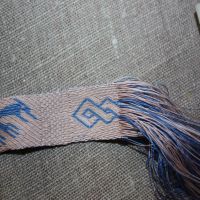
That lozenge pattern element is not a photograph, but a scan. So it should be to scale. But I pinned...
Guest - Katrin Sprang Discussion
15 September 2026
I was not referring to Rachel's reconstruction (is the reconstruction you refer to the one photograp...
Guest - Beatrix Sprang Discussion
14 September 2026
There is something Rachel did not mention. She told me: "Well, I worked with the measurements we too...
Guest - Katrin Sprang Discussion
14 September 2026
Well, this is certainly developing into an interesting discussion. Firstly, going from that lovely l...
NOV
03
0

It's good to be back home again!

I'm back home with the slight residue of a cold I caught somewhere during the last two weeks (fortunately it was a light one), a brain full of new information, project development for the winter season already started (it was a long drive home, with plenty of time to plan together with Sabine), and - as usual - a nice backlog of work and stuff to be taken care of.

The OEGUF conference was wonderful, though it had a few minor drawbacks: Our room was getting quite stuffy quite soon, there was no conference coffee point (which seriously cut back on the usual coffee socialising), and that in connection with short breaks due to the programme being stuffed very, very full, there was just not enough time to catch everybody I wanted to catch to chat or comment or discuss with. But apart from that, there was lots of laughter, oodles of fun, and a very large amount of presentations that were brand-sparkling new (at least to me) and of a very high quality - archaeologists and craftspeople alike meticulously looking at tiny details and working out things about bell beaker making, salt mining, and music instruments, to name three topics among many. The spinning experiment presentation was very well received too, and I did get quite a few comments about it, including one from a skilled statistician who offered to also take a look at the database and see if he might be able to see something in addition or something different from what I found when staring at all those numbers.

I met with some folks that I had not seen for a longer or shorter time, and it was wonderful to reconnect and see them again; and I also have some new acquaintances among the colleagues. There were two excursions, and during one of them I had the opportunity to make contact with the caretaker of a herd of museum sheep, a special old Hungarian breed - wonderful wool for historical spinning, and amazingly well suited to dye them coptic black, since the wool is already almost black. With all these things together and stuffed into a few days only, it's no wonder that my brain sort of ran on stand-by on Monday and still during part of yesterday, also an indicator that it was a good conference.

Socialising, learning about stuff, getting new and weird ideas, and carrying home material for textile works - have I mentioned already that I love conferences?
0
SEP
01
1

Can I have chocolate? Please?

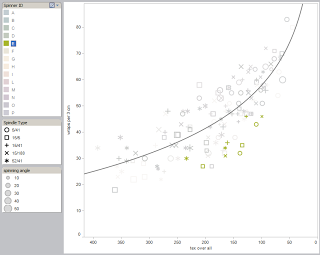
Unfortunately, I think we consumed the rest of our chocolate yesterday while looking at graphs and fiddling with axis setups (the most patient man of them all and myself). Good chocolate. Good graphs.

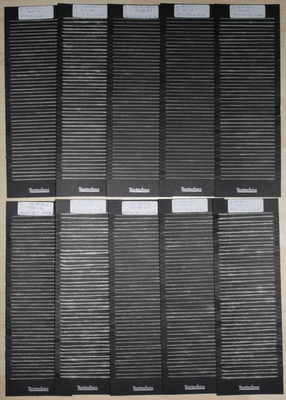
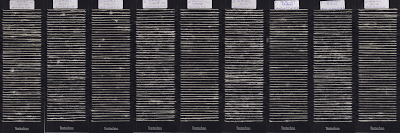
And not only have I graphs, I also have visual survey cards of all the spinner's threads. Which you already know from one of the photos I posted a while ago - but now I have them all. And they are all scanned in and available digitally.

And they are huge.


This has already been resized - generously, I might add, because it did not fit into the blog otherwise. It's Spinner C, by the way - our not too experienced spinner who delivered valuable comparison data to the experiment.
0
AUG
31
2

Can you believe it?

After weeks (or what felt like ages, at least), rainy mornings, there is actually blue sky above today. And the weather is supposed to get a bit better during the next days. Whew!

Apart from that, I'm making things like this:


which, in this case, shows the ten thread samples Spinner E spun. E's data points lie in a group underneath the trend line for wraps per 3 cm compared to tex (which compares the weight of thread per metre to its diameter, giving a hint on how tightly spun it is).

And that tells us that E spun a bit looser than most of the other spinners, and did so consistently. Incidentally, E also has a quite "flat" spinning angle, flatter than most of the other spinners. Which perfectly fits together with soft, fluffy threads.
0
AUG
23
0

Today is one of these days...

...when I'm happy to have mostly desk-based work. We spent a good part of the weekend helping a friend of ours with his move, and a lot of stuff (some of that heavy) to be carried down from a fourth-floor apartment with no elevator got me a generous measure of muscle ache.

In addition to moving help, we actually got around to take care of some odds and ends here, my current-sock-in-progress has grown a bit, and I have whittled a second thick and bulky spindle stick. I'm already very, very curious to see how that one will work for me... but for now, I'm happily settled on my chair at my desk and set to get some more info out of the spinning experiment yarns.

That said, here is a demo picture of one of the spinner's threads:

You can click it to make it huge. Top row is all Merino, bottom row is all Bergschaf, and the columns are one spindle each, so you can see how the spindles and fibres compare. And even from this small preview, you can see that there is more thick-and-thin in the Bergschaf than in the Merino - which is probably at least partly due to the preparation of the fibre as batt.

Now I only have to get the rest of the threads treated similarly and then laid out in that way and do such a photo of them all... or can somebody please find Experimental Archaeology Brownies to help with that?
0
AUG
20
0

I have been thwarted. By my own stick.

Yesterday somehow was one of those slow, feels-like-nothing-gets-done days, so I sat down in the sun to do some spinning. And what can I say, other than my spinner-self showed my scientist-self that the latter had totally underestimated the power of the spindle stick when designing the spinning experiment... but let me explain.

For the Hallstatt project, I am spinning a thread thickness that does lie below my normal don't-think-about-it, do-it-in-your-sleep thickness. It is thin enough to mean that I need to pluck out or stretch out even micro-slubs to get a smooth, good-quality thread. It's always very hard to give difficulty ratings to thread, but it is definitely not the most undemanding spin.

My favourite spindle is one that I have been using for quite a while, since before I got the spindle-stick replicas made. That means the stick is home-made, from an old cedar wood arrow, and that means it is whittled down on top and bottom, but not to a very pointy point - more like a token rounding off on top especially. (Whittling is not my forte, and I much prefer spending my time doing something I can do well.) And since I don't usually spin for production, but mostly for demonstration, I usually leave the stick in and just slide off a finished cop of wool (most often to stuff it somewhere and forget about it for a while). But I have used the whorl with the Bergen sticks too, and they generally do work for me - I'm just not using them normally.

When I went to the Wooly Week Workshop, I brought my spindle whorl, a few of the Bergen sticks, and the cedar stick (with the whorl on that). And when we started, I used the cedar stick because, well, it was already in there and handy, and I use it all the time when I demo. So I did get "spun in", if you want to say so, with the spindle on the cedar stick, which I used all week for the tests.

Fast forward to the "production phase" here. Since one of the benefits of a removable whorl is that you are able to just swap sticks and ply off the two spun-full sticks later on, I thought I'd just continue with one of the Bergen sticks. And that is where I was thwarted yesterday. I tried spinning with the Bergen stick - and the spindle runs very well, very fast with it; there is little wobble because the tip is tapering so nicely; it feels good... but I was not able to spin the correct gauge thread with it, and I got breaking thread way, way too often. Believe me, I really tried hard to spin with it, but it just would not work. Finally I switched back to my thick-tipped cedar stick, and it worked much, much better again. So what happened? What is the difference between the sticks?

Is it added weight? The Bergen stick is a bit heavier than the Cedar stick, but that is not what brought me down - during the Wooly Week, I usually had a good-sized amount of thick starter thread wound around my spindle, bringing it up to a significantly higher weight than yesterday's assembly with Bergen.

Is it changed MI? According to André Verhecken, who does research about MI in spindle whorls, the stick does not change much - and a difference of one or two grams will not change anything significant in the MI.

But something changed when I changed sticks - something significant enough to keep me from making the thread I wanted to make. And as I watched myself spinning, I found out what else had changed - the stick diameter close to the top, where I put my fingers to give spin to the spindle. Bergen tapers very slowly from an already slim shank to a slim point about 3 mm wide, while Cedar is much thicker, probably about 6 mm in diameter where I place my fingers, and tapers over a short distance only. And I got the impression that when I give twist to the thinner shank, the spindle will turn a lot faster than when I give twist to the thicker shank... which would be a considerable influence on my spinning, and which would explain why I was getting more breakage - too much spin on the thin thread.

That means that, given time and practice, I could most probably adapt to the faster-spinning spindle setup and change over to the Bergen sticks, either giving less (slower) spin to the stick or drafting faster; though for these fine, finicky threads, drafting faster is not really an option.

And it means that, because I was not aware of how much spindle stick shape can influence spinning, the stick was a variable totally left out of the experiment 2009. On the other hand, adding yet another variable to check would have been too much for one week of testing time, and of course all spindle sticks on the experiment spindles were the same - so it's possible to develop a follow-up experiment with modified spindle sticks and then continue researching into this topic with all the data we have.

And this means that my scientist-self will think about spindle sticks, and experiments, and how it could be tested, and all kinds of things like that during the hours I will spend spinning the Hallstatt threads... after I whittled myself another chunky cedar stick, that is. Because that will take a lot less time and effort for me than to learn now how to cope for the higher spin on Bergen for the Hallstatt threads. Because after all, my spinner-self is still just a lazy spinner.
0
JUN
17
2

Spinning Experiment Analysis, continued...

I am fully occupied with sorting through some stuff here, trying to stow tools and materials in a better way than before, getting my textile technique demonstration projects maintenanced and ready to show things again, plus planning for and working on some stealth projects.

And I have one non-stealth project to blog about, too: My "Fehlerschautafeln" have arrived! These are rectangular black cardstock boards with slits punched into each of the long sides. Using these slits, thread can be wound onto the card and then sits in exactly parallel lines. And then it's very easy to get an impression of how evenly spun the thread is, if it is smooth or rather fluffy on its surface, if there are any thick blobs of fibre or badly twisted bits, and so on. Now I just have to decide how to handle all the thread samples with their vastly different lengths - should I start winding about five metres in, where possible? And if yes, from the beginning or from the end? Or should I try to get the middle section of each thread? Going "x metres in" would be much easier to accomplish, but I am willing to do the "more work" approach if there is a good reason for it; however, the method has to be the same for all the samples (except the utterly short ones where I'll use an alternative method of determining where to start).
I can wind about 3,5 metres on each of the boards; most of the spinners made between 30 and 40 metres of thread during the one hour spinnng time. 3,5 metres would thus correspond to about 6 minutes of spinning time.

Now, if you spin for two hours, and there's a sample from hour one and from hour two - when in each hour would you suspect are the most representative six minutes to pick?
0
MAY
21
2

Still playing with the data.

I'm still crunching on all those numbers and will be for a while, I guess. Next item coming up will be to handle all the samples again: Spooling them back into cops from their skein-state for better handling and easier storage and measuring thread diameter as well as making an "inspection card" for each of the samples. These are cards in a contrasting colour to the thread, where the thread is wound on in parallel lines - that gives a quite good first impression on how even the thread is.

And for now, I think I need a better graph program than ol' MS Excel. Any suggestions?
0

By accepting you will be accessing a service provided by a third-party external to https://pallia.net/

Contact