Latest Comments

Guest - Katrin Sprang Discussion
18 September 2026
Hi Rachel, I have looked for more photos of you, but that was not very successful. I found a link on...
Guest - Beatrix Sprang Discussion
15 September 2026
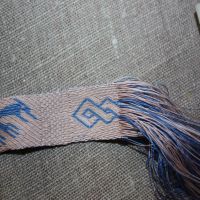
That lozenge pattern element is not a photograph, but a scan. So it should be to scale. But I pinned...
Guest - Katrin Sprang Discussion
15 September 2026
I was not referring to Rachel's reconstruction (is the reconstruction you refer to the one photograp...
Guest - Beatrix Sprang Discussion
14 September 2026
There is something Rachel did not mention. She told me: "Well, I worked with the measurements we too...
Guest - Katrin Sprang Discussion
14 September 2026
Well, this is certainly developing into an interesting discussion. Firstly, going from that lovely l...
APR
23
0

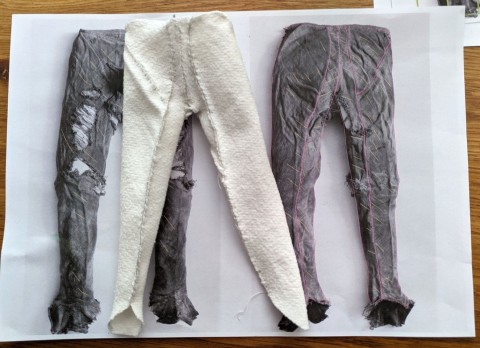
Teeny legs!

I'm not a huge fan of sized-down models for  testing garment patterns, but sometimes, well, sometimes it is not the worst idea. So it happened today - and the result is, I'd say, not that bad:

I have managed to invert sides (or would need to turn it inside out now), but overall, there's been a few insights, especially regarding the braguette. So... once all the other questions are solved, I might have a better idea of how to attach it!

(Still to crack: The "how to place it on fabric and so on" riddle.) 

0
APR
22
0

Stuff that's happening.

I got a new battery for my trusty laptop today, as the old one is, well, trying to turn itself into a soft hillside. Not good. 

Still working on the Alpirsbach riddle, where lots of the grain directions on the actual photo don't match very well with the grain directions on the pattern drawing, and where the two legs were consequently probably designed/drafted individually and slightly differently in approach. Gnah.

One single white tulip is blooming.

There is a part of the Swedish Historical Museum website that has all the documentation drawings of the Birka excavations, and you can search the list and look at the individual graves all you want. Why do I know this? Because I had to find out today, when working on a translation from German to English, whether the thing with textiles attached in grave 901 was scissors or shears. (German can do a distinction if you write Bügelschere instead of Schere, but the latter can mean both, so unless there's an explicit Bügelschere, you never know. It was shears in the grave, by the way.) This translation issue reminded me of a friend's explanation why so many of the automatic translation programmes have issues with genders: Because it's much easier to have just one dataset for each language that goes to English and back, and to translate from, say, Finnish to Suaheli, you'd go Finnish - English - Suaheli. Which gets you odd effects if you are translating from a language with a certain distinction between things to English where this is lacking and back to another language that would in theory mirror the original distinction, but now it won't because the information got lost in the intermediate step. 

0
APR
20
5

Surprisingly (well, not really) complex...

So. There's still pondering taking place regarding the Alpirsbach trousers  legwear... because, well, my way of thinking.

The task is to make a reproduction of the trousers for an exhibition, which technically means that I could take the pattern published after the examination of the trousers garment, read the description, enlarge the pattern and then cut exactly that. But that, to me, would be sort of... cheating. I would much prefer to understand how the pattern was constructed originally, then re-do that construction process, and make the trousers with that re-done pattern.

Which, in turn, means that I have to understand the pattern. Not just which body measurement is found where in the thing, or where which part goes to sit on the body, or which bits to measure, or how much seam allowances to add to a given part, but also how to place the thing onto the fabric.

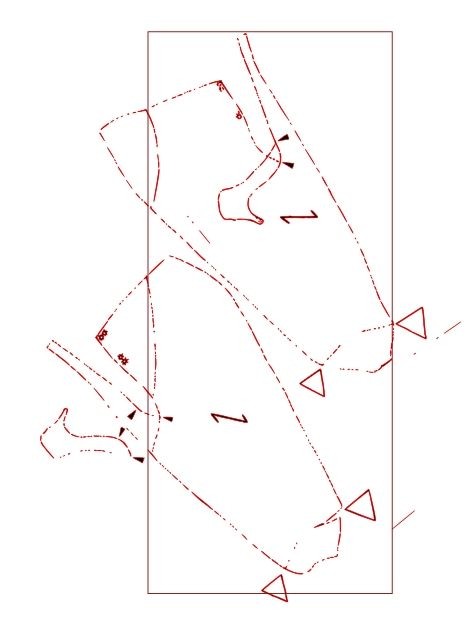
You see, in the original there's two main parts, and they look quite similar but they have different bits tacked on due to the fabric width not being enough to cut everything in one piece. My current hypothesis is that one leg was constructed first, cut out, flipped over, placed on the fabric and traced to make the second leg. For this, the (to me) logical choice would be to cut the right leg first, as this has only a small bit on the butt added in, and all the relevant long measurements are fully on the fabric.

It would look like this, laid out:

Pattern after Ilse Fingerlin.

Some of the bits are very clear (there's a crotch middle spot, and the butt strip, and the foot part, and the thigh circumference), but the exact shape of the crotch cutout is a lot smaller and more pointed than a lot of the re-creation patterns of joined hose that I have found in other places.  So... is this correct? Will this work? How to reliably construct it?

Questions over questions. It does remain interesting, I can say!

0
APR
13
0

Weekend Over.

Is it really Monday already? 

But on the other hand, the weekend saw some nice hanging out, some bouldering, making a new batch of cat food so the furry lady can munch on something different, and some painting of miniatures. Which (the minis) will be seeing the gameboard this evening, if all goes according to plan!

The weekend also included some more puzzling over the Alpirsbach thing making, and I did get some helpful hints from Beatrix Nutz. Including the hint that they should not be called "trousers" but "hose" or, even better, "joined hose".

Eh. Terminology. I do like to complain about textile terminology and its many, many pitfalls and dark corners and its general horrible unreliableness, so it's good to see that at least there's reasons for my complaining! (In Middle High German, "hosen" would be the hose, too, but in modern German they are called "Beinling" and the full garment with everything covered and everything sewn together would be "Hose", in the singular, so of course I was assuming that English would handle it the same way and "trousers" are the full thing while "hose" are the Beinling equivalent. There you go.) 

0
APR
09
0

Trouser Ponderings.

I've been wondering in the back of my brain for most of the night, since looking at the Alpirsbach pattern yesterday: How would it have been constructed?

You see, the pattern, as published in Fingerlin, I., 2001. Textil- und Lederfunde, in: Landesdenkmalamt Baden-Württemberg (Ed.), Alpirsbach. Zur Geschichte von Kloster und Stadt, Theiss, Stuttgart, pp. 715-818 on p. 737 looks like this:

The whole thing is placed at an angle onto the fabric, as indicated by the little arrows - so you can use the elasticity on the bias to make everything work better.

So far, so good. But... we're in the late 15th, early 16th century here. There's definitely no Burda-style patterns made from paper, and the thing is not lined, so you can't use the lining for construction. Which leads me to the question, as always when looking at garments from medieval times: How do you construct this? Which measurements do you take, and how do you transfer them to the fabric to cut out your thing, especially since there's bits not cut in one piece due to the fabric width?

Of course you can construct one leg first and then use that as template for the other one. But in this case, which one do you do first, the one with the bits of the front and the back strip cut extra, or the one with the solid bit of the ass part cut extra? 

Questions over questions. First step for trying to solve them is printing out the thing and marking it up with all the known bits - which pieces are definitely the same length, which bit correlates to a known body measurement, how are the warp and weft aligned in the extra bits. Which is exactly what I am going to do today, in a bout of slightly brain-bending fun!

0
APR
07
0

Exciting things...

Easter has not only brought some time with family and plenty of eggs (both the coloured-shell chicken version and the chocolate version), but also some more prep for the exciting trouser project to come.

The trouser find from Alpirsbach, most probably dating to the late 15th or very early 16th century, is rather well-known for being, well, one of a kind. The fabric was a linen 2/1 twill, which is unusual by itself. The cut though very nicely corresponds to trousers shown on artwork from the same period. You can see an image of the find here (on a German page).

I'm currently working on a request of a museum to have a reconstruction of the piece, with the feet parts on. First problem was to research the fabric and figure out if there's someone who can weave it, and I'm very happy that Marie Ekstedt Bjersing is now going to take on that challenge, as the fabric is quite unique as well - not only because of the binding, but also having a thin warp and a comparatively very thick weft.

My task will be to make the fabric into a garment, and as I'm writing this, some modern, machine-made fabric is hanging outside to dry so I can do a test run in order to understand the pattern correctly before I'm cutting into the good stuff.

So. Exciting things. 

0
AUG
20
0

Corded Skirt Progress...

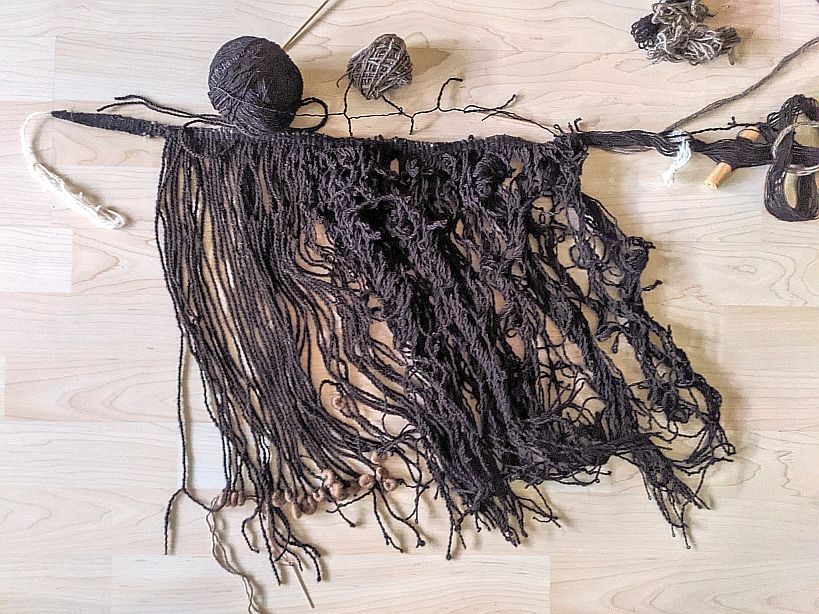
So how far did I get on the skirt during the weekend? Here's the progress pic: 

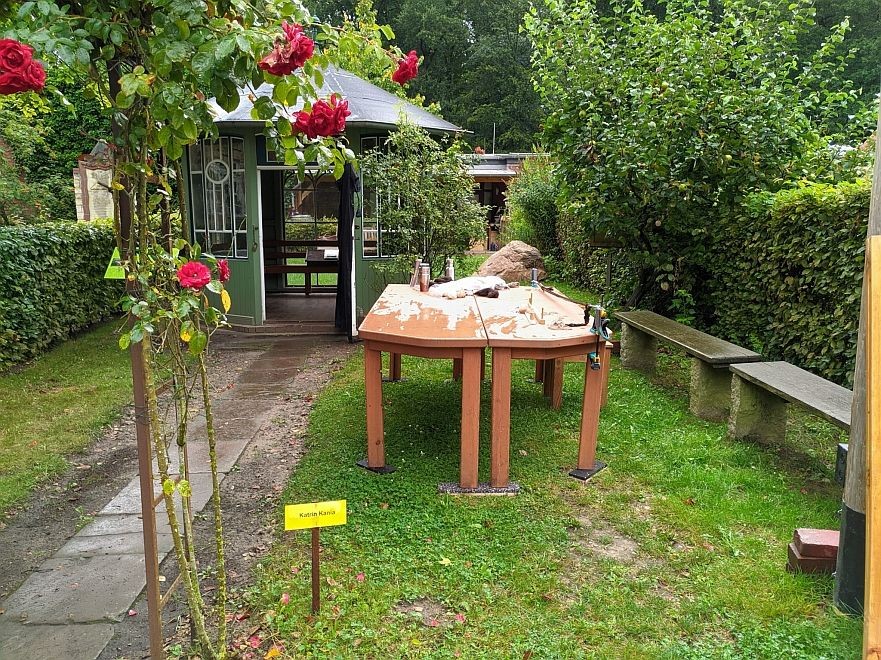
I had about 5 cm of the starting part woven, so weaving in the extra cord for holding the loops was done on site - and all the weaving that follows, and the cording, and the ring-making. The pic makes it very obvious that the cording and ring-making take more time than the weaving, and hence the rather great reserve of un-corded loops. This, by the way, was my workplace: 

I swapped the setup around after that image, so that I was facing the other way - this would have sat me with my back to the main path, and thus to the public. The other way around I had a nice view on the horse showing Bronze Age tack and on the musician explaning (and playing) his instruments, and the fisherman with all his nets and hooks and things. 

And as usual I have no pictures from during the day, as I completely forgot or was too busy explaining and working. I didn't get to have a nice stroll around to take pics of the other stations either, so no images from there. The curse of the soloists! 

0

By accepting you will be accessing a service provided by a third-party external to https://pallia.net/

Contact