
Latest Comments

Guest - Katrin Sprang Discussion
18 September 2026
Hi Rachel, I have looked for more photos of you, but that was not very successful. I found a link on...
Guest - Beatrix Sprang Discussion
15 September 2026
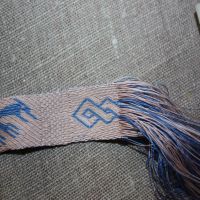
That lozenge pattern element is not a photograph, but a scan. So it should be to scale. But I pinned...
Guest - Katrin Sprang Discussion
15 September 2026
I was not referring to Rachel's reconstruction (is the reconstruction you refer to the one photograp...
Guest - Beatrix Sprang Discussion
14 September 2026
There is something Rachel did not mention. She told me: "Well, I worked with the measurements we too...
Guest - Katrin Sprang Discussion
14 September 2026
Well, this is certainly developing into an interesting discussion. Firstly, going from that lovely l...
AUG
19
0

Back home...

I'm back from the weekend doing corded skirt weaving, and a little more tired than I'd hoped for - thanks to the new sleeper trains with their single cabins, which are in theory very nice, but have a rather hard mattress, too firm for my taste. So I didn't sleep too well, and then at a little past four suddenly the light was on in my cabin, and then I had to get up in time to leave the train quite early, so altogether I arrived here already looking forward to a nap.

It was a lovely weekend, even though the weather was a little more rainy than the forecast had predicted. For a little while on Sunday, I thus had to take shelter in the 19th century garden pavillion together with my weaving, but the rest of the time, it was at most a very, very light drizzle, so that was fine. The wool was a bit miffed by the high moisture content in the air, though, and stuck some more than usual. 

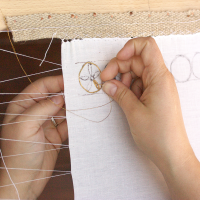
Apart from this, I can only complain about being so busy explaining that I didn't get away from my place all day, so there was no time to stroll around and visit the colleagues. The visitors stopping by were very interested, and I got a good chunk of weaving done showing how a corded skirt is made. (It's far from being finished, of course - I'd need a few weeks of demo-ing for that.)

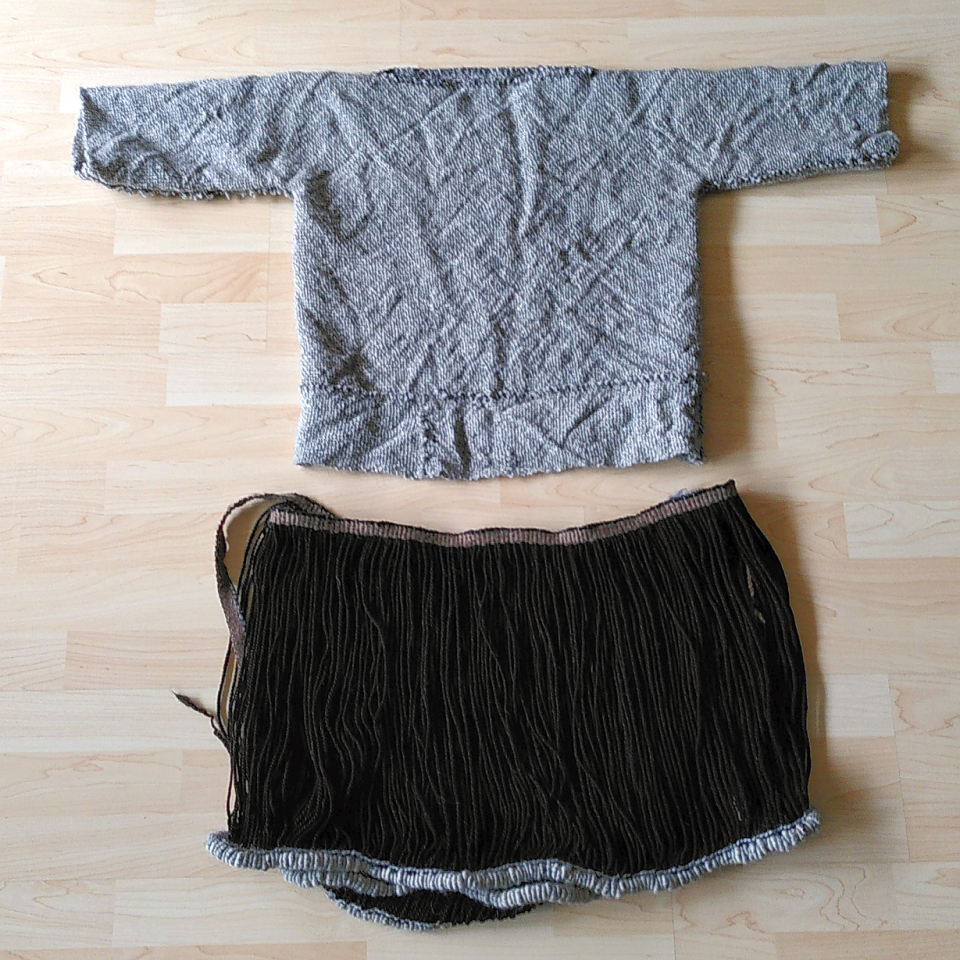
I also got to hang out with the full skirt I made for the museum again, and it was such a nice moment to lift it out of the box and hold it again. For explanatory and demonstration purposes, I also wrapped myself in it a lot of times. It does not fit me correctly - the Egtved girl was of a slighter build - but where it was lying in double layer as intended, the movement of the cords is really fascinating. Yes, they shift and they can fall apart when moving, but they fall apart on top of the leg, and more or less flow together in the lower (or should I say the nether?) regions. 

It's a really fascinating garment, and I had a lot of nice discussions about it, both with visitors and with some colleagues stopping by. A very nice weekend indeed, and I hope it will get a repetition some day!

0
MAR
01
0

The Syke Presentation is Online.

If you'd like to watch the presentation I gave in Syke - here you go! It's all in German (sorry English-only speaking readers).

It wasn't possible to do a livestream, but I'm delighted that there was the possibility to make a recording, and put that online. I hope you'll enjoy it - I certainly did!

0
FEB
15
0

Tassel Threads.

I'm still working (of course) on the presentation for Syke, and it's really nice to revisit all the things that went on in that project. As usual, I'll have to cut some (or what feels like a lot, actually) of the things I'm putting into the draft of the presentation. There's so much that I could probably speak about it for half a day...

One nice thing about looking back on a project like this is that it's easy to remember all the fun bits and sort-of-forget about the annoying ones. At some stages, things just felt like they would never ever end... it was a lot of cords, and a lot of rings for the ends of the cords, and a lot of loops to sew onto the cloak. But it did end, eventually.

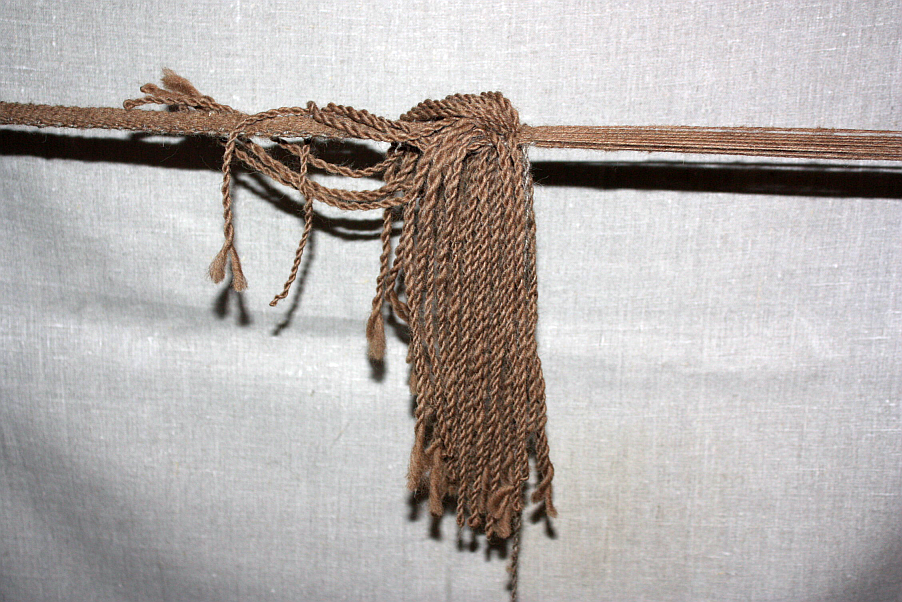
And because I've been revisiting pictures, here's one for you from the selection going into the presentation.

This is the end of the belt reproduction from the Egtved find. It has a tassel at the end, formed by cords finished in (you guessed it) rings. These rings are then gathered together so the whole thing forms a cone shape - surprisingly stiff, and quite stunning. The puny number of just 20 warp threads would, of course, not be enough for a nicely sized tassel like that, so the weaver solved the problem by adding in some more cords at the end of the belt weave. That's exactly what can be seen in this photo: The extra threads inserted, and there's already a few more wefts done to keep them in place.

After finishing the belt weaving, they were then corded, and then the belt provided me with the opportunity to get into ring-wrapping... but that's another story.

0
OCT
25
0

More on the Cloak.

With all the many things going on, I never got around to posting a photo of the Trindhoj cloak after sewing on the many, many, MANY loops of thread.

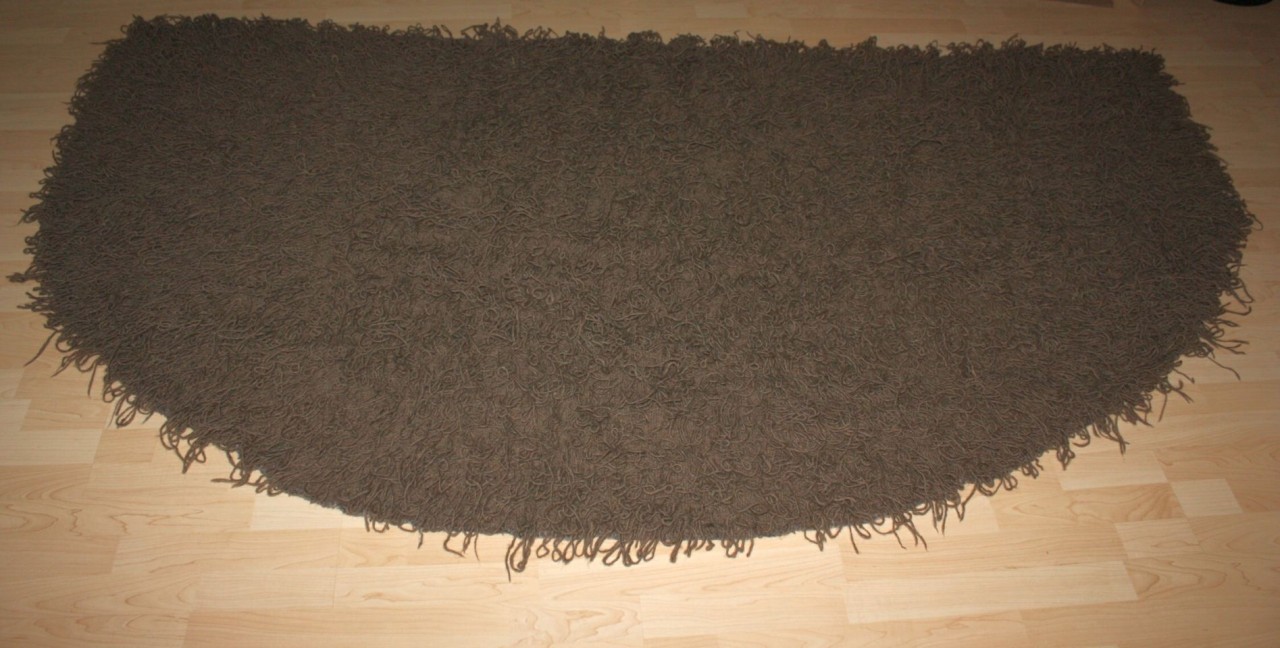
Did I mention there were a lot of them? There were a lot of them. The cloak is rather large, with about 3 m width along the straight edge, and it is all over covered with these loops. Oops. (Sorry. I still get a little silly when I am reminded of all the loopy stitiching.)

The original cloak shows the remainder of stitched- on threads, spaced apart but not very widely spaced. There's not too much left, and it's not described in detail in Hald's publication, so I mostly went by the image available from the Danish National Museum website and some photos I was sent by a colleague. 

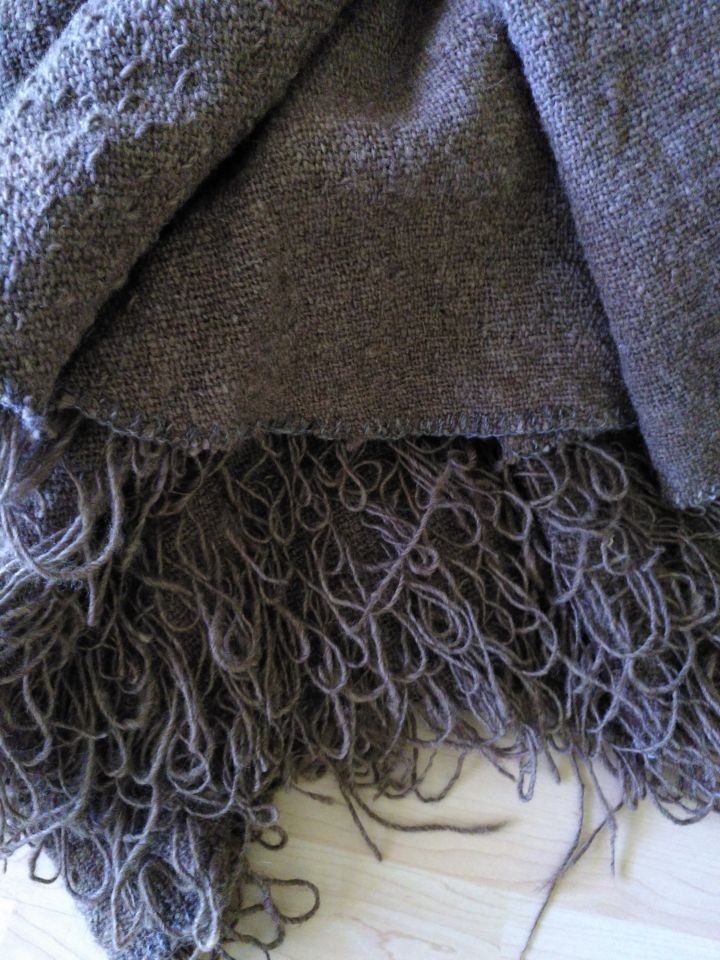
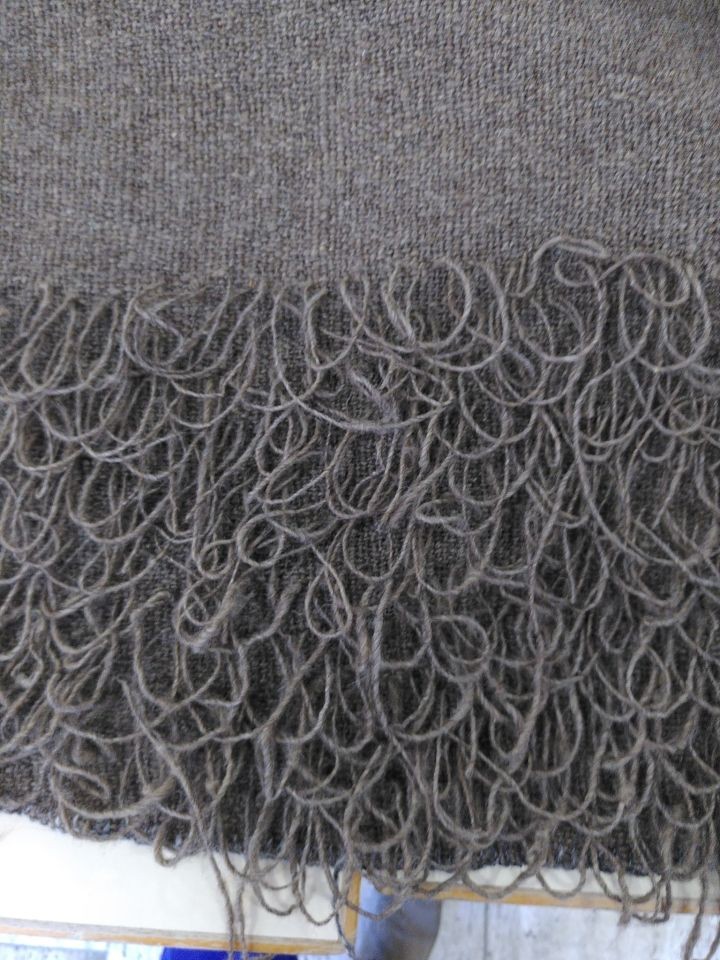
Because there's only bits of the threads next to the stitches left, we don't know if they were loops, or individual threads, and we also don't know how long they were. I wound the thread around my hand when stitching to have a similar length for all of them, and to have the loops long enough to overlap the next row below.

A test piece that I made, with loops cut open and loops left closed, looked quite differently after washing in the two parts. The opened loops had acted like you could expect of single yarns and fluffed up considerably, but also lost a good bit of their twist, so they seem quite vulnerable to wear and tear to me. The loops that had remained closed had mostly plied together, keeping the individual loops stable.

The photo above shows the cloak after finishing the sewing work, but before its final bath. It looks a bit like one of those shaggy carpets that were in fashion a few decades ago... 

It's also, not-really-surprisingly-but-still-surprisingly heavy. Unfortunately I completely forgot that it might be interesting to weigh it before and after stitching all those loops, but I used up almost all of the extra yarn that I had spun, which was a generous amount, and it's quite heavy now. It will settle nicely on shoulders, though, and I can absolutely imagine somebody showing off his (or her, maybe, though this item was found in a male grave) riches.

It is a lot of spinning time and a lot of weaving time that went into this piece, and then a lot of stitching time as well. We know from weft crossings in the original that several weavers worked on this together, and I can well imagine that several spinners worked on the yarn for this (or one spinner for quite a good bit of time).

0
JUN
15
5

Loop Stitching.

Sometimes, when chatting about work in historical/medieval/prehistoric times, especially the very time-consuming textile work, somebody says "ah, well, but they did have more time back then". 

Did they, though? 

My usual answer to this comment is that back in history, days also only had 24 hours each. Not all of these hours were light, and there was less artificial lighting available than we're used to today, both in quality and in quantity. Some of the dark hours were, of course, spent sleeping - so let's just say, for simplicity's sake, that after 8 hours of sleep, there's 16 hours of time left to do things.

To do... all kinds of things. Especially those that were directly connected to sustaining yourself in some way, either by farming directly or by doing some other work to earn money to buy the things you'd need, or a mixture of both. Sounds familiar? Because that is, basically, what we're still doing today.

So depending on what your work is and how long it takes, you might have resources left over to spend on luxury goods in the wider sense, or you might not. That, again, is something that remains the same no matter what era we're in. There's people who have more resources and people who have less, and those with more resources can invest them in stuff that serves as status symbol, and those who don't... they have to make choices.

Time-consuming manufacture of things means that you either have the surplus time yourself and can spend it on making something fancy, or you have the money (or bartering means) to buy somebody else's time. If the rest of your social environment knows the worth of the item made, it can serve as a status symbol. (That won't work if you get something very pricey and fancy but nobody can appreciate it, because it's not common knowledge. A very fine hand-knit sweater would take a lot of time, but most people won't realise that when you pass them on the street - something like a fancy designer hand-bag, though, would be more widely recognisable.)

I am a firm believer that "back then", people did not have so much more time than we do have now. They'd also have had distractions, and days when things did not go as planned, and they'd have hung out with friends and family in their leisure time and not worked all the time on something. (Well, not more than modern people do.) That is also what I try to explain when the comment comes up.

Sometimes, though, I feel like going "oh my goodness, someone had waaaay too much time", too. Like now, when I am doing the stitching for the pile on the reconstruction of the Trindhøj cloak.

That is a lot of stitching. A LOT. 

Don't get me wrong, it's a quite nice task, and each single stitch goes rather quickly, but a lot of quick actions will still take a long time. I also hope that the yarn I spun will be enough, and I won't run out before I finish the loops.

Maybe it helps to work faster? So I'm finished before the yarn realises that it's not enough?  

1
JUN
02
0

More Bronze Age Stuff.

There is still some Bronze Age stuff going on - stitching, to be precise.

Because, well, after the Egtved things have been all wrapped up (and literally wrapped up and sent off to the museum), work went on with the men's garments, modeled after the find from Trindhøj. 

One of the pieces is a cloak, shaped like a half-oval. That, by itself, does not sound very spectacular. However, what makes it spectacular is both the size of the woven fabric. The cloak is approximately 126 cm long and 243 cm wide, and it's cut out, so the minimum size of the woven fabric must have been larger still.

The other thing making it special and rather spectacular? It was finished with a sewn-on pile made from yarns. And this is what I'm working on right now:

It's rather pleasant work and each stitch does not take very long, but it's a large piece, and I am not yet at the thirdway point, according to my estimates. So... more stitching to do.

Also, there's several things that itch me in this: Because there's not much left of the pile, it's hard to tell how dense it was, how long the individual pile threads were, and if they were loops or cut open after being sewn on. There's also no good documentation or analysis of the stitch used to apply them that I could find. Which means I'm sort of making it up as I go along - or, in other words, I've tried around a bit after orienting myself after the reconstruction attempts done before, and analysis of another stitch used for pile, and found a process that feels good to me. Which I'm now sticking with.

All this is, again, a nice example of how one may have the impression that everything is known about a given textile... but once you start to re-create it, all the small and large gaps in our knowledge emerge. It's fascinating, and it's humbling, and it's always, always the case.

0
MAY
06
0

Egtved Update.

Here's a little bit more about the Egtved project - which is sort-of-half finished now. Sort-of-half because there are the men's garments to be finished, and they might be more than half the complete work time altogether. I strongly suspect that, actually. (I also should probably get them their own tag, as it's not Egtved but Trindhøj, and it would be a little weird to list them under Egtved.)

So... the blouse is finished, and with that, the whole set of garments is ready to be photographed for a final documentation, then packed up and sent off to the museum. It's been very interesting to sew that blouse, and it's also interesting to wear (because of course I tried it on...)

I had gotten all ready to cut the piece, with the measurements taken off the Egtved documentation, and then that nagging feeling got the better of me, and I cut and sewed a mock-up first, using the original measurements. Turns out it was a good thing I did, because the Egtved girl was just that: a girl, aged 16 to 18 years according to estimates from her dental status. Meaning that she was not so tall, and also must have been quite slender, appropriate to her age. 

She's estimated to have been 160 cm tall, and I am 163 cm. I can just fit into the mock-up blouse, though it takes a bit of wiggling to get in, and it's not wide enough to comfortably fit me, especially since my breast circumference is a bit more than the approximately 86 or so cm the original has. (It will squeeze in, as breasts are squishy to a good extent, but it's not really fitting well that way.)

That means the piece would not be wearable or try-on-able for a lot of people... and comparing it to the two other finds of similar blouses, the one from Egtved is by far the smallest. The other two have about 98 cm circumference in the torso part. So after checking back with the museum, we decided on using the Skrydstrup measurements as basis for the piece, making it large enough to fit a German size 42, approximately. I stayed with the slit-like neck opening, though.

The wool is somewhere between soft and scratchy to me, and that is also how the fabric feels when worn on the skin. When I was younger, I used to wear wool sweaters from Iceland on bare skin, though I might be somewhat, um, hardened against scratchy stuff. I'm also quite able to ignore a bit of scratchy feeling. What I'm not able to ignore is a neck opening that is close to the front of my neck, I find that really uncomfortable and irritating, so that would be one reason for me, personally, to not wanting to wear the blouse for an extended amount of time. (Or, if it were mine, I'd just make the neck opening a little bit deeper in the front.)

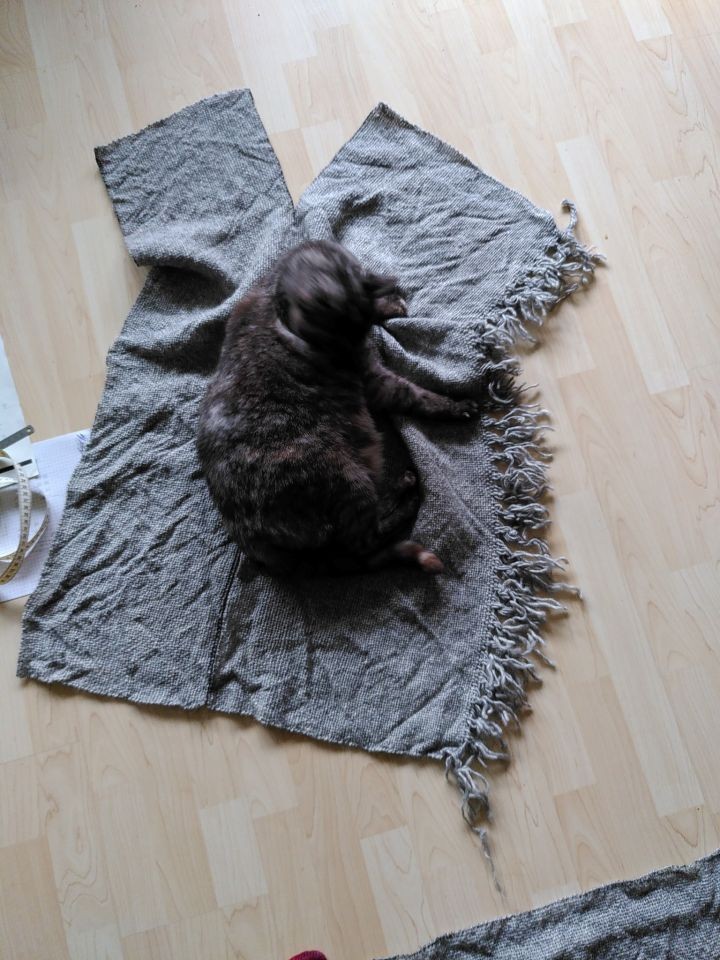
Of course there was assistance provided when I was cutting the fabric...

Sewing the garment was an interesting experience. The seams, according to documentation by Hald and Broholm, were about 1 cm wide, with the two layers of fabric simply overlapping and whip-stitched together from both sides. Now we only have a few threads per cm here, about 3 to maybe 4... which is not much to anchor stitching. 

I solved this problem by stitching through the threads of the fabric instead of between them, which was easy to do with these large and relatively soft yarns. Made like this, the seams feel reliably sturdy. 

Sewing the blouse was overall also the part that took least time - spinning the yarns, weaving the fabric, weaving the skirt, these all took a lot longer than the actual cutting (not much) and stitching.

Overall, I'm rather happy with all of this - even though, like always, there are quite a few compromises that had to be made...

0

By accepting you will be accessing a service provided by a third-party external to https://pallia.net/

Contact