Latest Comments

Guest - Katrin Sprang Discussion
18 September 2026
Hi Rachel, I have looked for more photos of you, but that was not very successful. I found a link on...
Guest - Beatrix Sprang Discussion
15 September 2026
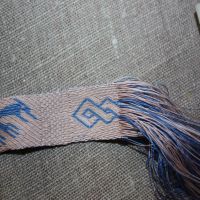
That lozenge pattern element is not a photograph, but a scan. So it should be to scale. But I pinned...
Guest - Katrin Sprang Discussion
15 September 2026
I was not referring to Rachel's reconstruction (is the reconstruction you refer to the one photograp...
Guest - Beatrix Sprang Discussion
14 September 2026
There is something Rachel did not mention. She told me: "Well, I worked with the measurements we too...
Guest - Katrin Sprang Discussion
14 September 2026
Well, this is certainly developing into an interesting discussion. Firstly, going from that lovely l...
DEC
03
0

Egtved Progress.

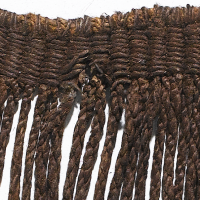
Another week has flown past - but yes, there is some progress. Apart from some more spinning, the weaving bit of the corded skirt is finally finished, after a bit of a hiatus. But there's just so much spinning that I can comfortably do in a day...


So the corded part is woven. I had to spin a bit more after all, as there'll be some takeup when I'll be wet-finishing, and I only did the maths after spinning... of course. Duh. The corded bit is followed by a bit of plain band, which is also done, and the final finish is a braided bit. The latter might get slimmer in the original, so I'm planning to possibly un-braid again and finish it properly when I'm nearer the completion of the whole piece. For now, there is more cording to do; after that, I'm planning to give the whole thing its nice warm bath, then finish off the cords with the rings.

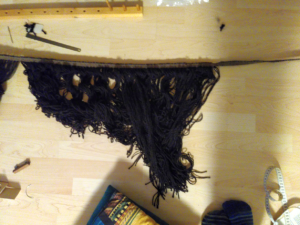
The bit you see in the picture, by the way, is all the two-ply loops drawn through that are waiting to be corded. Lots and lots of twisting coming up!
0
DEC
01
0

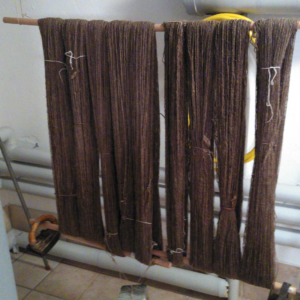
Drying!

A bunch of skeins is hanging out in the cellar, where it's nice and warm, and they are all drying. Actually they are almost dry - but I prefer to be really sure and leave them a little longer, if I can, than take them off sooner.


This is a little more than 2.5 km of yarn. I'm wet-finishing the skeins - soaking them in hot tap water (which has about 60° C here) for about 20 minutes, then stretching each skein, then hanging them to dry with a bit of weight to keep the yarn slightly stretched. It's not a lot of tension they are under, just enough to hold the yarns more or less straight.

I've marked each skein with a number, corresponding to the sequence they were spun in - and I'm very, very curious now to find out if the yardage has changed with the wet finish. Soon. As soon as they are completely dry...
0
NOV
24
0

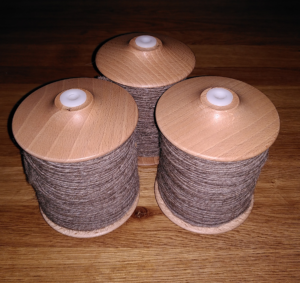
...three more are done...

Here I am, with some more spinning done, and another three bobbins full.


Well, by now they have been emptied and partially re-filled. I also found out that my estimate of how much needs to be spun was a considerable amount lower than the final estimate is, after doing a test weave sample. It's the Law of Reconstructions and Reproductions, it seems, that if one mis-estimates anything, it's always a mis-estimate towards lower, quicker, easier, or cheaper than it turns out to be in the end.

Soon there will be a stack of skeins large enough that it will be time to draw a hot bath for them, and give them their settling soak. I've marked every skein with its number in the spinning sequence, so I can label them once they are dried - with the length in metres, the weight and grist. That will hopefully help to see how consistent the yarn is.

I'm also thinking about doing at least a partly re-skeining after washing and drying the yarn, to see if there's shrinkage. If so, I'd need to adjust the amount of yarn spun so it doesn't run out before the fabric is finished...
0
NOV
18
1

No Comment Necessary.

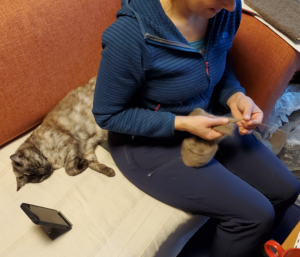
I think there's not much of a comment necessary, the picture says it all:


This, dear friends, is really pleasant work in a pleasant place with very nice and butt-warming pleasant company. And a nice podcast to boot.
0
NOV
17
3

It adds up.

Calculations for the fabric that I'm currently spinning for are finished, and, well, what shall I say? Those bronze age fabrics are... big. BIG.

Which, consequently, means that even though they only have a few threads per centimetre (around 4, overall), they do add up. Which means there's a lot more spinning to do until I'm finished. Overall yarn requirement for the piece of fabric needed to make the Trindhoj find man's garments, consisting of some kind of wraparound tunic and a half-oval cloak, is about... 5700 metres. Plus a bit of wiggle room.

Even spinning quite quickly, and winding into hanks quickly, and wet-finishing several skeins at once (which is taking a lot less time than doing them one by one), that eats up a hunk of hours. So if you're looking for me, I'll be at my spinning place... making yarn. In very nice cat company.

Have you measured your production spinning speeds? If so, I'd love to hear about how much you spin in an hour.

If you haven't done it yet, but are curious - my recommendation is to use a stopwatch, and spin over several hours before measuring. Doing just half an hour or one hour can result in quite different speeds than production over more hours. (Don't ask me how I know...) Note down how long you were spinning for the sessions if your stopwatch tends to eat the current time (I have one that will turn itself off after a while, and then the numbers are gone.) For measuring, find out the circumference of your skeiner and count the rotations.

Then do the metres spun by hours division, and voilà, you have your production speed number for this yarn type and thickness with this tool and this type of fibre... which might be quite different from a different yarn. Which, I find, makes spinning an even more interesting thing!
0
NOV
12
0

Back to Spinning Work.

After doing a bit of spinning in teaching context, properly medieval with distaff and hand-spindle, I'm back to spinning with the slightly more modern method...

First task of the morning was using up the remaining small bit of weft thread for the corded skirt that I had on the spool, and afterwards spinning the last bit of yarn that will be necessary to finish weaving. That, as always, was done by guesstimating how much yarn I'd need and how long it would take me to spin according to my more-or-less known spinning speed for that kind of yarn, and then spinning the guesstimated time.

And afterwards, there was more spinning straight on - for the warp threads for the first of the woven items. Our test weave turned out with a bit too many warp threads per 10 cm, so I'm aiming to spin just a little bit thicker this time around... and hope fervently that it will be the right amount of extra thickness.

Spinning for a reconstruction is always a little bit nerve-wracking for me. There's lots and lots of yarn to be spun, and there's always a little bit of danger to slowly, gradually, unnoticedly (that should totally be a word) segue from the yarn that has the intended thickness, amount of twist, and regularity into a yarn that is just a little off, and then maybe even more off. That's why I do rather frequent stops to check if I'm still in the range, and typically have a "comparison yarn" put up and nicely visible at my spinning workplace.

Apart from that, spinning is a very pleasant job, and I thoroughly enjoy it. Which is a good thing, because for making fabric for garments, a lot of spinning is necessary!
0
NOV
09
4

Modern Tools For Reconstruction Work?

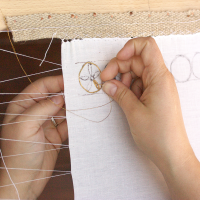
Following up on the cording and cording tool use discussion - here's a few thoughts about modern tool use for reproducing ancient or old things.

In an ideal world, if you're doing a reconstruction, everything would be as it was in the original - same materials, same processes, same tools. However, that is usually not possible - due to a number of reasons.

Sometimes, getting materials that correspond to the original material is not possible. That is especially the case when working with plant or animal materials that have been undergoing selective breeding for a few hundreds, or thousands, of years since the original item was made. You don't get the medieval varieties of food crops these days anymore (maybe with a few very rare exceptions), and if we're looking at animal materials, whether bone from cattle or wool from sheep, there's been a huge lot of change as well. So compromises may be necessary starting with the material, which will, of course, have an influence on the finished piece.

Using the original tools and processes is the next part that can turn out to be more difficult than one thinks at first. First obstacle is that we often don't know how, exactly, something was made. With a lot of textile work it's possible to use different processes and different tools to arrive at the exact same outcome. You will not be able to tell whether a yarn was spun on a spindle or on a more modern spinning wheel if the spinner takes care to match the properties of the original thread, for example. Same thing applies for a woven fabric - if there's no tell-tale things like a starting border, how could a bit of fabric let you know what loom type it was woven on?

For purposes of research and experiential archaeology (and in some cases, if there's a question to answer and the setup is done accordingly, even experimental archaeology), it would of course be preferable to use tools and processes that are known for the period the original item comes from. However... when a reproduction is commissioned, there is often a limit to the amount of time available before the thing has to be finished, and - even more important - there is also a limit to the amount of money that can be spent on a single item. Both these constraints will make speeding the whole thing up a very attractive, or very necessary, thing.

So while I enjoy working with old methods and reconstructed tools, personally, I have no problem whatsoever with using modern gadgets for my reproduction work if there will be no perceivable difference in the end product. Using an e-spinner for making yarns, or a modern cording tool for making cords, or a treadle loom instead of a warp-weighted one for weaving plain fabrics, these are all things that can still result in a reproduction that is as close as possible to the original while cutting down on costs a lot. And I personally do prefer to make these compromises in the process to make repros more affordable, thus getting more of them out into the world, for people to see and touch and experience, than having a "perfect" replica made once in a blue moon.

Though if you should know of someone wanting to have something made using all old reconstructed methods only - do send them my way, I'd be happy to be part of such a project, too!

 
0

By accepting you will be accessing a service provided by a third-party external to https://pallia.net/

Contact