

Latest Comments

Guest - Katrin Sprang Discussion
18 September 2026
Hi Rachel, I have looked for more photos of you, but that was not very successful. I found a link on...
Guest - Beatrix Sprang Discussion
15 September 2026
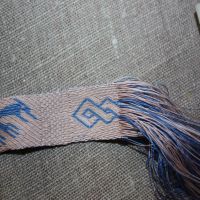
That lozenge pattern element is not a photograph, but a scan. So it should be to scale. But I pinned...
Guest - Katrin Sprang Discussion
15 September 2026
I was not referring to Rachel's reconstruction (is the reconstruction you refer to the one photograp...
Guest - Beatrix Sprang Discussion
14 September 2026
There is something Rachel did not mention. She told me: "Well, I worked with the measurements we too...
Guest - Katrin Sprang Discussion
14 September 2026
Well, this is certainly developing into an interesting discussion. Firstly, going from that lovely l...
SEP
02
0

Sprint to the finish.

I'm packing my paper presentation with nice colourful graphs now (and videos! I've been making screenshot videos to "leaf" through the different spinners), and I'm faced with the typical problem of somebody having stared at one set of data for a long time:

Do I present everything that everybody needs to know, or am I leaving out a too-large chunk at the beginning? Is it possible for others to see the things in the graphs I show that I see, or do I see the things because I have looked at other graphs before that made it clearer? And can I explain the sometimes rather complex graphs well enough so that they are legible and understandable?

We'll all know in a little less than a week. Or at least I will know, and then let you know on the blog. For now... I will go play with colourful graphs a little more. Pasting them into Powerpoint. Hoping that the video-stuff will work during presentation as well.
0
SEP
01
1

Can I have chocolate? Please?

Unfortunately, I think we consumed the rest of our chocolate yesterday while looking at graphs and fiddling with axis setups (the most patient man of them all and myself). Good chocolate. Good graphs.

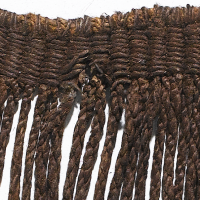
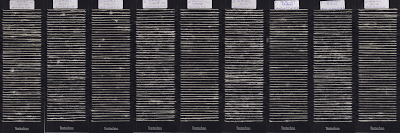
And not only have I graphs, I also have visual survey cards of all the spinner's threads. Which you already know from one of the photos I posted a while ago - but now I have them all. And they are all scanned in and available digitally.

And they are huge.


This has already been resized - generously, I might add, because it did not fit into the blog otherwise. It's Spinner C, by the way - our not too experienced spinner who delivered valuable comparison data to the experiment.
0
AUG
31
2

Can you believe it?

After weeks (or what felt like ages, at least), rainy mornings, there is actually blue sky above today. And the weather is supposed to get a bit better during the next days. Whew!

Apart from that, I'm making things like this:


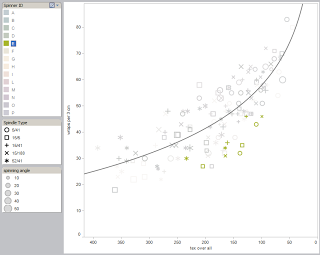
which, in this case, shows the ten thread samples Spinner E spun. E's data points lie in a group underneath the trend line for wraps per 3 cm compared to tex (which compares the weight of thread per metre to its diameter, giving a hint on how tightly spun it is).

And that tells us that E spun a bit looser than most of the other spinners, and did so consistently. Incidentally, E also has a quite "flat" spinning angle, flatter than most of the other spinners. Which perfectly fits together with soft, fluffy threads.
0
AUG
25
0

It's the sprint to the finish.

Now at last the finish line is in sight - if things go smoothly today, the Forum Experiment analysis (the hands-on part of it, that is) will get finished.

I'm already looking forward to squeezing results out of all that data. A few steps of the documentation are still left to do, though - like scanning all the visual survey cards so that they are available for presentations and easy on-screen comparison, and reading out the spinning angle on most of the samples, but the worst and most time-consuming part will be dealt with. And in good time, since I will do a presentation of the results at Textile Forum.

In other news: Some of you might remember Hartenstein and the two knights for the exhibition there. There's something more for that museum in the air... and I'm already looking forward to lots of fun and a heap of work. Stay tuned to read more about it once details are emerging from the project!
0
JUN
17
2

Spinning Experiment Analysis, continued...

I am fully occupied with sorting through some stuff here, trying to stow tools and materials in a better way than before, getting my textile technique demonstration projects maintenanced and ready to show things again, plus planning for and working on some stealth projects.

And I have one non-stealth project to blog about, too: My "Fehlerschautafeln" have arrived! These are rectangular black cardstock boards with slits punched into each of the long sides. Using these slits, thread can be wound onto the card and then sits in exactly parallel lines. And then it's very easy to get an impression of how evenly spun the thread is, if it is smooth or rather fluffy on its surface, if there are any thick blobs of fibre or badly twisted bits, and so on. Now I just have to decide how to handle all the thread samples with their vastly different lengths - should I start winding about five metres in, where possible? And if yes, from the beginning or from the end? Or should I try to get the middle section of each thread? Going "x metres in" would be much easier to accomplish, but I am willing to do the "more work" approach if there is a good reason for it; however, the method has to be the same for all the samples (except the utterly short ones where I'll use an alternative method of determining where to start).
I can wind about 3,5 metres on each of the boards; most of the spinners made between 30 and 40 metres of thread during the one hour spinnng time. 3,5 metres would thus correspond to about 6 minutes of spinning time.

Now, if you spin for two hours, and there's a sample from hour one and from hour two - when in each hour would you suspect are the most representative six minutes to pick?
0
JUN
01
3

Textile Forum News

The programme and workshop programme for the Textile Forum 2010 are finally finished, and we are happy to present a very varied and interesting week. Topics for workshops range from Stone-Age Twining Techniques to Norwegian Twined Knitting and from Estonian One-Piece Shoes to Filet Netting - many fascinating possibilities to learn a technique or two that you are not yet familiar with. For the evenings, we have planned a panel discussion about the question "what makes a textile?", plus several very interesting lectures. Inbetween, there is of course plenty of time to talk about textiles and textile techniques with the other participants.

The Forum will take place from 6.-12 September 2010 at the Archeoparc Museum in South Tyrol, Italy. Conference fee for the whole week, including full board and lodgings in a two- to six-bed-bedroom (with shower and toilet ensuite), is 350 Euro; workshops cost 40 Euros (plus in some cases a few Euros for materials).
We still have a few places left, so if you would like to have a thoroughly textile week with us, go to www.textileforum.org to register - or if you know somebody who might be interested, please pass this on!
0
MAY
25
0

Is it over already?

We spent a most wonderful and deliciously lazy long weekend, and I am a little sorry that it is over already - since the weather is still fine and warm and sunny, just like during the last three days. And it is amazing how much like a holiday it can feel if you are hanging around having breakfast and coffee with friends, sitting out in comfy garden chairs and seeing green all around you.

And for the first time in what seems like ages, I have found the leisure to take up the knitting needles again, starting to work on the "Skew socks" with a delightfully teal-coloured variegated wool.  Unfortunately that sock is not designed to work on feet with a very high instep like I have - so after working the heel on the sock, I found I had to rip back to the beginning of the instep, and I will now try stretching the gussets with extra plain rows and starting them much earlier.

But data doesn't mine itself - and that means back to the computer, and nose back to the grindstone. And today, in addition to data mining, an update to the Textile Forum website is due - so hop over there later today or tomorrow to find the preliminary programme!
0

By accepting you will be accessing a service provided by a third-party external to https://pallia.net/

Contact