Latest Comments

Guest - Katrin Sprang Discussion
18 September 2026
Hi Rachel, I have looked for more photos of you, but that was not very successful. I found a link on...
Guest - Beatrix Sprang Discussion
15 September 2026
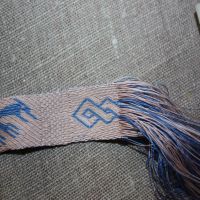
That lozenge pattern element is not a photograph, but a scan. So it should be to scale. But I pinned...
Guest - Katrin Sprang Discussion
15 September 2026
I was not referring to Rachel's reconstruction (is the reconstruction you refer to the one photograp...
Guest - Beatrix Sprang Discussion
14 September 2026
There is something Rachel did not mention. She told me: "Well, I worked with the measurements we too...
Guest - Katrin Sprang Discussion
14 September 2026
Well, this is certainly developing into an interesting discussion. Firstly, going from that lovely l...
MAY
21
2

Still playing with the data.

I'm still crunching on all those numbers and will be for a while, I guess. Next item coming up will be to handle all the samples again: Spooling them back into cops from their skein-state for better handling and easier storage and measuring thread diameter as well as making an "inspection card" for each of the samples. These are cards in a contrasting colour to the thread, where the thread is wound on in parallel lines - that gives a quite good first impression on how even the thread is.

And for now, I think I need a better graph program than ol' MS Excel. Any suggestions?
0
MAY
20
6

I'm back, and armed with yarn length measurements.

I'm back from spending a very instructive and very nice (though also quite exhausting) time in a textile laboratory, measuring the lengths of all the thread samples. For this, I had the use of a thing called "Weife" - a special, very accurate reel with thread guides and a counter, turned with the help of a hand crank. Two full lab days were needed to measure all the thread samples, and I can probably still do the sequence of motions in my sleep: Open small bag, take out thread sample and label, smooth out label, replace empty drinking straw on the "spool-holder" with the sample on its straw, turn crank until counter stands at next full 10 metres, note down the number it stands at (I filled one whole page on a notepad with number after number), search for the spinner questionnaire of that session, double-check that it is the right questionnaire.
Fix end of thread to the reel, start turning the reel (all the while taking care that no snag on the sample spool changes the tension too much or leads to thread breakage). Once the red starter thread turns up, stop cranking on. Temporarily fix the red thread end somewhere to maintain tension and keep everything in place. Read the amount of full metres, then measure the rest down to the last centimetre. Write down amount in metres on both label and spinner questionnaire. Secure the skein with the red starter thread, take down from reel, fold together securely and put back into small plastic ziplock bag together with its label. Place spinner questionnaire on the "done" stack, place finished sample into large ziplock bag. Repeat until all samples of spinner are done, then put stack of questionnaires into large bag too, close bag, put into box, take out next spinner's bag. Start early in the morning and repeat until lab closes.

While this might sound very, very tedious, I actually did still enjoy myself. It would probably have been the most mind-numbing thing ever if that had not been "my" spinning experiment - but as it is, I had a lot of things to discover and marvel about. One of my pastimes was finding out again who had which spinner ID letter - some I did remember at once, and some I needed to read one or two questionnaires. And then, of course, the data! The metres spun! The different thicknesses (though I did not see much of these turning the reel, that blurs up everything). And, most interesting to me, the fact that a spinner complaining about bad, slow spinning in the questionnaire does not at all mean that the thread had to be bad or short - quite on the contrary: Complaints usually meant nothing in regard to thread length. My guess is that a "badly running" spindle will automatically require more concentration and thus a higher output compared to an undemanding one.

Some tidbits of the data: least amount spun was 2,90 metres, maximum length spun was 72,69 metres. Overall, the least amounts were spun on the 15/5 (the spindle from Hell with almost no moment of inertia) and on 52/41 (the thick cylinder whorl with a very high weight compared to its moment of inertia). However, this does not mean that these spindles were not also used productively by some spinners - 60,00 metres and 66,98 metres were also done on those two (by th same spinner, by the way).

Spinner output is influenced by the spindles used, but not in a similar pattern over all spinners, and with the more experienced spinners, there is not as much variation as you might expect given the very, very weird "spindles" used in the experiment. And thread thickness ranges are another very interesting thing: Some spinners seem to have a "thin range" and a "thick range" with a distinct gap between those two.

These are just the very first results, and I hope to get some (or even much) more out of that. There are lots of possibilities now to look at all the variables - which means doing all sorts of different sortings and of course different graphs to see if something can be seen.

It's all very, very very very interesting. I'll be off to play with yummy data some more now...
0
MAY
11
4

Broaden the Horizons, Widen the Skillset.

If anyone of you is looking for a way to widen the skillset and learn a heap of new things as autodidact, I can only recommend running a conference with an archaeological experiment. It is amazing how many things you can hone on that - including not only computery stuff like database wielding, but also things like photographing.

I spent the day yesterday behind the camera and a photo-tent (for good lighting). In the photo-tent? A sheet of paper with orange millimetre-grid and changing motifs (but all of them similar, and very wooly). And I progressed from photos like this,


when I started fiddling with the settings,


to this as the final result:


All photos are taken with a very long exposure time and a very small aperture to get a high depth of focus. I'm very happy that my camera has a setting exactly for things like that, which means that once I set up the label and wool cop, I only have to press the button once and then wait until the camera on its tripod has taken three pictures with slightly different exposure time...

Today I will take the rest of the photos, which is easy work but more than a bit boring, since the long exposure time means that it takes about two to three minutes for each item to finish. And in that time, I can more or less just stand around and be bored...
0
APR
22
4

So... I'm almost off!

It is a truth universally acknowledged, that a single man day spent very productively must inevitably be followed by one much less productive.

Following this truth, I did (of course) not get done everything I had hoped for yesterday. Still, gold thread has been wound off into portions, "get-hooked-on-goldwork"-kits have been assembled, things have been aired out and packed up and put together and planned.

So. Today I have to take care of some mails and then I can start getting all that stuff into the car... and I'll be off tomorrow! Since this means no blogging until Tuesday or Wednesday the week after next - when I'm back and hopefully recovered - I will at least leave you with few links.

First of all, there's an exciting new research project on textile and clothing terms in unpublished medieval sources at the University of Westminster.

Secondly, the workshop list for the Textile Forum is now completed and online - so if you are interested in learning about stone-age bast twining techniques, couched embroidery, traditional one-piece footwear, twined knitting and much more, get yourself registered for the Forum!
0
APR
15
3

Forum News!

I'm sorry for the much delayed post - our Internet was acting up, just when I was about ready to post this, and it took a good while until it recovered.


The Textile Forum planning is progressing nicely, and I have just updated the Forum website with the workshop offers.

We have received a number of really, really yummy topics for the workshops, and I'm already afraid that we will have a hard time to make the schedule in a way that will enable as many people as possible to attend as many workshops as possible. And the range of workshop topics is huge as well - from stone-age twining techniques with tree bast, Iron-Age tablet weaving techniques and felting of hollow forms to Norwegian Twined Knitting, there's bound to be something that tickles your curiosity.

Thus if you are interested in the Textile Forum, now would be a good time to click your way to our site and have a look!
0
APR
13
2

All the stuff to do, it makes me queasy.

I am sadly, badly lagging behind now with a medium-sized stack of paperwork that I don't have much energy for at the moment, but need to tackle really soon ("really soon" as in "yesterday"). So... the plan for today consists of going to the kitchen to make some tea, sit down at the tent to work some, change to the computer and desk to take a break from sewing and do some of the relaxing paperwork, change back to tent, and so on, all the while consuming medium to large quantities of tea and chocolate.

The tent (as you can glean from the fancy progress bars now in the side of this blog) has already gotten a nickname: Tente à Grande Vitesse, short TGV. There's still a huge lot of work left on this, but things are not looking as bleak as they did on Saturday afternoon. We might even have enough wood in our stash to make the wood structure (which consists of only two uprights and one crossbeam) from non-hardware-store wood.

All the practice sewing on the other stall tent, by the way, seems to have elevated my saddler's stitch working speed quite a bit. When we started on the TGV, I checked how much seam I had gotten done in an hour, just to get a feeling if this project was doomed before it really started or now. If things run smoothly and I am not too tired, I sew about one metre in an hour. That's actually not too bad, I'd say.

On a totally different note: If you are waiting for updates on workshop offers for the Textile Forum, that is one bit of the paperwork I'm due to tackle today. Updates thus coming soon.
0
MAR
12
0

Finally: The Call!

Not only one, but two (almost three) calls that I can call out here today. If you know somebody who might be interested in either of these events, please pass the Call on!

First of all, the Call for Papers for the EXAR conference 2010 is up and running. EXAR's topic is Experimental Archaeology in Universities 2010. You can get to the full invitation and the registration form for the conference in Berlin, which will take place on October 8-10 2010, via EXAR's website.

And then there is the Call for Papers and Call for Workshops for our own dear Textile Forum:

Working in historical textile crafts can be a very lonely affair. To help remedy this, we are again organising the European Textile Forum for people working in historical textile crafts. The event will take place September 6-12 2010 in ArcheoParc Schnals, South Tyrol/Italy.
The programme consists of three parts: Free time to work, try out things and talk about textile techniques in the mornings; the possibility to attend workshops about historical techniques in the afternoon; and a series of short paper sessions in the evening hours. We would like to present current projects, reconstructions, technical problems or research work during those talks. Poster presentations, including a "show-and-tell" of your current project in progress, are also very welcome.

The museum that generously hosts our Forum is very close to the place where Ötzi was found, in a valley in the South Tyrolean Alps. With this quite early background for the Forum week, we do not want to set a focus on single techniques; instead, we would like to think about and discuss the question of what makes a textile. Is it the material? The production technique? The use? The properties of the piece? What is the difference between a mat woven from grass and a mat woven from stiff threads? What concept does every single one of us have in mind when the word "textile" falls?
Papers or posters about this topic, or papers and posters about objects that are not "standard textile", are thus especially welcome.

We want to give up to thirty textile experts and enthusiasts the opportunity to meet at the museum for one whole week, each with his or her project(s), and there is free time to work, chat, demonstrate and talk about textiles and textile crafts during the day. The museum is open to the public and we welcome other weavers, spinners, dyers, to come so they can also sit, work and talk with both guests and participants. With this opportunity for everybody interested in textiles, we want to help establish a better communication between professionals and non-professionals like Living History enthusiasts. Evening paper sessions and workshop participation are for participants only.

We have organised an accommodation and full board for the participants. The lodgings are two- to six-bed rooms in a guesthouse, all rooms with shower and toilet en suite. If you prefer a more luxurious room, you can book your own accommodation in Unser Frau in Schnals. Full board consists of breakfast, lunch and dinner; water to drink will be available at all times, and coffee or tea can be bought at the museum café during the afternoon and the evening. Meals will be served in the museum café, providing even more opportunity to talk textiles. The conference fee, including accommodations and full board during the week, is 350 Euro per person. Workshops can be booked at additional cost.


For the Forum, we are looking for both paper or poster presentations and workshop offers. Workshops will take place in the afternoon and can take up to four hours per afternoon. They will be booked separately by the participants, and teachers will receive a reimbursement.
Due to space restrictions, there will be no market held at the Forum this year. We regret having to take this decision, but we hope to offer you a market opportunity again in the next Forum. However, we will put up a little "exhibition stand" for small goods, info leaflets or books that participants might want to present or sell on Saturday. If you have something for the exhibition stand, please contact us per mail and tell us about it.

To register for the Forum with or without a poster or paper presentation, please submit your current area of research, the title and abstract of your presentation (papers not longer than 20 minutes) until May 2 via the registration form http://www.textileforum.org/register_2010.html. If you would like to offer a workshop, please register and send an e-mail to This email address is being protected from spambots. You need JavaScript enabled to view it. telling us the title and topic of your proposed workshop, time and space requirements, minimum and maximum number of participants and the cost per person (workshop cost plus approximate cost for materials). Please note that workshop offers have an earlier deadline and need to be made by April 15. The Forum workshops will be announced on the website on April 20.

For any questions left, you can contact us directly via This email address is being protected from spambots. You need JavaScript enabled to view it..

We are looking forward to a wonderful conference with you!
0

By accepting you will be accessing a service provided by a third-party external to https://pallia.net/

Contact