

Latest Comments

Guest - Katrin Sprang Discussion
18 September 2026
Hi Rachel, I have looked for more photos of you, but that was not very successful. I found a link on...
Guest - Beatrix Sprang Discussion
15 September 2026
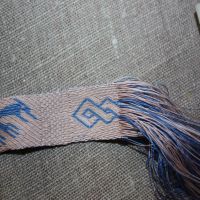
That lozenge pattern element is not a photograph, but a scan. So it should be to scale. But I pinned...
Guest - Katrin Sprang Discussion
15 September 2026
I was not referring to Rachel's reconstruction (is the reconstruction you refer to the one photograp...
Guest - Beatrix Sprang Discussion
14 September 2026
There is something Rachel did not mention. She told me: "Well, I worked with the measurements we too...
Guest - Katrin Sprang Discussion
14 September 2026
Well, this is certainly developing into an interesting discussion. Firstly, going from that lovely l...
FEB
02
0

The Textile Forum.

In case you are reading this and did not yet know, the Call for Papers for the Textileforum in September is still open - so if you would like to participate at the Forum with a paper or poster presentation, please register on our registration page. (I hope I managed to fix the bug with the UK postcodes - it was only accepting figures and no letters.)

The Textile Forum this year will have the focus topic "Metal in Textile Crafts", but any other topic is very welcome as well. It will take place in Germany, and we can offer the whole week including full board for only 300 €. This means you can have all meals together with your colleagues and will not have to think about where to get fed. We also can offer simple lodging included in that fee for the first dozen or so people who register - so don't wait too long!
In addition to being an event where crafters working in historical techniques can get together with one another and exchange tips, tricks - and questions, the Forum is always a boatload of fun and a perfect way to meet and get to know others who are working in the field of historical textile crafts. We are open to everyone with an interest in the crafty aspects of textile works, be they living history folks, conservators, professional textile workers, archaeologists, or hobby spinners - as long as you are interested in the crafts part of these techniques and in how things are (or can be) actually done, the Forum is for you. Don't miss this opportunity!
0
FEB
01
0

Friends are the awesomest thing.

Since I had some more little troubles with xmgrace yesterday, I used the Phone-a-Friend Lifeline and did just that. And thus got myself a nice little one-on-one, flesh-and-blood Grace tutorial.

Where I learned the following Two Rules for Getting Grace:
Rule one: If plotting or importing data does not work, you probably have a dumb user problem and screwed up your dataset. Which is easy to do - just add a line break at the wrong place, or leave a string in.
Rule two: When working with grace, pretend it's a jump-and-run game or an egoshooter - save early, save often, save lots of different versions. Grace has no undo function, and hitting the wrong button (or even the right button) at the wrong time can permanently screw up things.

I'm not sure whether there's a third rule - insist on grace being totally cool and a very good tool no matter how much trouble it can make - but I will find that out (probably).

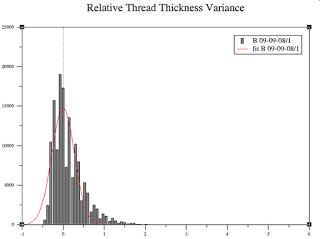
For now, though, I know how to get stuff like this:


so I'm perfectly content.
0
JAN
27
2

Statistics, statistics.

It really, really is amazing what one can learn (and has to learn) just because of some spinning. I have learned on Thursday last week that Excel will find the median of a list of numbers by... choosing the value in the middle of the list. Which means that instead of finding the statistical median (half of the values are larger than this number and half of the values are smaller than it), it finds the number in the middle of a list. Thank you, Excel, I could have done that myself. By placing a simple link to the cell in the middle of the list. Because yes, I can count! So I worked on a little more, using the average instead, and grinding my teeth (figuratively speaking only, though).


In case you do not have your own version of a spinning experiment that you need to evaluate and analyse, and have no clue what I'm talking about: the average is made by summing up all numbers in a dataset and then dividing it by the amount of numbers. The median is the value in the middle of the dataset. Why do I want the median instead of the average? Median is way less vulnerable to outliers in the data. Case in point - let's assume we have a list of values that goes 1, 2, 3, 4, 100. Average is (1+2+3+4+100) divided by 5, which is 22. In contrast to this, the median of the same dataset is 3.

And Friday morning, I had a little private time with Mr. Google again, and I found out that yes, you can force Excel to get the statistical median. You can tell it to find the x-largest number in a bunch of cells. Which means that if you know how big your list of data is (I do) and see if it's an odd or even number of data (I do) and, if it's even, can divide said number giving the length by 2 (I do) and can make Excel calculate an average (I do) you can tell it to calculate the average between the two numbers in the middle of the list. Gotcha.

Oh, and I need the median... because after some fiddling and trying out and looking at data and getting brain-dead and trying something else, the most patient husband of them all and me came up with a possibility to give relative variations of thread thickness. Which uses a simple formula built around either the median (good) or the average (not quite as good). And now please excuse me while I try to get my now nicely-sized histogram bins into a good graph form.

Which will include giving my computer a split personality - because the programme I plot to do my plotting with is only running on Linux machines.
0
JAN
18
2

Image Tweaking.

It really is amazing how much time a single small macro can gobble up.

Especially if, when you are almost through, you decide that the process might be even better suited to the aims if done a little differently. Because it does make a difference whether you run a median filter first, or whether you filter out outliers first, or make a transformation to binary first and run filters later on.

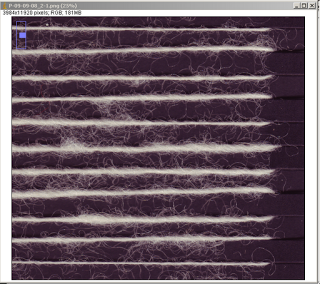
Anyways, I now have a method to turn a scan of thread samples like this:

into this:


and then read out the thread thickness of every single one of these threads.

Now I only need to wrangle the gazillions of datapoints into something resembling histograms or some other form of legible visualisation. And be amazed again at how much time a single little spinning experiment can eat.
0
JAN
12
2

Things that may have gotten lost before the holidays.

I gathered yesterday that launching the call for papers for the Textile Forum shortly before Xmas season may have led to this going under - with all the other seasonal things to take care of and the end-of-year frenzy of work.

So here it is, again:
We will be having the next European Textile Forum in Mayen, Germany, with the kind support of the RGZM. Our focus topic will be "Metal in Textile Crafts", which we think is a very exciting and very interesting - and also very broad - topic, covering everything from the conservation processes of archaeological textiles by metallising via the use of metals in the embellishment of textiles or the use of metals in the mordanting and dyeing process to the manufacture, importance and use of metal in textile tools.
The Forum will take place September 10 to 16 in the brand-new Laboratory for Experimental Archaeology and will include the usual evening lectures, one extra lecture day, an archaeological experiment to find out about the possible influence of the lead dye pots from Pompeji dye workshops on the resulting colours, and of course plenty of time to work on projects and exchange knowledge, tips and tricks or complain about problems to colleagues. The full conference fee of 300 Euro covers full board and lodging in simple dorm rooms (lodging is of limited availability).

If you are interested, you can find out more via our website www.textileforum.org - there you can also register for the Forum. And if you are not interested, but know someone who might be - please spread the word!
0
DEC
20
4

It's updated!

We have finally wrapped up all the prelim discussions and clarifications, and now the Textile Forum homepage is updated.

As previously hinted and announced, the Forum 2012 will be held at the brand-new Laboratory for Experimental Archaeology, a new research facility of the RGZM. Our focus topic will be "Metals in Textile Crafts", and we are looking forward to an exciting time with this very wide and fascinating topic. You find the Call for Papers and more info about registration here.

As of now, you can also register for the event, which will take place September 10-16, via our registration page. And please spread the word about the Forum!
0
DEC
16
0

Three things at once.

Or is it only three? Anyways, here's the news on three things I'm working on:

The Textile Forum. We are in the process of wrapping up the planning stage, and I'm already working on the update of the web pages so we can go live. And yes, that includes the call for papers, which will officially be sent out when the website is updated, and a brandnew registration form. Said form or rather its making and adapting, by the way, ate a good chunk out of my workday yesterday. Because I do basically not know how to do php stuff.

Connected with the Textile Forum, I have also finally changed my newsletter-sending software arrangement, which will hopefully end the weird formatting that newsletter recipients have had to endure the last few times. If you wish to subscribe to the Textile Forum Newsletter to receive announcements and the call for papers (and that's about all that is going over the list, so you won't be inundated at all), you can do so via this form.

And also connected with the Textile Forum, and the famous 2009 spinning experiment, I have further developed the method of how to measure thread thickness variations. The good news: Yes, it works, and will so very well. The bad news: I have to do some filter-testing and script-writing and macro-wrangling to really make it work, and my programming fu is about as nonexistent as my fu in all the other things that I actually don't really know stuff about but try to fumble my way through them anyways. (In German, I would call it "herumeiern", which is more or less wobbling around somewhere and not getting to the point, or traipsing around more-or-less-aimlessly. Just like an egg does when you roll it. And I love that word.)

At least it's Friday! So once my brain is in shambles due to too much pressure on the logic circuits, I will have all weekend to relax and recuperate.
0

By accepting you will be accessing a service provided by a third-party external to https://pallia.net/

Contact