Latest Comments

Guest - Katrin Sprang Discussion
18 September 2026
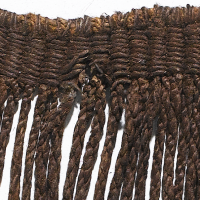
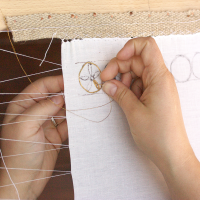
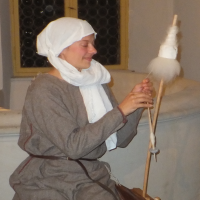
Hi Rachel, I have looked for more photos of you, but that was not very successful. I found a link on...
Guest - Beatrix Sprang Discussion
15 September 2026
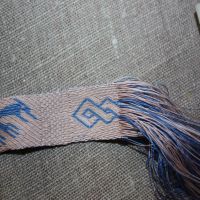
That lozenge pattern element is not a photograph, but a scan. So it should be to scale. But I pinned...
Guest - Katrin Sprang Discussion
15 September 2026
I was not referring to Rachel's reconstruction (is the reconstruction you refer to the one photograp...
Guest - Beatrix Sprang Discussion
14 September 2026
There is something Rachel did not mention. She told me: "Well, I worked with the measurements we too...
Guest - Katrin Sprang Discussion
14 September 2026
Well, this is certainly developing into an interesting discussion. Firstly, going from that lovely l...
NOV
11
2

How to make yourself very tired.

Here's a good recipe on losing some sleep, in a thoroughly enjoyable way:

Have an idea for a conference.
Find a place to run it, organise a caterer, and a place for the participants to stay.
Find about a dozen other people who are passionate about textile research, and historical textiles, and the crafts involved.
Get all of them, plus tools and books and materials, together in said place you organised - to share knowledge and try out things, for one whole week.
Throw a little experiment in with the mix...

... and there you go.

There was sprang, and tea, and coffee. There was much running (at least for me - to open doors, and gates, and nip back to fetch something). There was beautiful weather, and there was chocolate, and of course we had stroopwafels (which is a Dutch sweet and traditionally used for spinning at the Forum).


 There was silk reeling, and with it the admiration of both the intricate process and the dead bugs that made the coccoons.

In short, it was a wonderful week, full of textile crafts and research and learning, of friendly support of each other and discussions about which technique would be suitable, and how this or that could work. It was the European Textile Forum. It was also brutally exhausting - but I couldn't pick a better way to work on making yourself very, very tired!

0
NOV
02
0

It's time for the Textile Forum!

The Textile Forum has started, and I am in Mayen to spend all week doing textile things - looking into early modern knitting, investigating the differences between knitting and nalebinding, and other things like it.

As I will be utterly busy running this conference, there will be no blogging until Wednesday, November 11 - when I will have recovered from the incredible textile archaeology overload the Forum inevitably generates, and will be able to tell you stories of what we did and how things went.

I'm here! (Well. Behind this thing. More or less.)

0
OCT
29
2

Breaking things, repairing things, twisting templates. And linen dyeing.

I spent the morning going more into the up-and-coming relaunch, and I did manage to do a test migration into WordPress, so there will be some changes to this blog's looks before the year will end.

The new shop design is also coming along nicely. It will be much lighter, and much cleaner, and there will be larger pictures. Overall, I really like it a lot! There's still a few issues to be solved and snags to be taken care of, and changing the old pallia.net site over into Joomla will mean a bit of re-writing of text and menu restructures (read: a good bit of work, including thinking and figuring out the best way for stuff), but I have hopes it will all work out eventually.

Apart from that, I managed to break my xampp programme (the thing required to test-drive a web page on your own computer, under the charming name of "localhost") and to actually fix it again (by deleting a single line of code that had crept in through an aborted installation of WordPress). Whew!

Now, however, I will have to put this project aside for a bit, as the Textile Forum is coming up (I can't believe it is already almost November) and there's still a few things to prepare for it. Packing linen cloth for our next test run regarding linen dyeing, for instance!

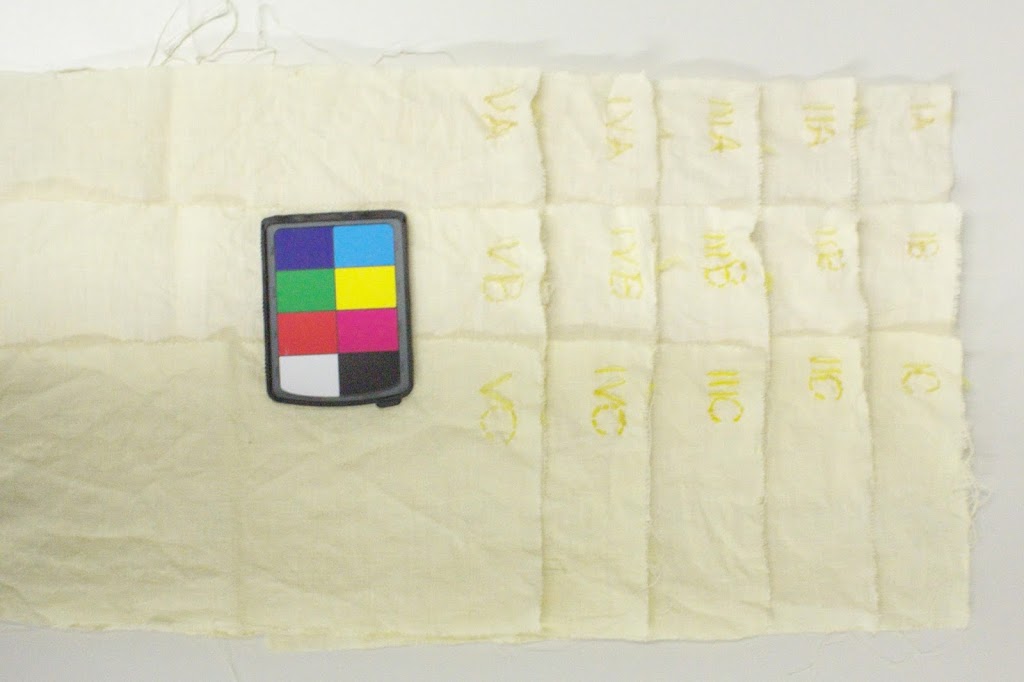
Sabine and I have been thinking about the chemistry involved with dyeing linen for a few years now, and we did a first trial run on exploring linen dyeing at last year's forum. One of the possible influences on how well the linen takes the mordant (which is usually not very well at all) is the pH of the mordanting and dyeing liquid, so we set out to test this.

Last year's test results. As you can clearly see, there was not much dye taken up by the linen fabric, regardless of the pH adjustment of the mordanting and dyeing baths.
We'll try different concentrations of alum this time. We've also planned to test a pre-treatment with sulphur fumes, though the required sulphur strips have not arrived yet - I'll keep my fingers crossed that they will come today.

The reason for sulphur pre-treatment? It seems that the metal components of the mordant bind to wool through a connection to the sulphur bonds the wool has. So if it's possible to sulphurise the linen, it might be possible to have a much better mordant uptake, and thus dye uptake. Next week we'll know more!
0
APR
02
1

As promised - the European Textile Forum Call for Papers.

Please note: There was an issue with the direct link to the registration form provided in the CfP below. If you have tried to register and did not receive an e-mail with your registration data, please do register again - I have fixed the link so it works now. Thank you and sorry for any inconvenience!

As promised yesterday, I have spent the morning hours updating the Textile Forum website and re-making that form (have I ever mentioned that php forms are a godsend and a pain in the backside at the same time?) and it's finally, finally finished. It should all work now (and probably I'll be getting an email in about 10 minutes, telling me about something I totally overlooked when going through stuff and setting up the form...)

So, here for you, our Call for Papers:

The European Textile Forum in 2015 will again take place in the Laboratory for Experimental Archaeology in Mayen, Germany. This is the experimental archaeology research center of the Römisch-Germanisches Zentralmuseum (RGZM). The date for the Forum is 2-8 November 2015.
We have been very happy with the combination of lectures and practical sessions, and we invite you to submit your proposal for a short lecture (about 20-40 minutes) followed by discussion and practical research regarding the textile techniques or problems presented in the lectures. The practical part can be in form of a workshop, a demonstration, or something like a "hands-on round table". Evenings are reserved for socialising and for more work on textile projects.
Our focus topic in 2015 will be "Non-Woven Textile Structures". This includes a large variety of textile techniques, such as knitting, braiding, nalebinding, felting or netting. We invite you to explore this topic together from all aspects, including but of course not limited to use of different tools or techniques to arrive at the same end product, differences of non-woven fabrics compared to woven fabrics, problems and possibilities of these techniques and their description or identification, and of course their use in everyday life.
As always, while papers or posters about our focus topic are especially welcome, if you have another topic outside this focus that you would like to present, please do submit your proposal. The same applies if you would like to offer a poster presentation or a workshop/demonstration only. For any questions, feel free to contact us directly.
With this Call for Papers, registration for the Textile Forum 2015 is now also open. Please be advised that there are very limited accommodation possibilities at the site: Due to the space available at the Experimental Archaeology Lab, we can accommodate about a dozen to fourteen participants on-site only, and the conference will accomodate only a few more participants than that altogether. Due to these restrictions, we may have to consider registrations with a presentation before those without.
The RGZM is graciously supporting the European Textile Forum by granting us use of the simple, mixed on-site dorms. If you prefer a room in a hotel or pension, you can of course book your own accommodation in Mayen; some more information can be found on the Travel and Accommodation page.
Full board consists of breakfast, lunch and dinner; water to drink as well as tea and coffee will be available at all times. All meals will be served in the Laboratory. The conference fee, including the sleeping possibility in the on-site dorm and full board during the week, is 320 Euro per person.
To register for the Forum with or without a poster or paper presentation, please submit your current area of research or interest as well as the title and abstract of your presentation, if applicable, by using this registration form. If you would like to give a paper longer than 40 minutes, please let us know about that and we will try to make it possible.
If you have questions or suggestions, you can contact us directly via This email address is being protected from spambots. You need JavaScript enabled to view it..
We are looking forward to a wonderful conference with you!

If you are on our newsletter, you will get the same in an e-mail as well - which I will send out later today. That's it from here for today! And for tomorrow, and Monday, since both days are a public holiday hereabout. I wish you a happy Spring Celebrating Festival, whatever it's called, and I hope you will have a few nice, sunny and relaxed days!

0
APR
01
0

So it goes with plans.

This morning, I was wondering what to do - should I try and do an April Fool post? There are others who are doing it so much better, though.

And then I thought that I'll just be normal and boring and do a totally normal post. Maybe about Textile Forum stuff. Maybe I could just announce the registration being open, and post a Call for Papers... that would be a nice blog post.

However, that means writing the CfP first, and getting the website up to date, and since I had to run some errands inbetween... it was obvious that I would not get it done until early afternoon. So I took a deep breath and thought to myself that since I have been blogging late quite often during the end phase of the Beast, you'll all be used to the occasional late one, and it should be fine if I post it by early afternoon.

It's the end of mid-afternoon now, and unfortunately the CfP is still not finished. Well, the CfP is finished, but I realised that with our newer concept of pairing up a paper with a practical session, I have to fix up the registration form to change it from a radio button set to checkboxes, and that would best be done by making an entirely new form to hopefully tackle some other issues, and that in turn might take another hour or two... so you are getting this blogpost instead, about how plans go kawumph in the afternoon when sudden realisations about the need for updates hit them hard.

Tomorrow, though. You shall have the CfP tomorrow.
0
MAR
30
2

Textile Forum Planning.

It's early spring, and what better time of the year than to start planning for November? We have found a date for our next European Textile Forum, and we are hoping to finish plans this week far enough so we can send out the official Call for Papers and update our website. If you are on the mailing list, you'll get anote when we have done that. (If you are not yet on the list, but would like to be - go here to subscribe.)


I'll disclose our year's focus topic for you here right now, though. It will be "Nonwoven Textiles", which includes nalebinding, braiding, felting, netting and of course knitting. So we're excited to hear what papers and presentations will be offered as soon as the CfP will be out. If you are interested in attending and presenting, you could start thinking about something right away... while we'll be planning the actual thing.

Sabine and I are beyond delight that our crazy idea from back in 2008 has developed into a conference that is going strong, and we are looking forward to having another week with fellow textile researchers, crafters, conservators spent talking, thinking, reconstructing and researching. It's a good bit of work every year to plan and prepare that conference - but when that week comes, it is stuffed with wonder and learning, and every time we lean back and say that putting in that work? It is so, so much worth it!
0
DEC
06
0

Spinning Experiment Article!

Today it's time for me to rejoice - my article about the Spinning Experiment (yes, that one back from 2009) has been published in Archaeological and Anthropological Sciences. Here's the link.

It's not open access, since that requires the author (yes, the author) to pay a stupid amount of money which I can't afford (and even if I did, I would not since I am a strong believer in the Rule, or Yog's Law). I'd much prefer if it were free, or open access, or offered at an affordable price - but as things are, I am very happy to have the article out there, and published in a journal where it will be seen (and hopefully read) by a lot of people.

(If you would like to read the article, you may have access to it from a library computer if the library subscribes to the journal.)


0

By accepting you will be accessing a service provided by a third-party external to https://pallia.net/

Contact