
Latest Comments

Guest - Katrin Sprang Discussion
18 September 2026
Hi Rachel, I have looked for more photos of you, but that was not very successful. I found a link on...
Guest - Beatrix Sprang Discussion
15 September 2026
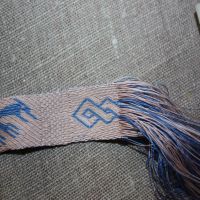
That lozenge pattern element is not a photograph, but a scan. So it should be to scale. But I pinned...
Guest - Katrin Sprang Discussion
15 September 2026
I was not referring to Rachel's reconstruction (is the reconstruction you refer to the one photograp...
Guest - Beatrix Sprang Discussion
14 September 2026
There is something Rachel did not mention. She told me: "Well, I worked with the measurements we too...
Guest - Katrin Sprang Discussion
14 September 2026
Well, this is certainly developing into an interesting discussion. Firstly, going from that lovely l...
MAY
22
0

European Textile Forum News!


It has taken a good while, but it's finally all settled - the European Textile Forum 2019 has a venue, and it will take place November 4-10 as planned.


Our venue for this year is the Lauresham Laboratory for Experimental Archaeology, connected to the UNESCO World Heritage Site of Lorsch Abbey and a spectacular place to be. I have a lot of personal fond memories of Lorsch, having been on archaeological digs there several times, working together with lovely colleagues, and having some memorable moments. Like the one where one of the students found some coins right after the assistant prof promised a money prize for finding a coin. Like the one where I was staring so hard at the greenish-pinkish bands in the sand there, to find the line between an old trench and natural undisturbed soil, that I stopped seeing in colour and had to stare at a white wall for a while. Like assisting the technician in taking site measurements; he was a very, very special character, so working with him was sometimes quite exhausting (but I got treated to an ice cream sundae in the evening, which did make up for that). Best of all is that I was part of the student group that excavated in the so-called "Südosttor" area... and what had been thought to maybe have been the south-east gate turned out to have been the loo.


So I'm very happy to return to Lorsch, especially since I have not been there for years, and the whole Lauresham Laboratory is also new to me.


For the Forum, we are graciously given use of the Visitor Information Centre with several rooms, plus use of the facilities in the open-air laboratory itself. This includes houses and workspaces modelled after archaeological finds and ideal-typical monastery plans and descriptions from Carolingian times. Most important for our purposes, there is a dye house on the grounds, as well as a weaving house with three warp-weighted looms installed there plus one mobile warp-weighted loom. I cannot tell you how thrilled I am at how this all worked out, and I am so much looking forward to our conference!


I have also been promised that our group will get a tour of both the Abbey grounds and the Laboratory, which will surely include a visit to the 8th/9th century Gate Hall, the most famous building in Lorsch, and truly, truly spectacular.


So now, finally, it's time to send out the Call for Papers. As every year, we will have a focus topic, and this time it's "Shared Warps, Shared Wefts". You can find the CfP on our website, or you can download the pdf version here.


Last details regarding the conference still need to be figured out, so registration is not open immediately, but will be possible from May 27 onward.


For now, please save the date if you're planning to come, and spread the word about this conference if you know people who might be interested!
0
APR
03
0

Lightfastness Tests - with pictures!


For those of you interested in the lightfastness tests, here are pictures!


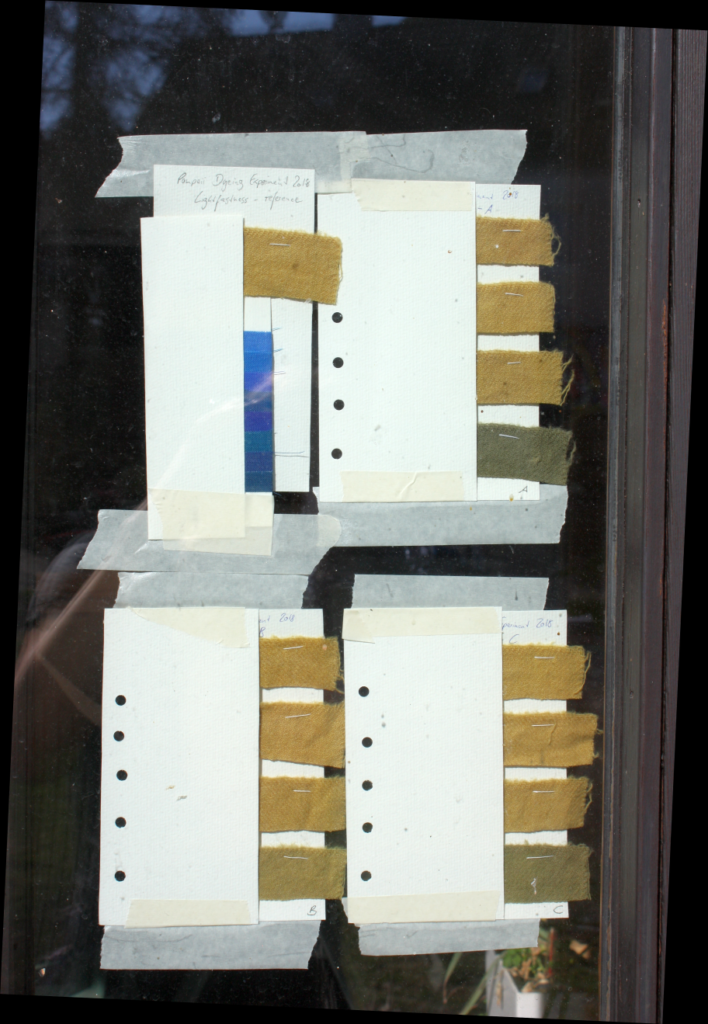
This was how the setup looked at the start...


I covered the parts to be protected with cardboard and stuck the whole shebang into the window of our wintergarden, facing south. After 7 days, I took it all down and checked the fading.


On the blue wool scale, each reference strip takes about two to three times longer to begin fading as the next lower strip in the scale. As the Material Technologies Limited website states:


Under normal solar testing conditions, reference 1, the least permanent, will begin to fade in 3 hours to 3 days, depending on geographic location, season, cloud cover and humidity; reference 3 will fade in 5 days to 2 weeks; reference 6 in 6 to 16 weeks; and reference 8, the most permanent, in 6 to 15 months.) These scales are used for paint lightfastness testing under international standard ISO 105-B, and are also used by gallery curators to measure the accumulated amount of light received by museum displays of paintings, textiles or photographic prints. 


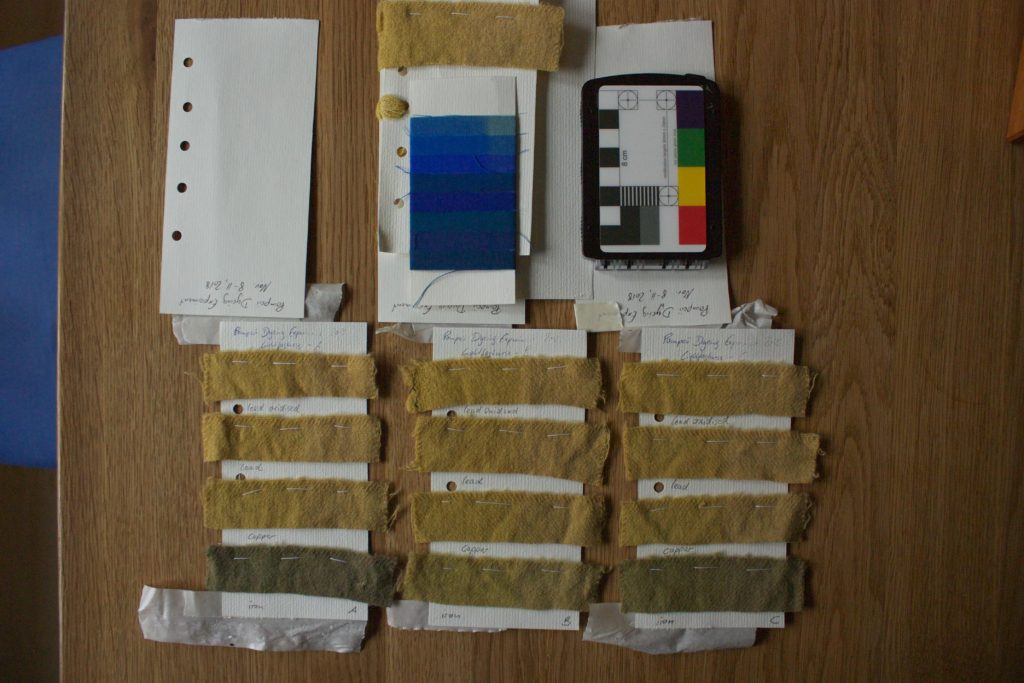
This fits in fairly well with the speed of fading that I had, with reference strip 3 already noticeably faded after the 7 days that I took it down for the check. And this is how the birch looked:


As you can hopefully see, there's distinct fading on the first blue strip, and there also is fading on the second and third one. It is not so easy to see on the photograph, but in actual natural daylight, there also is a little fading visible on the birch-dyed cloths. That would place the colour fastness regarding light of these strips somewhere between strip 3 or 4 - not too bad, seeing that modern recommendation for clothing dyes is to have 4 or better.


This, by the way, is another example of it being rather difficult to document nicely and clearly - not everything is easy, or even possible, to show on a photo.


After taking these pictures, the strips were covered again and went back into the window. I'll take them down once more soon, and see how things look then.

0
JAN
31
1

Finishing Stuff.

One of the things about archaeological experiments is that they always take longer than expected... and then, in the aftermath, there's... the aftermath.

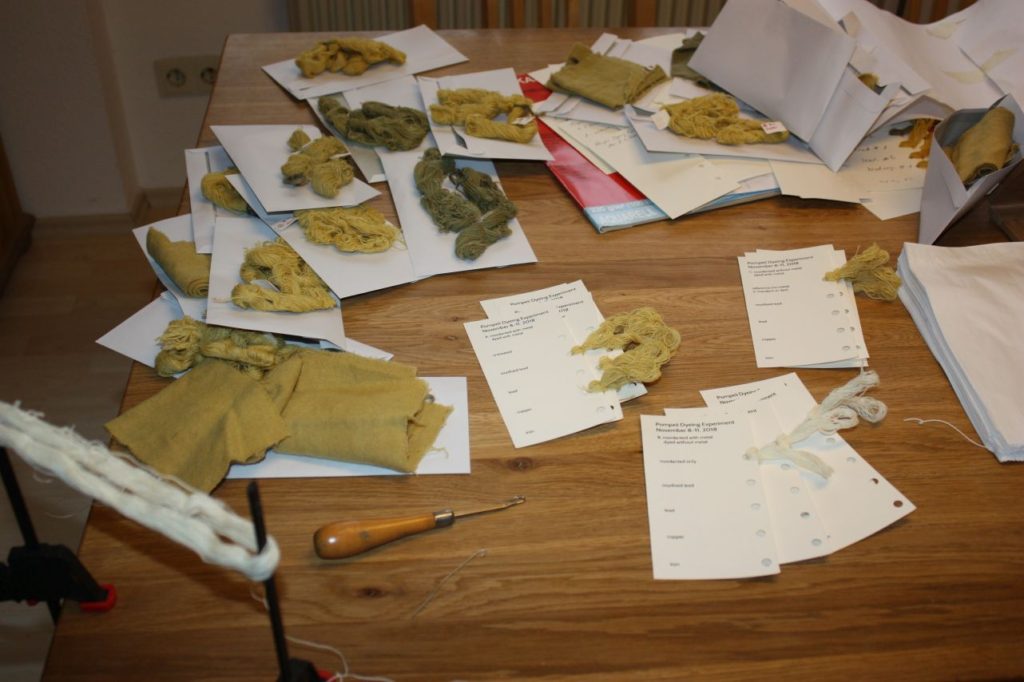
Which, in the case of the Pompeii Dyeing Experiment, involves making reference cards for the different dyeing results. Which means labeling sheets of cardboard, punching holes next to the labels, and then winding off tiny skeins of yarn which are in turn pulled through these holes and fastened.

If you have never done something of the sort, let me tell you: it takes a ridiculous amount of time, and it is stunningly boring work, and I can totally, utterly understand if a dyer does not do yarn colour reference cards (which are only an indication of what colours are possible anyways) and even better why they are not handed out to customers.

[caption id="attachment_4258" align="alignnone" width="640"] Work in progress - I'm less than halfway through here. Altogether, it's four sets of three cards with five skeins each, so it's sixty samples to wind and attach. Can you feel the boredom oozing through the picture?


Now, though, it's finally done, and I can send off the cards to their respective owners (among them the Lab for Experimental Archaeology, for their archive of experiments done at their place). And then, some samples will go into a different lab for testing - so there's a post office run in my near future, which will be followed by a deep, heart-felt sigh of having finally finished that part of the Textile Forum Aftermath!
0
DEC
06
2

Some more Forum Pics.

Yesterday's post reminded me that I have not written about the Forum yet... so here are at least some pictures that I took to hopefully delight you!

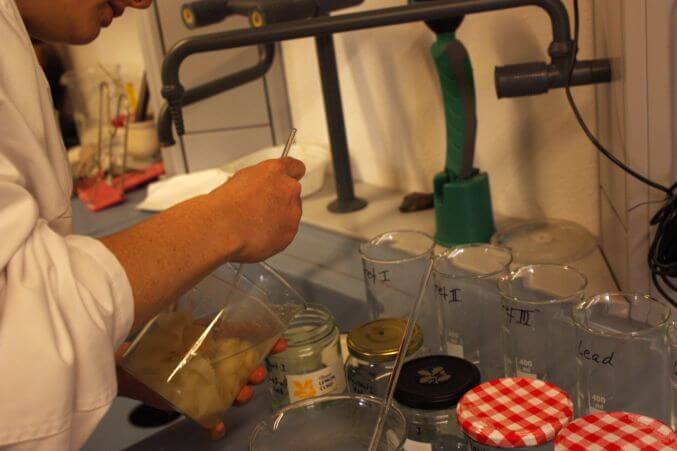
There was another instance of the Pompeii Dyeing Experiment, so liquids were boiled up and, in this case, also decanted in sampler jars (also known as "empty jam jars"):


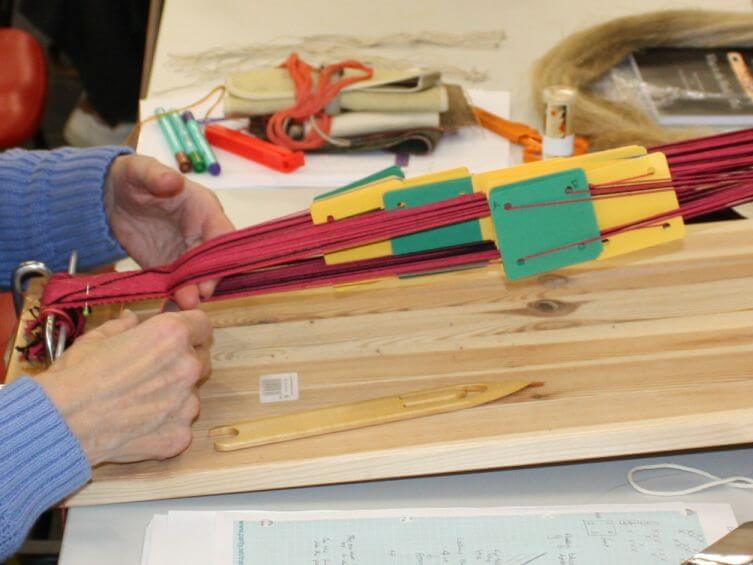
Then there was some tablet weaving:


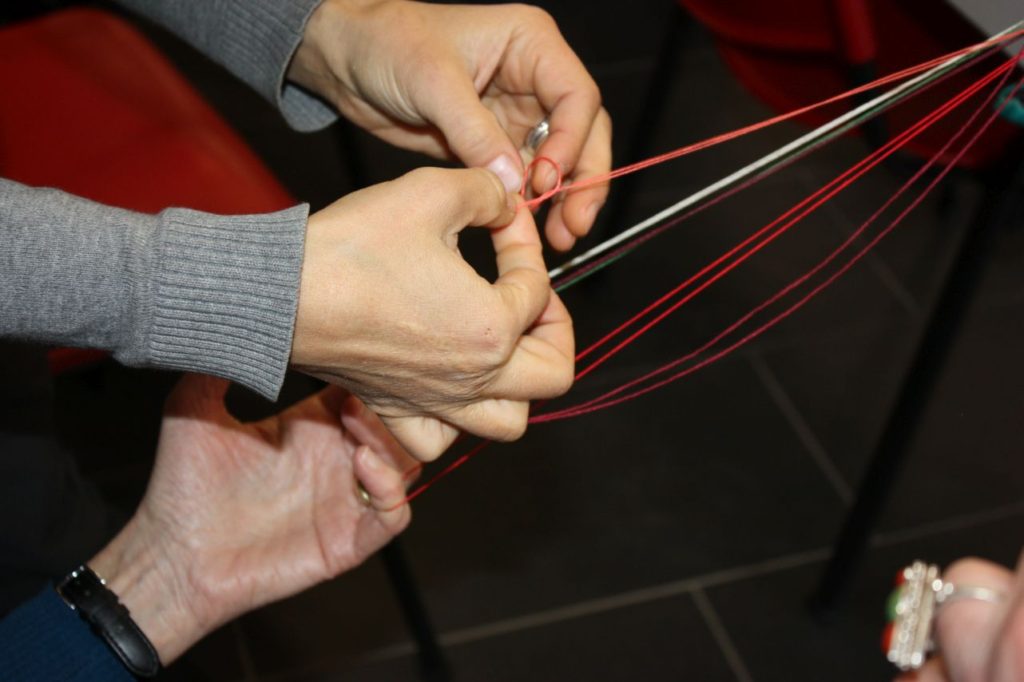
and there was lots and lots of braiding, much of that with loops:


0
NOV
05
0

It's Textile Forum Week!

Textile Forum, for me, is like a party and a family reunion and a conference and a fair and a week of crazy textile stuff all rolled up into one. It's the one week in my year that's making me run in circles a huge lot beforehand, packing up loads of stuff, losing lots and lots of sleep over fretting if all will go well (and the occasional late-night doing of stuff), and writing more lists than for anything else in my year.

It's also the week making me absurdly happy because it's bringing textile folks together, and there is so much networking and learning and sharing taking place. I'm part of this, and that is a wonderful feeling for which I gladly pay the price in sleep and coffee over-consumption.

Finally, it's the week that is making me really, really tired - so there will be no blogging from tomorrow on until I've recovered from the Textile Forum, which, according to experience, takes me about a week as well... which means I'll be back on the blog on Monday, November 19.

See you then - and happy textile and non-textile shenanigans until then!
0
OCT
22
2

Update on Current Things.

I'm currently busy preparing for the European Textile Forum - which mainly means writing lists, writing even more lists, and dragging things into heaps according to the lists to minimise the risk of my forgetting some crucial tool or material.

Also - last-minute ordering of things I've run out of, or that will be necessary. We will be doing another run of the Pompeii dyeing experiment (looking at the influence of metal kettles on the dyeing outcome), as we've found somebody willing to do an analysis of the mordanting and dyeing liquids to see how much metal ions are in them, so I've harvested birch leaves (currently residing in the freezer), and I will need to make sure we have enough yarn, fabric, and alum for the dyeing experiment.

And on top of all this, I should actually be sitting down, finalising my bits of presentation. Which includes having my tablet weaving test band set up so I can use it at the Forum. Fortunately, the warp is already done, so I only need to get some initial wefts in. I have a few additional plans for that test warp, though (and you will hear about this soon), and if I can in some way manage, I want to do the associated weaving before the Forum too.

Can someone hand me an extra day, maybe, please? Or two?
0
OCT
19
0

Proofs!

To my and Heather's great delight, we are in the very, very last stage of getting Ancient Textiles, Modern Science 2 all done and set - the last proofs have arrived, and it's only a matter of giving the book a very last read, catching the very last typos, before it's all good to go to print.

Yay! Getting this book done was a string of pitfalls and delays, due to all kinds of things - crashing computers and illnesses only being two of them. So I'm really happy to get this to a close, and consequently proof-reading is what I am doing now!

If you want to have a look at what the book will contain, it's already listed on the Oxbow website, and you can even pre-order at a special price!

 
0

By accepting you will be accessing a service provided by a third-party external to https://pallia.net/

Contact