Latest Comments

Guest - Katrin Sprang Discussion
18 September 2026
Hi Rachel, I have looked for more photos of you, but that was not very successful. I found a link on...
Guest - Beatrix Sprang Discussion
15 September 2026
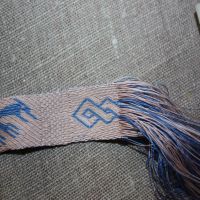
That lozenge pattern element is not a photograph, but a scan. So it should be to scale. But I pinned...
Guest - Katrin Sprang Discussion
15 September 2026
I was not referring to Rachel's reconstruction (is the reconstruction you refer to the one photograp...
Guest - Beatrix Sprang Discussion
14 September 2026
There is something Rachel did not mention. She told me: "Well, I worked with the measurements we too...
Guest - Katrin Sprang Discussion
14 September 2026
Well, this is certainly developing into an interesting discussion. Firstly, going from that lovely l...
SEP
06
0

The Season of Madness is Approaching.

Autumn is coming, and with it the Textile Forum is drawing nearer, and that always marks my own personal Season of Madness - as things are getting sorted out and planned and organised. 

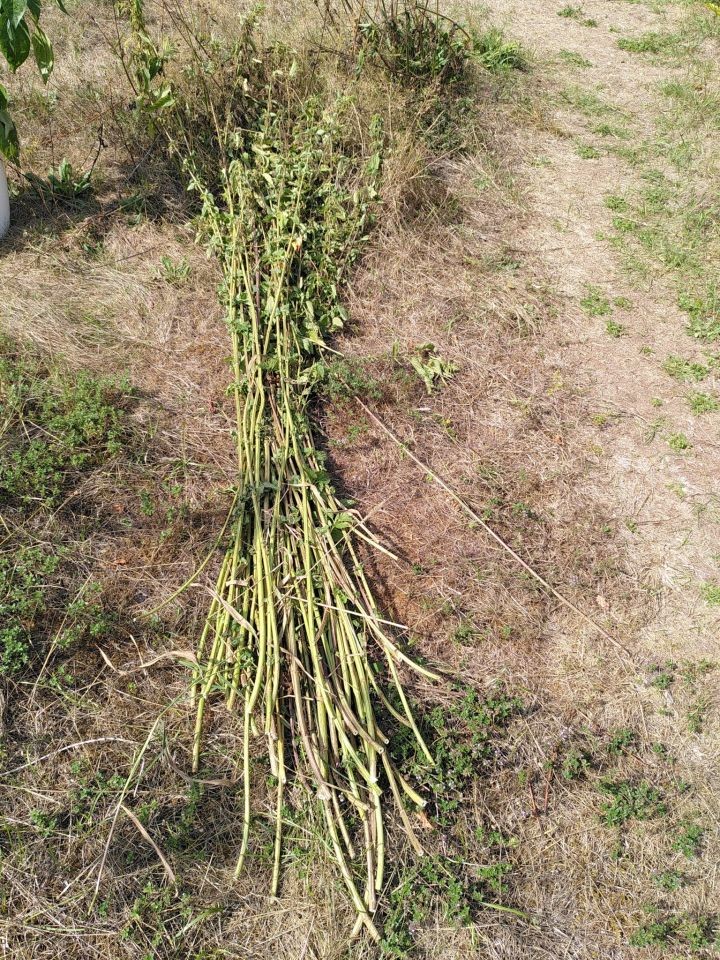
There's long lists of stuff to check, or pack, or look into - and since this year's focus topic is "making threads" which includes splicing technique, there was a little bit of nettle harvesting today:

These grew on public ground, and quite obviously on a piece of public ground that they found pretty nice, as some of the stalks are more than my height in length. Now I'll have to figure out what best to do with them until we need them in November. Ret them? Let them dry? Freeze them? Hm... 

0
JUN
23
0

Doing Forum Things.

Part of this day was spent on doing things for the European Textile Forum. We do have a date (November 7-13), we have a topic (spinning and making thread in the wider sense), we have a location (we'll return to Mayen), but there's a few things that have to be organised in a different way this time around. Biggest of them all is our catering - the company that used to provide us with food (including very creative uses of canned pineapple in a lot of dishes where I would not have expected it) seems to have gone under during the pandemic. Which means... getting a new caterer.

That's not quite as easy as it sounds, as options in a small place are limited, and we have specific requirements that have to be communicated properly. That is under way.

Another bit that has to be set up again is the registration form - the software that I used previously is not compatible with the current version of Joomla that the Forum website runs, so I've had to find a new one and am now getting acquainted with it. And building the form - so registration can finally happen. 

There'll be a bit of a price increase for this year's conference, as everything has gotten more expensive. I'm a little sad about this, but, well, it can't really be helped.

So... it does look like I've figured out and tested that form thingie, and the updated cost estimate, and now all that remains is finishing the info bits and the CfP, and then the thing can actually go online. Hooray!

0
MAY
05
0

Phew, and Phew.

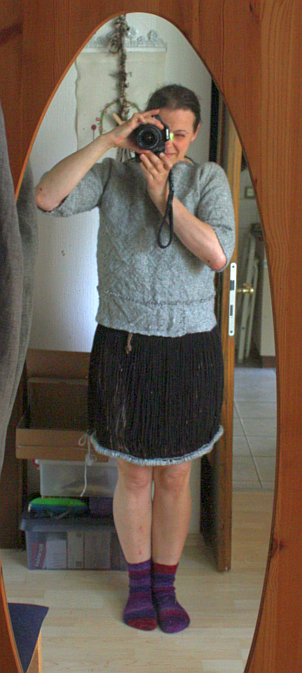
I may or I may not be sitting here dressed in the Bronze Age women's clothing - trying it out (or on) before it goes on its happy journey to its final work place. I may also have taken a quick mirror-selfie before sitting down here to write this blog...

I may also have managed to resurrect the Textile Forum website, and wait for all the mails to go out (there's a restriction on how many mails can be sent in a given time, to avoid spamming and hogging of resources that you have not paid for, so sending out a few hundred mails takes a bit of time). 

  Just in case you're wondering, by the way: I managed to kill the Forum website by clicking the wrong button at the most inopportune moment ppossible to do so. Which removed the database (not good!) and some of the files. Resurrection was mostly a question of finding the correct set of files (that matched the re-uploaded database) and getting them back into their proper place.

Now things are running again, though it still does not look pretty - the site still suffers from template issues, which have been unresolved due to the need of getting a new one anyways, with the switch to Joomla 4. Which is on my schedule to do once the mails are all sent out, and then, hopefully, things will be easier to look at again, and the photos will also come back.

For now, though, the most important, and most urgent, bit was to get the date and time for the next Forum online. Which will be November 7-13, and we'll be in Mayen, Germany, at the Laboratory for Experimental Archaeology again. Our focus topic will be making yarns and threads: "Simple, Special, Spun or Spliced: Yarns, Threads, and Their Making". You can find out more about it on the website of the Forum.


0
MAY
04
0

Shenanigans.

I've been trying to get the Textile Forum website up to speed, and I was working along happily, and everything was looking good, and then I managed to seriously botch up. So, at some point in the process of getting the site updated and back to functional, I managed to kill it. Whether that is a fixable kill or a really bad one will have to be seen. 

Possibly tomorrow, as it might just be that I'll run out of brain juice pretty soon. Even though Madame the Cat is warming my arm as I type, and purring along. At the moment, I'm extracting a backup and hope that uploading the relevant files will fix it - if not, I'll have to do things to the database as well. Sigh. 

Ah, for those IT things to once work really smoothly. At least, though, I should be able to relatively quickly re-write the texts I wrote today, and that of course got eaten up by the botch. They were written in my quest to prepare for the next Forum... which will happen in November, and take place in Mayen, and I'm already looking forward to it.

So. Keeping my fingers crossed that things will not be too badly killed...

0
OCT
04
2

Things That Happened During Summer Break (part 6)

(continued from part 5)

There was, of course, even more stuff about looms and weaving. Together with Florian, who works at Lauresham, I'd been pondering and planning a loom made from hardware store parts - things you'd easily get at a typical German Baumarkt. The aim was to have an affordable loom from parts you can get without having special stores, and it should of course also be easy to build.

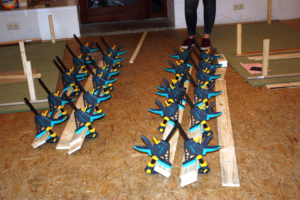
[caption id="attachment_6419" align="alignnone" width="300"] Putting together the two uprights - since we had the luxury of a lot of clamps, we used them. The boards are glued together, and then secured additionally with a few screws.


Most of the cutting-to-length of the parts can be done in the hardware store, where there's usually a cutting service point. That greatly reduces the amount of work and time necessary for making the loom - most of the tasks that are left is assembling the bits by glueing and screwing.

There's still some details to fine-tune, but overall, our little side project was a definite success. The hardest part about this loom is squaring off the ends of the round beam - it would be possible to use another solution, but the square ends will sit very securely in the upper part of the loom, and getting the sawing done was successfully undertaken by someone who does not have a lot of practice with this.

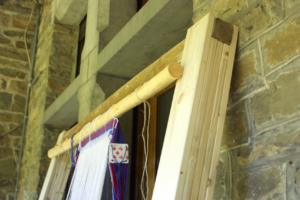
[caption id="attachment_6418" align="alignnone" width="300"] The upper part of the loom, with the square end of the round beam sitting nice and snug in the uprights. For the first test, another beam with a weave already attached was used - for "proper" weaving, you'd attach your weave to the beam directly or via a narrow slat or rod that the starting border has been stitched to.


The loom comes in at about 80-90 € for the materials, plus the cost for the loomweights. I did manage to find something hardware-store-y for that as well, though it might need pre-ordering, as it's not an utterly common item. Curious?

It's a certain kind of pipe connector that weighs about 120 g each, is about 3 cm wide, and can be strung up easily. So for someone who prefers to buy weights instead of getting hold of some clay and forming, then drying them, this is a viable alternative. They come in at about 3-4 € per piece, which means that if you want to do a very wide weave, it will cost you quite a bit of money. On the other hand, it also means you can get them from a suitable supplier and will have no work at all with them.

The finished loom is a full-size thing, with 140 cm between the uprights, and a bit more than 2 m in height. It's heavy enough to stand securely in our first tests, and it should be possible to adjust loom position to keep the shed size large enough for easy weaving even for beginners. The prototype is still being tested.
0
OCT
01
0

Things That Happened During Summer Break (part 5)

(continued from part 4)

The special thing about the pharaoh band is that there's extra heddles and extra warps that, when lifted alternatingly with the regular warps, form a pattern in the middle of the band. It's fascinating, and beautiful, and surprisingly difficult to get everything sorted out and aligned and moving like it should and behaving. You need to have the heddles straight so they can glide down or let the other threads glide up, but they can't be really pulled because you want the other shed.


And, as usual, when somebody skilled at this does it, everything looks easy...

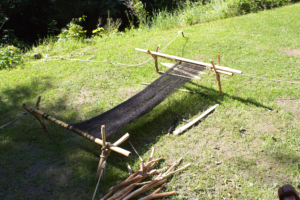
What I personally found much, much easier to do was weaving with goat hair on a Sudanese ground loom reconstruction. That was a very coarse weave, and there was only the natural shed, the countershed had to be picked out with a stick each time. With only a few and very thick plied threads per centimetre, though, this was relatively quick and easy to do. I had a stint of weaving on the loom early one morning, and a second bit of weaving on a sunny afternoon, and I really enjoyed the feel of the smooth, warm goat hair yarn on my hands.

 
I've been wondering about that kind of yarn ever since I read Hald's article about Bedouin spinning and weaving with goat hair for tents, and now finally I've touched it and worked with it. That was definitely one of the many, many "hooray!" moments I had at this Forum.

 
0
SEP
27
0

Things That Happened During Summer Break (part 3)

(continued from part 2)

I did hop into the car for a long drive to Belgium - because the next thing that happened was the European Textile Forum. To my utter delight!

The Textile Forum is my week of sheer and utter textile madness, and I missed it so much last year when it had to be cancelled due to the pandemic. It was a chance to take and plan for this year, but the stars lined up favourably, with a wonderful venue in Belgium that would have enabled us to cancel everything up to about two weeks before the Forum, if things should explode.

Fortunately, they did not.

First of all, let me introduce you to the house where we had our conference, called "Merveille de Méry". It's utterly beautiful, and spacious, and situated a bit above Tilff-Méry in the woods, so it's quite quiet and with lovely green surroundings.
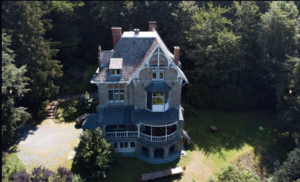

Unfortunately, I didn't take any decent photos of the house itself - but you can have a look at it on its own website (where you can also book it as a vacation home for up to 18 persons).

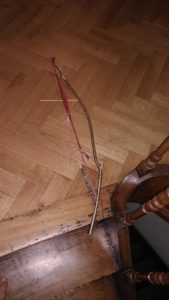
There was ample space in the garden for working, there was the multi-purpose room in the basement prepared with looms and tables for more weaving, and of course we spread out over the rest of the venue as well - the main room, where we had the presentations, and the balcony. At one point, there was a little abandoned bow loom sitting on the stairs late at night:


The topic of the week was "Sticks and Stones May Make a Loom", and being a non-weaver, I think this was the Forum where I did learn the most. It was absolutely amazing, and my weaving skills have increased a lot. They are still rather puny, I'm afraid - getting a lot better at something you have no real experience with is easily done while it may still let you end up in the "not very good at it yet" section.

I had a lot of fun, too.

Weaving included several weaver-tensioned trials, and I have finally understood, during that week, why you'd want to tie yourself to your piece of work. That had always been a mystery to me before. I will still use two fixed points for my tablet weaving in the future, but for bands or other types of weaving? Weaver-tensioned is definitely an option.

Basically, what weaver-tension weaving does for you is give you a lot of flexibility in your tension - and if you have mastered it, in a good way. You can reduce tension for some steps of the process, such as when you are changing sheds, and increase it for others, such as pressing in your weft, and this becomes an intricate and subtle dance with your tools and materials. It is absolutely fascinating to watch when someone does this well. It also means you can lessen the abrasion on your threads by only using as much tension as necessary for each step, and since that can differ, weaver-tensioning gives you the ability to use less tension overall.

Me, I'm still struggling with this intricate dance. I know, in theory, when I want to do what, but the movements are too big, too jerky, and my tension is usually either way too low or way too high. It is a question of fine-tuning the whole body fine motor skills, so to say... so maybe it's a good thing I have a full three items to practise on.
0

By accepting you will be accessing a service provided by a third-party external to https://pallia.net/

Contact