


Latest Comments

Guest - Katrin Sprang Discussion
18 September 2026
Hi Rachel, I have looked for more photos of you, but that was not very successful. I found a link on...
Guest - Beatrix Sprang Discussion
15 September 2026
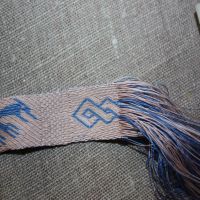
That lozenge pattern element is not a photograph, but a scan. So it should be to scale. But I pinned...
Guest - Katrin Sprang Discussion
15 September 2026
I was not referring to Rachel's reconstruction (is the reconstruction you refer to the one photograp...
Guest - Beatrix Sprang Discussion
14 September 2026
There is something Rachel did not mention. She told me: "Well, I worked with the measurements we too...
Guest - Katrin Sprang Discussion
14 September 2026
Well, this is certainly developing into an interesting discussion. Firstly, going from that lovely l...
SEP
19
0

Back to normal.

There I am, sitting back at my desk, the cat sleeping peacefully in her bed beside the desk, reams of papers spread over it (as usual), and a long to-do list waiting to be reduced to a more manageable size.

But I also have the Contraption with a silk warp on it (the Forum saw me finish the woolen band that was on it before). My lovely colleage, after years of softly prodding me, finally got me to dye something by myself, so now I have "smurf hair" - indigo-dyed wool that sort of happened to fall into the dye vat after our experiment was done. (How could that have happened? However would a bunch of textile people, confronted with a still healthy indigo vat, ever think of randomly tossing fibery things into the vat? I cannot imagine.)
There's also some blue-dyed linen thread (and I'm planning to look into that a little more, in the future). And a cuddly toy bat* (which is in want of a little scarf, I think - possibly a blue one). There's the distaff with hemp and the in-hand spindle that I finally found some time to work during the Forum. There's a rather crazy fingerlooped braid with a cross-shaped cross-section.

There's some more books, too - my own book is back in stock at my store, and the Forum proceedings book is also available now.

For today, though, I will try to resist the call of the smurf hair (spin me! spin me!) and instead get busy with more writing work. Because that's on top of my list... for now.


* The area around the lab is one of, if not the one, biggest living quarters for bats in Europe. Several thousands of bats live there, and when night falls, you can do bat-watching. Somehow, the bat became the inofficial mascot of this year's Forum... which, accordingly, led to a bat-buying binge.
0
SEP
18
4

I am back home again.

I have returned back home - back to bad weather (today it's raining hard), back to my comfy desk, and (of course) a large stack of stuff to deal with, such as the accumulation of mail both electronic and physical.
The next days will thus be dedicated to getting back up to date (and speed). You, however, will probably want to know how the Forum went... and I can tell you: it was fantastic.

There was a really nice bandwidth of papers, and our new format of paper and corresponding practical unit has met with much approval and made our Forum the most productive one that we had yet. We will definitely stay with this format!
We had a go at loopbraiding, reconstructing late antique underwear, and there was some weaving being done; our resist dyeing experiment took place (with results that are partly making me happy and partly making me wish we'd had some more time beforehand for testing things), and embroidered tunics from late antiquity were looked at and the technique reconstructed. The lab made it possible for us, in addition to the planned practical units, to have an impromptu experiment take place, researching the different outcomes of pressing fabrics into clay pots.

The forum was one full week stacked to the brim with ideas, tries, techniques and textiles. It made me very, very tired but also extremely happy - and even though the papertrail of this year's event has not been cleared yet, I am already looking forward to the next one!
0
SEP
02
0

This blog is taking a little break.

Yes, again. This time it's not due to me having gone off to have fun somewhere else and having no time to blog, it's because - oh.

This time it's due to me having gone off to have fun at the Textile Forum. Though it's working fun, this time, and I will have no time to blog because of that. If you want to come and make sure that I will be both working and having fun doing it (the best kind of work), you can stop by and join us for a day - we have day passes. The conference day will start with a paper presentation at 10 in the morning, and day passes are 15 € each.

After the Forum, there will be a few days to finish off our experiment documentation and plan ahead for the times to come, and then I'll be at the Wissenschaftsmarkt in Mainz. You will find me in the tent "Umwelt und Info" together with some colleagues, showing the possible imitation methods for byzantine textiles. The Wissenschaftsmarkt is on the weekend September 14/15, so if you are in the region, make sure to stop by - it's said to be a big thing!

So your regular scheduled blogging will return on September 18, which leaves me a bit of time to recover. Have a good time until then!
0
AUG
22
0

It's drawing nearer...

I have a hard time believing how time flies by - it seems just like yesterday that we left for our paddling holiday, and now it's weeks later and the Forum is almost upon us.

Time to take care of the last bits and pieces, which include the last bits of fine-tuning for the experiment that we have planned for this year. It's about Late Antique resist-dyed textiles... and among the things left to do is making a template for the application of the resist pastes we are planning to use. The materials, though, have not all arrived yet, a package seems to have gone astray. Which again proves Rule #1 for Experimental Archaeology: Things always take longer than you expect.*

That, and going through the whole thing together with Sabine who will take care of the actual dyeing process. We will dye using indigo - I'm really looking forward to that, I always love when fabric suddenly becomes blue!


* Rule #2, by the way, is Something that you need is always missing. Maybe I should do a whole post about the Rules...
0
JUL
17
2

Experimental stuff - it keeps you on your toes.

One of the things I love about archaeology, and especially experimental archaeology, is how it keeps you on your toes and gets you to suddenly learn stuff about things you never tended to think about before.

As in - did you know that beeswax actually starts to melt at around 40°C, not the 60+ that are usually stated as its melting point? And that the temperature depends not only on the species of the bees and maybe their location, but also on who made the wax and how old it is? I learned about that yesterday. I was not as successful in finding out the melting point of natural pinus pinea resin, though (if you should have a helpful hint, I'd love to have it).

Today, I am trying to find out about the temperatures used in traditional batik techniques. Looks like they dye above the onset of melting of beeswax... and tomorrow, if everything goes according to plan, I will finish the thinking and planning and write down a plan to follow for the actual testing. There's a few sticky points still to solve - how to get the mixture out of the cloth again, how to make sure that everything is dyed at the same temperature but with no bad side effects from stuff touching, how to ensure an uniform temperature for the mixture application, and some more pesky details like that.

And now... on to more hunting of .pdfs, and finding out about melting points and possible sources and temperatures and processes. 

(For those of you who have not guessed it yet: It's all about the resist dye technique test runs at the Textile Forum.)
0
JUL
12
2

The dyeing experiment is getting an add-on.

As you might know, the Textile Forum is a very experiment-friendly place. Last year, we had a little dyeing experiment looking at the influences of different metal kettles (simulated by metal plates in neutral pots) on dyeing, inspired by the question why the Romans in Pompeii had lead dye vats. (You can see pictures of the experiment, the dyed samples, and a poster of the preliminary results on the Forum's archive page, here.)

The experiment is now getting an add-on - a second test run, only with birch leaves as dye (due to time restrictions), but with the metal additions split between the mordanting only and the dyeing only. If all goes according to plan, it will be possible to see if there is more influence from the metal in the mordanting process or the dyeing process.

I have been preparing for this quite a bit already - the alum is ordered, the 80 m skeins are wound and tied off so they won't go knotty, and today will see my finishing off the outline and experiment plan. It takes a while to go through all this and type out, bit by bit and step for step, what is to do. But yay for a detailed plan like that - it's so helpful to have a sheet with the single steps all written out, and tables to put the measured values. Also helps a lot in making sure you don't forget to take a measurement, or a photograph.

And week after next will see the actual run of the experiment. I'm really looking forward to this!
0
JUL
10
0

Conferences and Calls for Papers.


There are a few conferences coming up:

First of all, the NATCC (North American Textile Conservation Conference) will take place from November 12-15, 2013, in San Francisco. More info on their website.

The next Costume Colloquium will take place in Florence, November 20-23 2014, and focus on colour as a topic - the official name is "Costume Colloquium IV, Colors in Fashion". It says in their Call for Papers:

The event is based on an international, interdisciplinary and intercultural format meant to spark a lively and informative dialogue among speakers and participants from a variety of backgrounds, professions and points of view. The three day event will not only feature an impressive selection of high profile presenters, but also all inclusive behind-the-scenes visits and excursions to exclusive places and sites pertinent to the interests of all who attend.
They are looking for papers from all kinds of backgrounds,  and the CfP is open until August 22 2013. Technically, there is a website, but there is no info whatsoever there apart from three rather unrelated links; so if you are interested, it's probably best to contact info(at)costume-textile.com directly.

The international digital heritage congress will take place from October 28 to November 1, 2013, in Marseille, France. More info, as usual and expected, on their website.

And finally, don't forget about the European Textile Forum - we still have some very few spaces left!

0

By accepting you will be accessing a service provided by a third-party external to https://pallia.net/

Contact