Latest Comments

Guest - Katrin Sprang Discussion
18 September 2026
Hi Rachel, I have looked for more photos of you, but that was not very successful. I found a link on...
Guest - Beatrix Sprang Discussion
15 September 2026
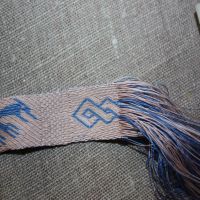
That lozenge pattern element is not a photograph, but a scan. So it should be to scale. But I pinned...
Guest - Katrin Sprang Discussion
15 September 2026
I was not referring to Rachel's reconstruction (is the reconstruction you refer to the one photograp...
Guest - Beatrix Sprang Discussion
14 September 2026
There is something Rachel did not mention. She told me: "Well, I worked with the measurements we too...
Guest - Katrin Sprang Discussion
14 September 2026
Well, this is certainly developing into an interesting discussion. Firstly, going from that lovely l...
JUN
18
0

Spinning Experiment, again

A huge box blocks the entry to my study - wool for the spinning experiment has arrived! We now have wonderful wool for the experiment, one very fine Merino and one medium-fine wool, all beautifully prepared, thanks to the Wollmeister. With the last batch of test whorls it now really feels as if serious progress is taking place.

Speaking of which, since I'm off to Hanau tomorrow for the "Lamboy-Fest", I'd better make some serious progress on the rest of my work...
0
JUN
08
1

Feeling lonely?

It's been ages since I last posted about the Textilforum, so it's high time. And I have a reason, too: We have extended the deadline for registration to June 30. There are still some spaces left for participants at the museum, so if your occupation includes historical textile crafts - research, reconstruction, analysis, conservation, replicating - you are welcome to join us at the Forum. We also need a few more handspinners (handspindle only) to make the required twenty that we need for the spinning experiment. If you are a handspinner and able to spin an even thread for two hours, you could be part of this nifty bit of science!

If you don't know what I'm talking about: The Textilforum is intended to get people working with historical textile crafts into contact with each other - because it can be a very lonely affair. So we would like to link both professionals and amateurs (like living history folks) in this Forum, where there will be ample time to work, chat, and exchange hints and tips with each other. There will be some programme provided - presentations about research or projects in the evenings - and we'll run an archaeological experiment, the spinning experiment, during the mornings. The rest of time is free; think "gigantic enormous conference coffee break".

You can read more about the Forum on our website, www.textilforum.org, and you can also register there: Go to Call for Papers site, and on the bottom, you will find the link for registration. See you in Eindhoven!

Oh, and you can read me here again next week - I'm off for a few days' vacation, before summer work stress really hits...
0
MAY
27
4

What's this with conference deadlines?

The deadline for the Textilforum Call for Papers is officially over. But... there are still places left. We have planned for 50 persons staying in at the museum (and I do think it's a good deal, even if you have to bring your own bedding), and I had thought that we would have no problem filling these places. Heck, there have been so many positive comments all over, I was sure we'd have no problem.

I know that it is a common thing to extend conference CfP deadlines, and I also know that I'm one of those people registering in the last week before deadline (or even on the last day). And that it can happen that I miss a deadline, too. So we'll extend our deadline to fill some more of the places.

However, I'm wondering why there have been so few registrees. Is it my fault? Has the wording been bad? Is the participant questionnaire too hard to find? Does it sound as if we don't want people to come? Maybe it sounds as if you have to give a paper or bring a poster or else you can't come? While we appreciate paper/poster offers, these are no absolute requirement. So if you are an archaeologist, conservator, hand weaver, hand spinner, historical textile person and have an interest in historical textile techniques, come join us! And we still need spinners for our experiment, too - so if you are a handspinner and would like to participate in the spinning experiment, do fill out the questionnaire and come have fun doing science!
0
MAY
22
5

Chopsticks, chopsticks!

I am inundated in chopsticks, and that is a Good Thing - because these cheap, all-alike, slim and slightly conical things will serve as the spindle sticks for the Spinning Experiment.

I have thought long and hard about what I could take for the experiment. One of the first ideas was to have twenty spindles and four different whorls each, and rotate the whorls during the spinning process. But then there is another variation in the process, one we can't measure or calculate: The order of spinning with different spindles in the test. What if it makes a difference whether someone starts the experiment spinning with spindle A and then B as opposed to spinning with spindle C and then A? And so on? So I arrived at the conclusion that the safest bet would be to give everybody the same spindle at the same time.

Which means making one hundred twenty spindle whorls (plus a few to spare in case of unforeseen desasters). And ideally, attaching all those whorls to a spindle stick so that they can't slip when you drop the spindle (something I do fairly often with an unknown, new and maybe awkwardly running spindle). Which means - as one possible solution - to glue a stick to each whorl. Which in turn means making one hundred twenty spindles glued together... with identical whorls and identical spindle sticks. There. Since our budget is not so big (read: nonexistent), cheap was not an option but a requirement. And slim, identical, slightly conical-at-the-top, round sticks for little money? You got it. Chopsticks.

That is why I am sitting here with a box, newly arrived, containing one hundred pairs of Taiwanese bamboo chopsticks. Next time, when we have won the lottery got a budget for a similar experiment, we might use proper sticks for another spinning experiment. For now, bamboo will do.
0
MAY
13
0

Progress?

Planning for the spinning experiment is still going on - there are a lot of things to consider, including how to extract the data out of all those yarns spun during the experiment time. A part of yesterday was spent doing test spinnings with all the test whorls I have made for the experiment. I found them all to be more or less workable, though some felt really, really awkward.

Then there's a paper to finish that is somehow not really willing to be finished. I'm glad (for a change) that the deadline for this is coming closer and closer, so there's only so long I can procrastinate by taking care of the hundred other odds and ends on my list. Including the daily blog - so time to rush off to that word processor.
0
MAY
12
2

Spinning Experiment Calculations

In preparation for the spinning experiment on the Textilforum, I need to figure out how much fibres to calculate for each participant. And to get a first impression, I spun with the carded and combed wool I have at hand - one hour in my normal thickness, and another hour as thick as I could manage.

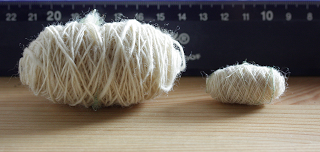
Now I'm one of those people who have a very limited range of thickness when spinning. And (unfortunately for this purpose) it is rather on the fine side. So I ended up with two very different-sized balls of yarn; I wound them off today and weighed them with my letter scales.

The "Thick Yarn" weighs in at about 8 g for one hour's spinning time. It is pretty uneven, in spite of my trying oh-so-hard to spin a decently smooth and even yarn. Thick stuff is just not for me. Here you see the sorry results of my thick-spinning:


Beside the huge (haha), bulky and uneven ball of thick yarn, you can see what I spun as my normal thin yarn. The weight? Somewhere between one and two grammes. Both yarns spun with the same wool on the same spindle (which was about double the weight of the reference whorl for the experiment, and fitted with a rather heavy wooden spindle stick). When wound onto a ruler, the thick wool gives about 20 threads per inch, the thin one about 12 threads per quarter-inch.

So now I've outed myself as a thin-spinning freak, can any spinners of thick yarn out there give me a rough estimate of how much fiber in grammes they hand-spindle away in one hour? Just to check against my calculations? I'd be very grateful...
0
MAR
16
2

Textilforum Call for Papers

The official Call for Papers for the Textilforum is now out, and a copy is up at our website.

Whether you are researching a textile project involving the craft aspects, working in textile restauration or a professional dyer, tablet weaver or spinner using historical textile techniques, go over there and send us some info about you, your work and a proposal for a paper or presentation. We also need a few more people to take part in the Spinning Experiment, so if you are a seasoned hand spindle spinner, you can use the form to tell us, too. The experiment time (spinning time of 10 hours) will be spaced over five days, so a bit more than two hours each morning will be spinning experiment time, and time for your own disposal after that.

And if you know somebody who might be interested, please pass on the information!
0

By accepting you will be accessing a service provided by a third-party external to https://pallia.net/

Contact